
Pt100 vs thermocouple
Hello,
PT100: High accuracy, limited range, expensive
Comparison of Thermocouple and RTD (Pt100)
Dear members, to answer the frequently confusing question “Should I choose PT100 or thermocouple for my machine?”, we have prepared the following evaluations.
Temperature range:
First of all, consider the difference in temperature ranges. Noble Metal Thermocouples can reach up to 3,100°F (1700°C), while standard (Pt100) RTDs are limited to 600°F (300°C) and extended range RTDs are limited to 1,100°F (600°C).
Cost:
A basic sheath thermocouple is 2 to 3 times cheaper than a basic sheath RTD. A thermocouple head assembly is roughly 50% cheaper than an equivalent RTD head assembly.
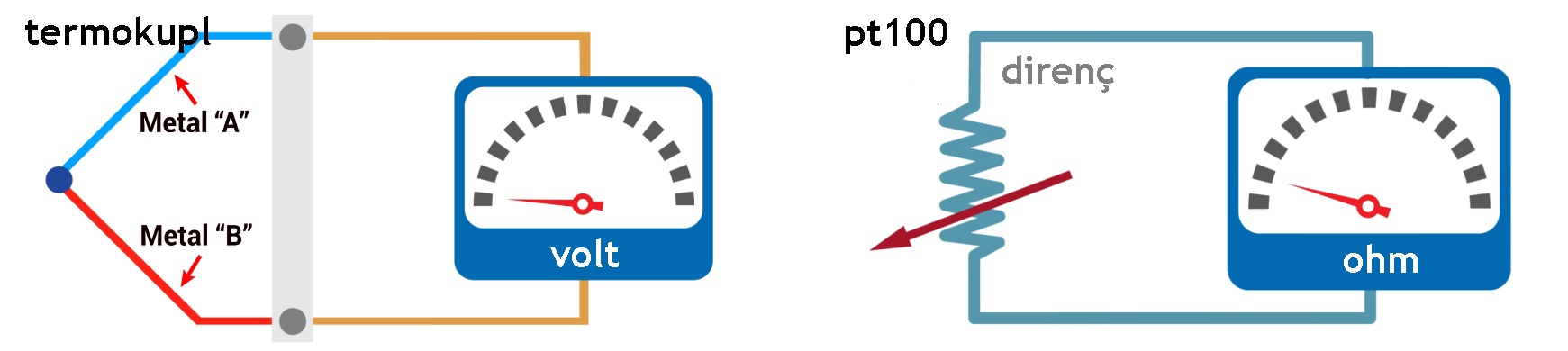
Accuracy, Linearity, and Stability:
As a general rule, RTDs are more accurate than thermocouples, especially at lower temperature ranges. RTDs are also more stable and have better linearity than thermocouples. If accuracy, linearity, and stability are your main concerns and your application is within the RTD’s temperature limits, go for an RTD.
Durability:
In the sensor industry, RTDs are considered less durable compared to thermocouples. However, REOTEMP has developed manufacturing techniques that greatly enhance the durability of our RTD sensors. These techniques make REOTEMP RTDs almost equal to thermocouples in terms of durability.
Response Time:
RTDs cannot be grounded, so they have slower response times than grounded thermocouples. Also, thermocouples can be placed in a sheath with a smaller diameter than RTDs. A smaller sheath diameter means faster response time. For example, a 1/16” grounded thermocouple sheath will respond faster than an RTD in a ¼” sheath.
What is the response time of a thermocouple?
A time constant is defined as the time it takes for a sensor to reach 63.2% of a step temperature change under specified conditions. It takes five time constants for the sensor to approach 100% of the step value. An exposed junction thermocouple offers the fastest response. Also, the smaller the probe sheath diameter, the faster the response, but the maximum temperature may be lower. However, remember that sometimes the probe sheath may not withstand the full temperature range of the thermocouple type.
What are Special Limits of Error (SLE)?
Special Limits of Error: These thermocouples are made with higher grade wire for increased accuracy. They are more expensive than standard thermocouples.
Standard Limits of Error: These thermocouples use standard “thermocouple grade” wire. They are cheaper and more common.
What is MI Cable?
MI (Mineral Insulated) cable is used to insulate the thermocouple wires from each other and from the surrounding metal sheath. An MI Cable has two (or four for duplex) thermocouple wires running through the center of a tube, filled and compressed with magnesium oxide powder to ensure proper insulation and separation. MI cable helps protect the thermocouple wire from corrosion and electrical interference.
What is System Error?
System error is calculated by adding the accuracy of the temperature sensor (thermocouple) and the accuracy of the meter used to read the voltage signal. For example, the accuracy of a Type K thermocouple above 0°C is +/- 2.2°C. If the meter has an accuracy of +/- 1°C, the total system error above 0°C is +/- 3.3°C.
How to choose between thermocouples, resistance temperature detectors (RTDs), thermistors, and infrared devices?
You should also consider the availability, features, and costs of the sensors. In addition, thermocouples can usually measure temperatures over a wide range at a low cost and are very rugged, but they are not as accurate or stable as RTDs and thermistors.
RTDs are stable and have a fairly wide temperature range, but are not as rugged or inexpensive as thermocouples. Since RTDs require electrical current for measurement, they are subject to errors caused by self-heating. Thermistors tend to be more accurate than RTDs or thermocouples but have a much more limited temperature range. They are also subject to self-heating. Infrared sensors can be used to measure higher temperatures than other devices and do so without direct contact with the measured surfaces. However, they are usually less accurate and are sensitive to the surface’s emissivity. Using fiber optic cables, they can measure surfaces that are not in direct line of sight.
Final word:
>> If you really need healthy and accurate temperature readings (0 to 300°C), using PT100 (RTD) is more suitable. Yes, it may be more expensive than thermocouple sensors, but there is no other way.
>> If an approximate deviation of about 1% is acceptable for your process, you can choose thermocouple (T/C) products, especially J type. Their prices and measuring devices are cheaper.
---ALL SENSORS ON OUR WEBSITE ARE INDUSTRIAL TYPE AND FOR AUTOMATION SECTOR.
>> PT100 MAIN PAGE >>
>> THERMOCOUPLE MAIN PAGE >>
>> TEMPERATURE CONTROL DEVICES >>
>> MOTOR SPEED CONTROL MAIN PAGE >>
>> SERVO - STEP CONTROL >>
>> PLC - HMI - SMART RELAYS >>
>> COUNTERS - TEMPERATURE CONTROL ETC. >>
>> INDUSTRIAL SENSORS >>
>> OUR TECHNICAL FORUM >>
Your shopping cart is empty!