
UL 60947-5-1
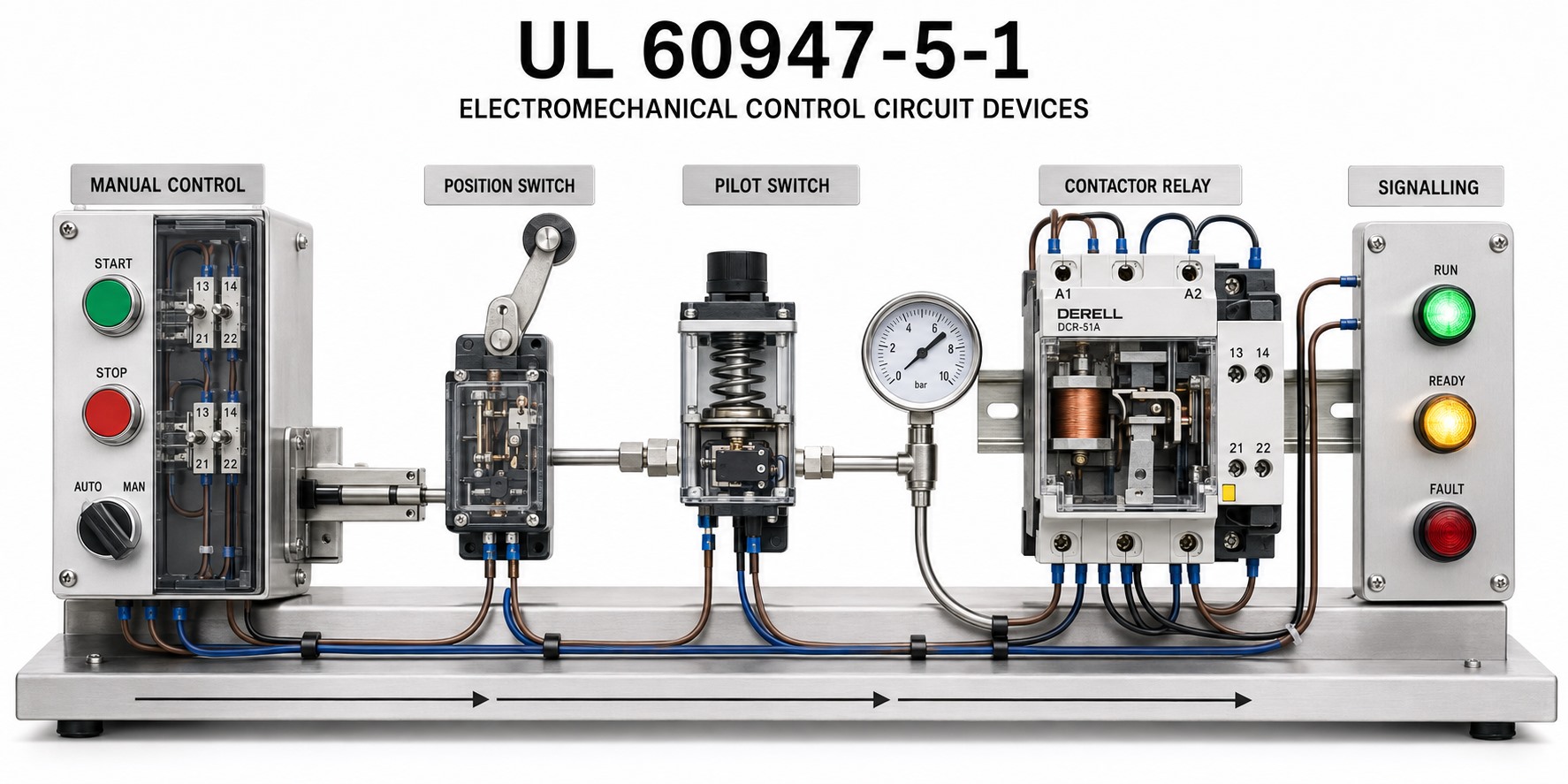
Choosing the right contact for a control circuit
UL 60947-5-1 addresses electromechanical control circuit devices used for control, signalling and interlocking in switchgear and controlgear. Choosing a pushbutton or limit switch involves more than counting contacts: the switched load, mechanical operation and service conditions must be considered together.
The main power contacts of a contactor carrying motor current perform a different task from a contact controlling its coil. UL 60947-4-1 is also relevant to power contactors and motor starters. Main and auxiliary contact ratings on the same device are not interchangeable.
Reading UL and IEC editions correctly
The ULSE listing checked on 17 October 2026 identifies the fourth edition dated 31 May 2022, adopting IEC's 2016 fourth edition with national differences. IEC 60947-5-1 reached its technically revised fifth edition in 2024. A matching part number does not mean a matching edition or identical national requirements.
The scope extends to 1,000 V AC or 600 V DC, with AC frequency limited to 1,000 Hz. These are not the operating ratings of every product. The UL scope references the US NEC and the Canadian CEC for installation.
An ampere rating alone is not enough
Operational voltage Ue, operational current Ie, insulation voltage Ui and thermal current Ith describe different characteristics. Ith concerns current carrying under specified thermal conditions; it does not permit switching that current with every load. Ui likewise does not establish suitability for every load at that voltage.
AC-15 and DC-13 utilization categories matter when assessing electromagnetic control loads. If an example product table specifies 3 A under AC-15 at 240 V AC and 0.27 A under DC-13 at 250 V DC, those currents cannot be interchanged. These figures illustrate how to read a table; they are not universal limits imposed on every device by the standard. Unlike AC, DC has no natural current zero crossing, which can make arc extinction more difficult.
When selecting contacts for a relay or contactor coil, review voltage, pickup current, holding current and switching frequency together. A mechanical endurance figure does not establish the same number of operations under electrical load. Electrical endurance must be read with its stated load and operating conditions.
Low-current PLC inputs need separate consideration
For a contact carrying only a few milliamperes into a PLC input, a high current rating alone offers no assurance of better performance. Minimum switching load and contact material matter: surface films on an unsuitable contact can interfere with a small signal. Check the manufacturer's low-load data against the actual input current.
For example, assume a 24 V DC input draws 5 mA. Assess suitability at that operating point rather than relying on the contact's large-load rating. Check voltage and current together. Contact bounce can also cause an electronic input to interpret one operation as several events; signal processing must suit the application.
An NC contact does not automatically provide direct opening
NO and NC describe a contact's defined normal state. Direct opening action concerns the mechanical transmission of actuator force to the contact during a specified opening movement. Over the relevant part of that movement, opening does not rely solely on a spring. The declared opening travel, force and mounting conditions must be met.
Editor's note: An NC designation alone does not establish direct opening action. Seeing a contact open during normal operation does not verify this property either. Check the manufacturer's direct opening declaration and mechanical requirements; do not treat an ordinary NC contact as a safety contact solely because of its symbol.
An emergency stop function also requires consideration of mechanical latching, restarting and the complete control chain. IEC 60947-5-5 separately addresses electrical emergency stop devices with mechanical latching. Component conformity does not determine the SIL or PL of the complete safety function. Sensors, logic, output devices and fault behaviour must be assessed together.
What should be checked during installation?
The contact block, operator head and mounting adapter must form a suitable assembly. Select conductor sizes, tightening torque, ambient temperature and mechanical movement according to the manufacturer's data. A front face's IP rating does not give exposed terminals inside the panel the same protection. After installation, check operator movement and contact block retention.
In normal motor control, a start pushbutton requests operation and a stop pushbutton requests stopping; coil and auxiliary contacts are selected for those tasks. That operational circuit is not an emergency stop safety circuit without a separate assessment. The requirements for operational control and the safety function must be defined in the circuit design.
Mentioning a UL standard in a catalogue is different from identifying a particular model's certification record. Compare the model code, certification scope, permitted accessories and conditions of use. Product testing does not automatically establish suitability for every site environment or conformity of the complete panel.
Related topics
Related standards: UL 60947-1 general rules; UL 60947-4-1 contactors and motor starters; UL 60947-5-2 proximity switches; IEC 60947-5-1 control circuit devices; IEC 60947-5-5 emergency stop devices with mechanical latching.
Devices and applications: Pushbuttons; limit switches; emergency stop pushbuttons; 1-0 and 1-0-2 selector switches; the difference between a relay and a contactor.
Sources
UL Standards & Engagement: UL 60947-5-1 scope and 2022 edition.
IEC: IEC 60947-5-1:2024 edition and technical changes.
ABB: Limit switches, utilization categories and direct opening terminology.
Schneider Electric: Contact block thermal current, insulation and mounting data.
OMRON: AC/DC loads, low currents and contact bounce.
Eaton: Direct opening and emergency stop applications.
Pilz: Distinguishing component SIL/PL from complete safety function values.