
What is Sink Source?

Hello friends,
One proximity sensor says PNP and another says NPN. Both use a 24 V DC supply, so why can they not always connect to the same PLC input in the same way? Sinking and sourcing describe the current path through an active output and its receiving input.
On this page: Basic idea · Animation · Wiring table · On a VFD · FAQ
What do sinking and sourcing mean?
A sourcing output connects its output toward the positive DC rail when active; a typical three-wire PNP sensor does this. A sinking output completes the receiving circuit toward 0 V when active; a typical NPN sensor does this. The direction shown here is conventional current, from +24 V toward 0 V. Electron motion is in the opposite direction.
The output and input must be considered together. A PNP sourcing sensor normally connects to a sinking PLC input that returns current to 0 V. An NPN sinking sensor normally connects to a sourcing PLC input supplied from +24 V. Some manufacturers label selectable modes from the perspective of the input circuit, while others describe the field device: confirm the real DI, common and supply terminals on the actual wiring diagram.
Follow a real current path
In these drawings, the PLC digital input circuit is the load. On the left, the PNP switch sends +24 V to DI, and current returns through COM at 0 V. On the right, current comes from COM at +24 V, crosses the input circuit and DI, then flows through the NPN switch to 0 V. Turn either output off to open its switch, stop the moving current trace and extinguish the input indicator.
Switch either circuit on and off: the moving dashes follow conventional current from +24 V to 0 V.
PLC input: sinking
ON: input is energized.
OFF: open output, input inactive.
PLC input: sourcing
ON: input is energized.
OFF: open output, input inactive.
This is a simplified educational 24 V DC input circuit. Actual output stages, input currents, commons and protection parts vary by product. The voltage on an open output is not necessarily one fixed value.
PNP versus NPN: wiring at a glance
| Sensor output | Compatible PLC input | Current path when ON |
|---|---|---|
| PNP / sourcing | Sinking · COM: 0 V | +24 V → PNP → DI → input circuit → 0 V |
| NPN / sinking | Sourcing · COM: +24 V | +24 V → input circuit → DI → NPN → 0 V |
For a three-wire DC sensor, brown: +24 V, blue: 0 V and black: output is a common convention. Always confirm wire colours and connector pins on the product label. NO/NC describes when the output becomes active; PNP/NPN describes what the active output does electrically. Both choices can coexist. For the separate case of a sensor wired in series with its load, see how two-wire sensors work.
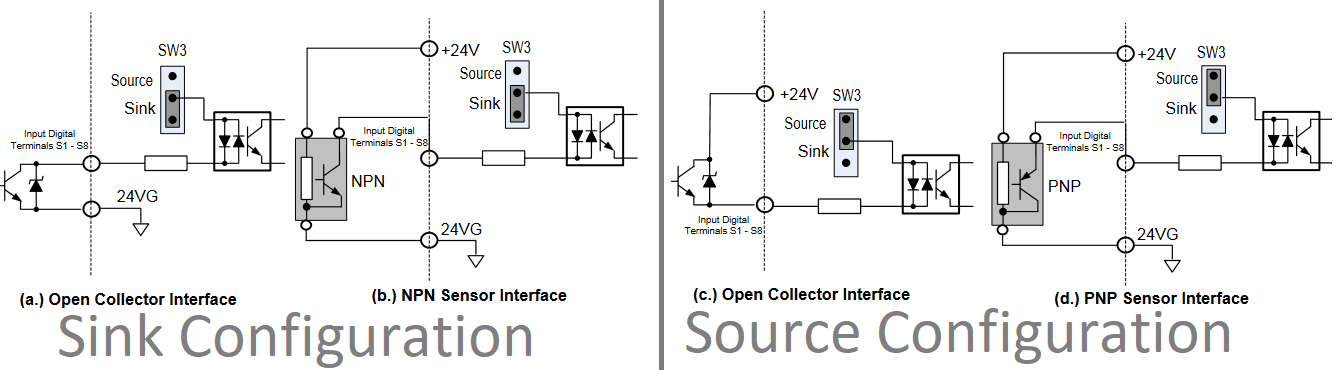
Keep this original illustration alongside the manufacturer's terminal drawing. The assigned roles of COM, DI and the internal +24 V terminal must be checked against the exact product manual.
What changes on a VFD digital input?
A variable frequency drive can read RUN, direction or preset-speed commands through digital inputs wired to a PLC or field device. Sink/source describes the electrical input and output pair. Three-wire START/STOP control describes how a run command is held, which is a different choice. Read the drive's SINK/SOURCE switch or parameter, PLC output type, internal +24 V supply and COM assignments as a single circuit.
My field check has three steps: is the sending output PNP or NPN, what current direction does the receiving DI expect, and how does the manufacturer's drawing join their power references? Where the PLC and VFD use different supplies, I never assume that their 0 V wires should be joined. I also keep control-circuit 0 V distinct from protective earth (PE); PE serves a separate safety function.
Short answers about sink and source
Does an NPN output produce a negative supply? No. When active, it offers a current path toward 0 V; it does not create a negative voltage rail.
Should I connect a PNP sensor to a sourcing PLC input? In the typical DC circuit shown here, use PNP sourcing output with a sinking input. Some modules can be configured for either type; follow the module's common-terminal instructions.
Are COM and protective earth the same? No. COM is an electrical common for an input group; PE is protective earth. Any connection between them follows the manufacturer's instructions and the system design.
Is a dry relay contact PNP or NPN? A dry contact is not a transistor output; its switched potential depends on its external wiring.
Read next: Review the sensing side in inductive sensors, the receiver in PLC and I/O equipment, and the drive command in three-wire VFD control. Where many field sensors must be connected, industrial communication describes a separate way to transmit data; it is not a new name for PNP/NPN wiring.
Related pages
Technical references: AutomationDirect – Sinking & Sourcing PLC Inputs · OMRON – NPN / PNP sensor outputs.