
What is torque?
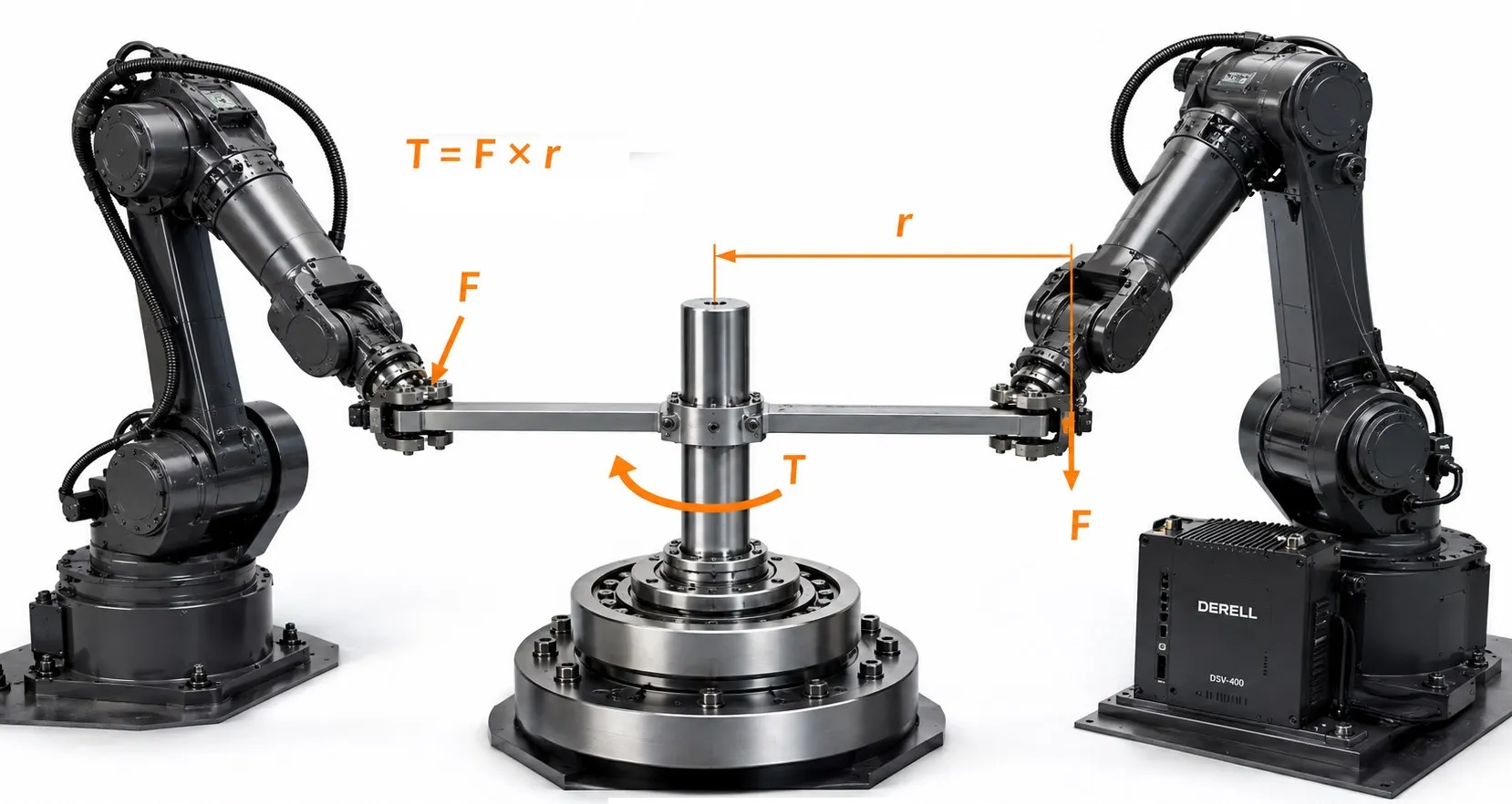
What is torque? Force, moment arm and motor power
Welcome, colleagues.
Torque is the turning effect of a force about a specified point or axis. It is also called a moment of force. Think of pushing a door near its hinges compared with pushing at the handle. The same force can produce more torque when applied at the right position and in the right direction. Force is measured in newtons (N); torque in newton-metres (N·m).
How do you calculate torque?
The practical relationship is T = F × d. Here, F is the force magnitude and d is the perpendicular distance from the axis to the force's line of action, known as the moment arm. The physical length of a lever is not always its moment arm: the direction of the applied force matters.
If θ is the angle between the force and the direction from the axis to its application point, use T = F × r × sin θ. A perpendicular force gives θ = 90° and T = F × r. The vector definition is τ = r × F; in that expression, × denotes the vector cross product.
| Force F | Distance r | Angle θ | Torque T |
|---|---|---|---|
| 100 N | 0.20 m | 90° | 20 N·m |
| 100 N | 0.40 m | 90° | 40 N·m |
| 100 N | 0.20 m | 30° | 10 N·m |
| 100 N | 0.20 m | 0° | 0 N·m |
The table gives torque magnitudes. When the force acts along the lever, its line of action passes through the axis and torque is zero. Torque also has direction: clockwise and counterclockwise moments about the same axis must be combined using a consistent sign convention.
Torque units: N·m, kgf·cm and lbf·ft
Common torque units include N·m, kgf·cm and lbf·ft (pound-force feet). 1 kgf·cm = 0.0980665 N·m, and 1 lbf·ft ≈ 1.35582 N·m. The abbreviation kgf represents force; writing only “kg” confuses mass with force. Although N·m and the joule share the same base dimensions, write torque in N·m and energy or work in joules (J).
Does torque always make something rotate?
No. A locked shaft can carry torque. Changes in rotation depend on net torque, rather than a single applied moment. For a fixed axis and constant inertia, Tnet = J × α, where J is the moment of inertia and α is angular acceleration. An electric motor running steadily under load still produces torque to balance load and losses; zero net torque does not mean zero motor torque.
What is the difference between torque and power?
Torque and power describe different quantities. Shaft power follows P = T × ω, with angular speed ω in rad/s. When speed is given in RPM, use P (kW) = T (N·m) × n (rpm) / 9550. This calculates mechanical power at the same shaft location; determining electrical input power also requires accounting for losses.
For example, 10 N·m at 1500 rpm gives approximately 1.57 kW. The same torque at 3000 rpm gives about 3.14 kW. A stationary shaft can carry torque while transmitting zero rotational mechanical power. Horsepower (HP) is another power unit; it does not specify torque on its own.
Starting, running and stall torque
Different torque terms are not interchangeable. Starting torque is the torque available from the motor at startup under specified supply and control conditions. Breakaway torque is the torque required to overcome a mechanism's static resistance and initiate motion. Continuous running torque is the torque a motor can sustain under its specified cooling and operating conditions.
For a DC motor, stall torque describes torque at zero shaft speed under specified conditions. In induction motors, locked-rotor torque and breakdown torque are separate ratings; check the terminology used in the data sheet. A stalled motor is not automatically suitable for continuous operation at that torque. Some purpose-built torque motors support stationary operation, but permitted current, temperature and duration depend on the manufacturer's ratings.
Can a gearbox increase torque?
A reduction gearbox can increase output torque by reducing speed. Define the ratio as i = input speed / output speed; then Tout ≈ Tin × i × η, where η is efficiency. With 10 N·m input torque, a 5:1 ratio and 90% efficiency, output torque is approximately 45 N·m, and output speed is one fifth of input speed. Increasing torque this way does not create power: losses make output power lower than input power. Calculated torque must remain within the gearbox's permitted continuous and peak torque ratings.
Motor selection and torque measurement
When selecting a motor, a kW rating alone is insufficient. Consider starting requirements, operating speed, acceleration, duty cycle and the torque curve together. In stepper and servo motor comparisons, holding torque, continuous torque and short-duration peak torque are different ratings. The torque–speed relationship shows what the motor can deliver at the required speed.
Depending on the application, torque measurement uses a torque wrench, a torque sensor or an appropriate test rig. Measurements can provide feedback for torque control. When evaluating effects on mechanical systems, identify the measurement location: torque at the motor shaft differs from torque at the gearbox output.
Technical references: OpenStax — torque · OpenStax — rotational power · BIPM — SI units · Oriental Motor — motors and gearing