
What is the impact of robotics on employment and the economy?
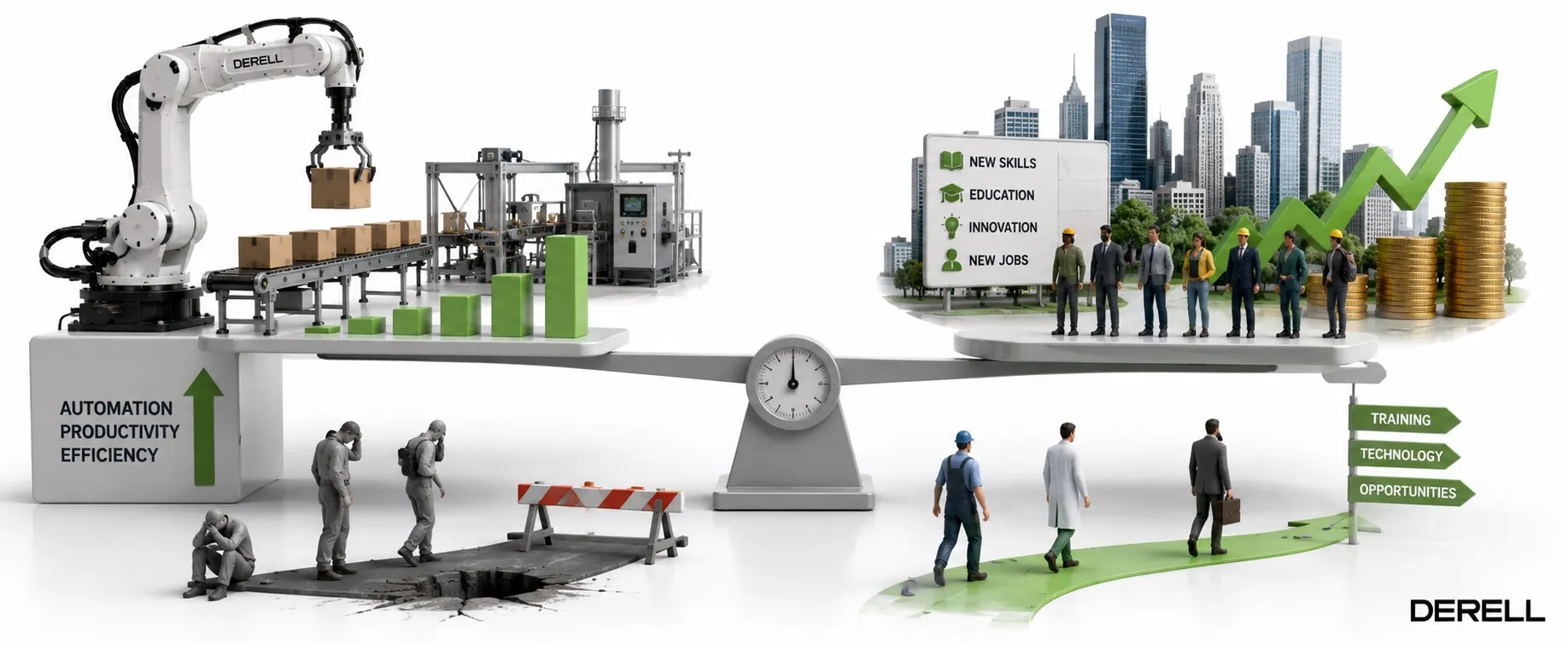
How does robotics affect employment and the economy?
Robotics can reduce the need for human labour in certain tasks, change the content of existing jobs and create new technical work. The economic outcome depends on productivity gains, product demand, investment costs and workers' ability to move into new roles. A business producing more does not, by itself, mean that it will employ the same number of people or hire more staff.
Evaluating automation requires three connected questions: Which tasks are reduced? Which tasks are created? Who receives the gains and bears the transition costs?
Tasks change first; an entire occupation may remain
A worker's job may include handling parts, checking quality, making adjustments, keeping records and identifying faults. Alongside the distinction between a robot and a machine, the distinction between a task and an occupation matters. When a robot takes over handling, the job can be redesigned. However, if fewer people can perform the remaining tasks, job losses may follow.
In industrial robot applications, standardised handling, welding or packaging operations may be suitable for automation. Exposure cannot be explained simply by labelling a worker “low-skilled”. Task repeatability, a structured environment and economic feasibility also matter.
A production example: More output means how many workers?
Hypothetical example: A cell staffed by two people produces 100 good units per hour. Following robot integration, it produces 130 good units per hour with the same staffing and working hours. Labour productivity, measured using good output per labour hour, has increased by 30%. That calculation alone does not establish the factory's profit or its future staffing needs.
Even if the robot's operating cycle improves, output growth may be limited if additional products cannot be sold. Rising demand may create a need for another shift or more capacity; with unchanged demand, staffing or task allocation may change. Choosing a suitable robot type affects technical performance, while employment outcomes depend on the wider production and sales conditions.
When do productivity gains materialise?
A well-designed application can deliver consistent quality, less scrap, more predictable cycles and fewer physically demanding tasks. Robots still require maintenance, adjustments and tool changes, and they can suffer faults. A robot not needing a personal break does not mean that the production line will run continuously.
Assessing robotic system limitations and the robot's main components involves more than the price of the arm. Tooling, integration, safety, training, maintenance, energy and downtime contribute to the total cost. A bottleneck elsewhere in the line can limit output even when the robot moves quickly.
New jobs and skills: Transition is not automatic
Robot adoption can create work in robot programming, PLC integration, sensor and actuator checks, servo system commissioning and maintenance. Creating technical tasks does not establish that every lost job will be replaced in equal numbers or in the same location. A displaced worker may need training and practical experience before moving into a new role.
Advanced software development is not the right training target for everyone. Safe operation, fault diagnosis, electrical fundamentals, quality monitoring and process knowledge also have value. Artificial intelligence and machine learning support some applications; they are not mandatory skills for every robotics role. A reskilling plan should connect a worker's experience with the actual requirements of the intended job.
How are growth and competitiveness affected?
Lower unit costs, better quality and more predictable delivery can strengthen a business's competitiveness. Gains still depend on demand and competitors' responses. One company may gain market share while others lose jobs. Success at an individual firm and the net effect on national employment are different measures.
Autonomous transport technologies and robotics in everyday life can enable new service models. Their economic value depends on conditions such as reliability, a real user need and sustainable operating costs.
Income distribution and working conditions
Productivity gains can be distributed through higher profits, lower prices, higher wages or shorter working hours. This distribution is not automatic. Access to training, labour market conditions and workers' bargaining power affect the outcome. Ethics in robotics includes how workers experience the transition and how the benefits are shared.
With appropriate robot safety measures, exposure to heavy lifting or hazardous processes can decrease. New moving equipment, maintenance interventions and a faster work pace can introduce other risks. Higher output alone is not evidence of better working conditions.
Why do studies find different outcomes?
Acemoglu and Restrepo's study of US labour markets, covering 1990–2007, found negative employment and wage effects in local markets more exposed to industrial robots. In Dauth and colleagues' study of Germany, covering 1994–2014, service-sector gains offset manufacturing employment losses; the researchers found no evidence of total job losses. This does not mean that every worker experienced a loss-free transition.
Countries differ in their industrial structure, training systems and labour markets. OECD research published in 2019 also shows that the relationship between robot use and employment varies across skill groups and countries. These historical studies do not provide a direct estimate for employment in Türkiye today or a certain forecast of its future.