
What is Planetary Gear Reducers?
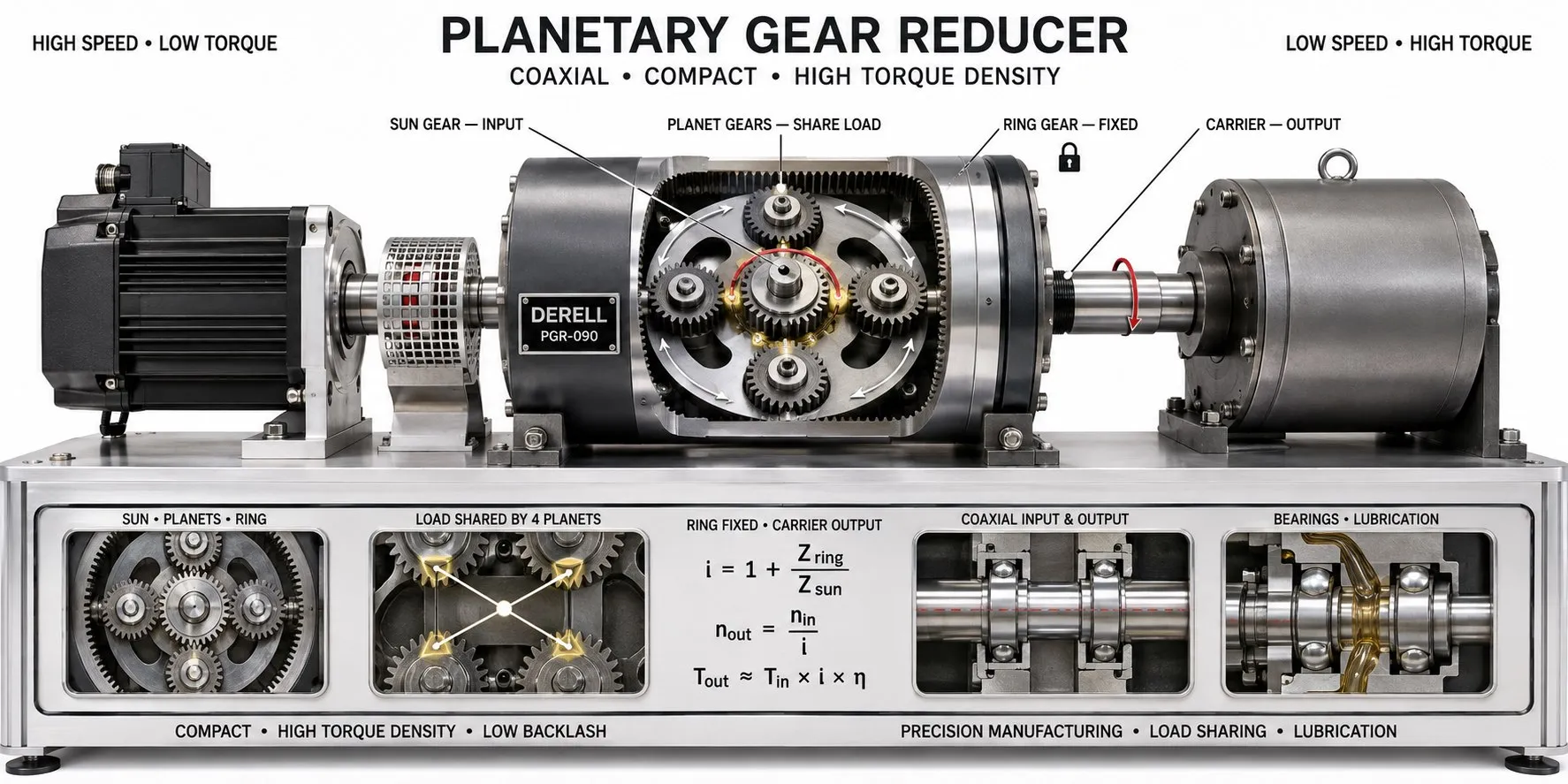
A planetary gearbox uses a central sun gear, surrounding planet gears, an internally toothed ring gear and a carrier supporting the planet pins. In a common reduction arrangement, the motor drives the sun, the ring is fixed to the housing and the carrier drives the load. The result is lower output speed with higher output torque.
Follow the planet pins to understand the output
Each planet has two motions: it spins about its own pin and its centre orbits the sun. The sun drives the planet teeth, while engagement with the fixed ring constrains their motion. As the planet centres travel around the sun, their pins turn the carrier. The output follows the carrier, not an individual planet's spin.
Watch the white dots and orange carrier. The dots reveal each gear's own rotation; the orange ring shows the carrier turning. Four sun revolutions produce one carrier revolution. In this arrangement, the planets spin opposite to the sun while their centres orbit with the carrier. The tooth outlines are schematic; the speed relationship is 4:1. A static view is shown when your system requests reduced motion.
Calculate the ratio from the sun and ring tooth counts
For a simple stage with the ring fixed, sun as input and carrier as output, the reduction ratio is i = 1 + Zring / Zsun, where Z is the number of teeth. Our example has a 54-tooth ring and an 18-tooth sun, giving i = 1 + 54/18 = 4. Having three planets does not make it a 3:1 gearbox.
At an input speed of 1,200 rpm, the carrier turns at 300 rpm in the same direction. With 2 Nm at the input and an illustrative efficiency of 95%, estimated output torque is 2 × 4 × 0.95 = 7.6 Nm. This calculation is not a gearbox torque rating. Check the product limits, then combine load and transmission calculations with motor and drive sizing.
Cascading two stages multiplies their ratios: 4:1 × 5:1 = 20:1. Their efficiencies also multiply. If each stage is assumed to be 95% efficient, the combined value is 0.95 × 0.95 = 90.25%. Actual efficiency depends on the selected product and operating conditions.
Why use several planets?
Several planets provide parallel paths for transmitting tooth loads. That helps achieve high torque density in a compact package. Perfectly equal load sharing is not automatic: manufacturing tolerances, bearing support and carrier design matter. This makes planetary gearboxes useful in robotics, CNC systems, packaging equipment and positioning axes.
The basic stage places the sun and carrier on a common axis, which simplifies integration. A complete product can still include an additional right-angle input stage. The internal planetary layout does not require every finished gearbox to have an inline exterior arrangement.
Planetary layout, helical teeth and backlash are separate choices
Planetary identifies the gear arrangement. Helical identifies the tooth form. A unit can therefore be a helical planetary gearbox. Low backlash is another specification, typically expressed in arcminutes, rather than a consequence of the name.
Backlash is the small amount of angular lost motion taken up after a reversal. Torsional stiffness describes resistance to elastic twist under load. A high-resolution motor encoder does not guarantee the same accuracy after the gearbox. Evaluate servo loop gain and the position loop with the mechanical transmission in mind.
What belongs on a gearbox specification?
Check ratio, continuous and peak torque, input speed, backlash, torsional stiffness, output bearing loads and motor mounting dimensions. Our gearbox selection guide explains these checks with numerical examples. Compare prices for equivalent configurations, and assess Derell servo gearboxes using the selected model's technical data.
Technical references
KHK — Internal Gears · Neugart — Planetary Gearboxes · Neugart — PLE technical data · Neugart — PLN technical data