
What is a Helical Gear Reducer?
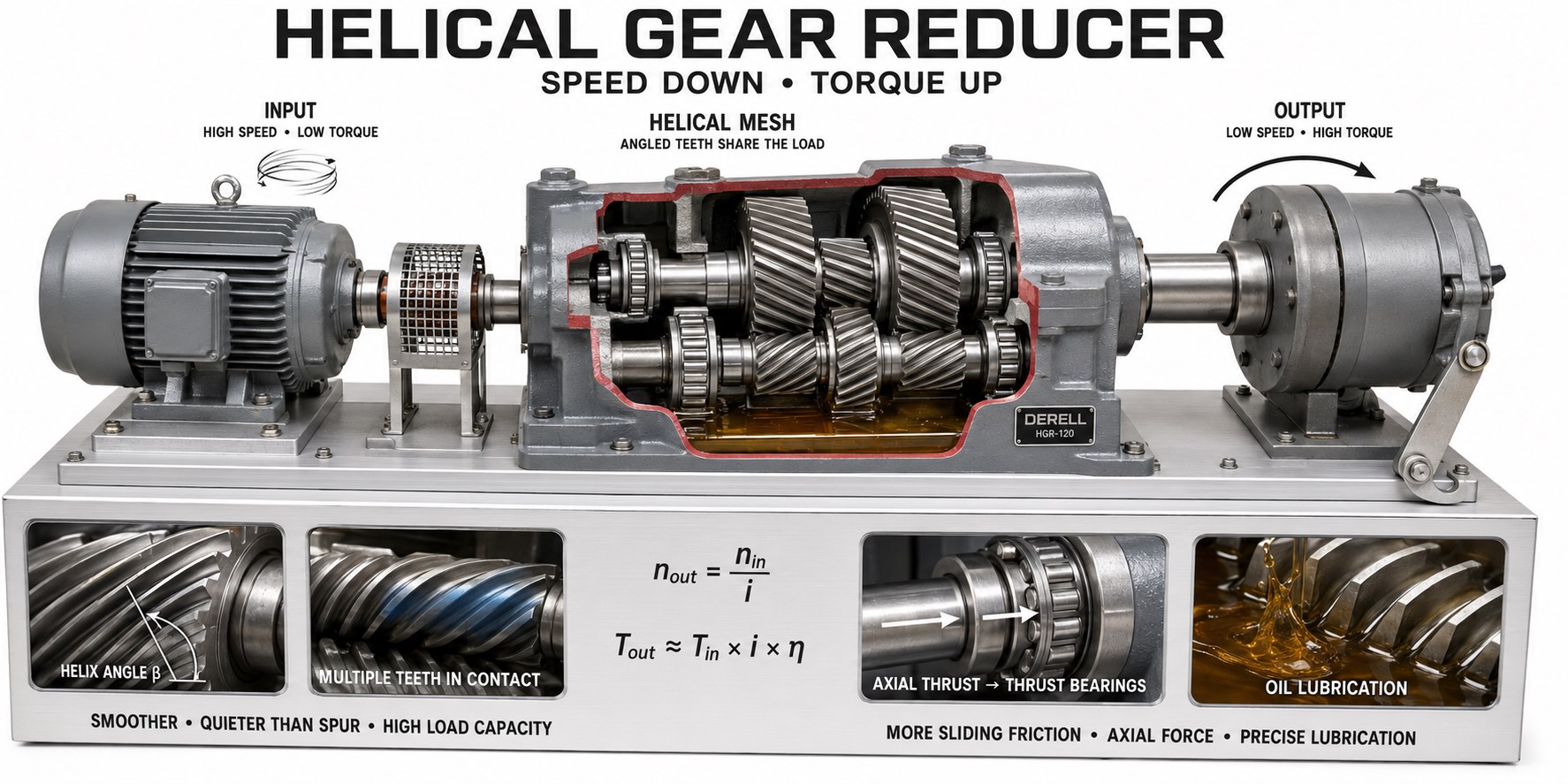
A conveyor that runs all day and a reversing positioning axis ask different things of a gearbox. Both may benefit from helical gearing, but one needs dependable operation under sustained load while the other may demand tight control of lost motion. Start with the job, then decide whether the selected gearbox and motor can meet it.
A helical reducer has teeth inclined to the shaft axis. Used for reduction, it delivers less speed and more output torque, allowing for losses. The geometry can support quiet, smooth power transmission; it does not replace an application-specific specification.
Why the tooth angle matters
On a spur gear, tooth traces run parallel to the shaft. A helical gear introduces an angle. Contact develops progressively across the face width, helping transfer load between tooth pairs less abruptly. Under comparable operating conditions, the result can be lower vibration and reduced running noise. Manufacturing quality and alignment remain essential; tooth geometry is only one contributor to acoustic noise.
The drawing shows the cylindrical surface laid flat, with the shaft direction running left to right. It compares straight and inclined tooth traces. It is an orientation sketch, not a meshing simulation or a manufacturing profile.
Check the bearings as well as the gears
The angle also introduces axial thrust: a force acting along the shaft. Its direction depends on the helix hand and rotation direction. Supporting it is a bearing design task. An improvised extra roller is not a substitute for a suitable internal bearing arrangement.
For a finished gearbox, check the manufacturer's external axial and radial load limits. A belt pulley or pinion can load the output shaft even when transmitted torque is modest. The load application point and any overturning moment matter too. Internal tooth thrust and allowable external shaft load are different quantities.
Translate motor speed into useful output
The basic equations are i = input speed / output speed and output torque ≈ input torque × i × efficiency. Consider a 3,000 rpm motor delivering 2.5 Nm, a 20:1 reducer and an assumed 96% efficiency. Output speed is 150 rpm; calculated output torque is 48 Nm.
That calculation describes an operating point. It does not establish the gearbox's permitted load. Check the ratings and your load calculation separately. The reducer trades speed for torque; it creates no extra power. Electronic speed and torque control cannot expand its mechanical limits.
Read “planetary” and “helical” on different lines
Planetary gearing describes an arrangement of sun, planet and ring gears. Helical describes tooth geometry. A helical planetary gearbox combines the two, so these are not competing alternatives in a gearbox comparison.
On a positioning axis, ask for backlash and torsional stiffness. Backlash is angular lost motion taken up after reversal; stiffness is resistance to elastic twist under load. Overall servo accuracy depends on the mechanical transmission as well as the encoder. Changing loop gain cannot remove mechanical backlash.
Use efficiency figures with their conditions attached
Helical does not automatically mean more efficient than spur. Tooth sliding, bearings, seals, lubrication, speed and load affect losses. Stage count matters: SEW-EURODRIVE reports gearing efficiencies of up to 98%, 97% and 96% for the relevant one-, two- and three-stage R/F/K units. Those are product-specific figures, not universal helical gearbox ratings.
The service plan is model-specific too. Check lubricant, fill quantity, installation orientation and maintenance intervals. A unit lubricated for life and a gearbox requiring oil changes need different treatment. Investigate a change in running noise, especially if accompanied by increasing temperature or leakage.
Make the enquiry specific enough to answer
Send output speed, continuous and peak torque, duty cycle, reversal frequency, shaft loads and mounting dimensions. Work through the gearbox selection guide together with motor and drive sizing. Include dust, moisture or washdown conditions so that the IP rating and environmental limits can be checked.
Compare prices at matching ratios, backlash classes and load capacities. For Derell servo gearboxes, use the chosen model's data rather than treating the word “helical” as proof of suitability.
Technical references
KHK — Helical gears: assembly and axial thrust · Gear contact modelling — research paper · SEW-EURODRIVE — R/F/K gearing efficiency · Neugart — example technical data: PSFN