
What is NTC Sensor?
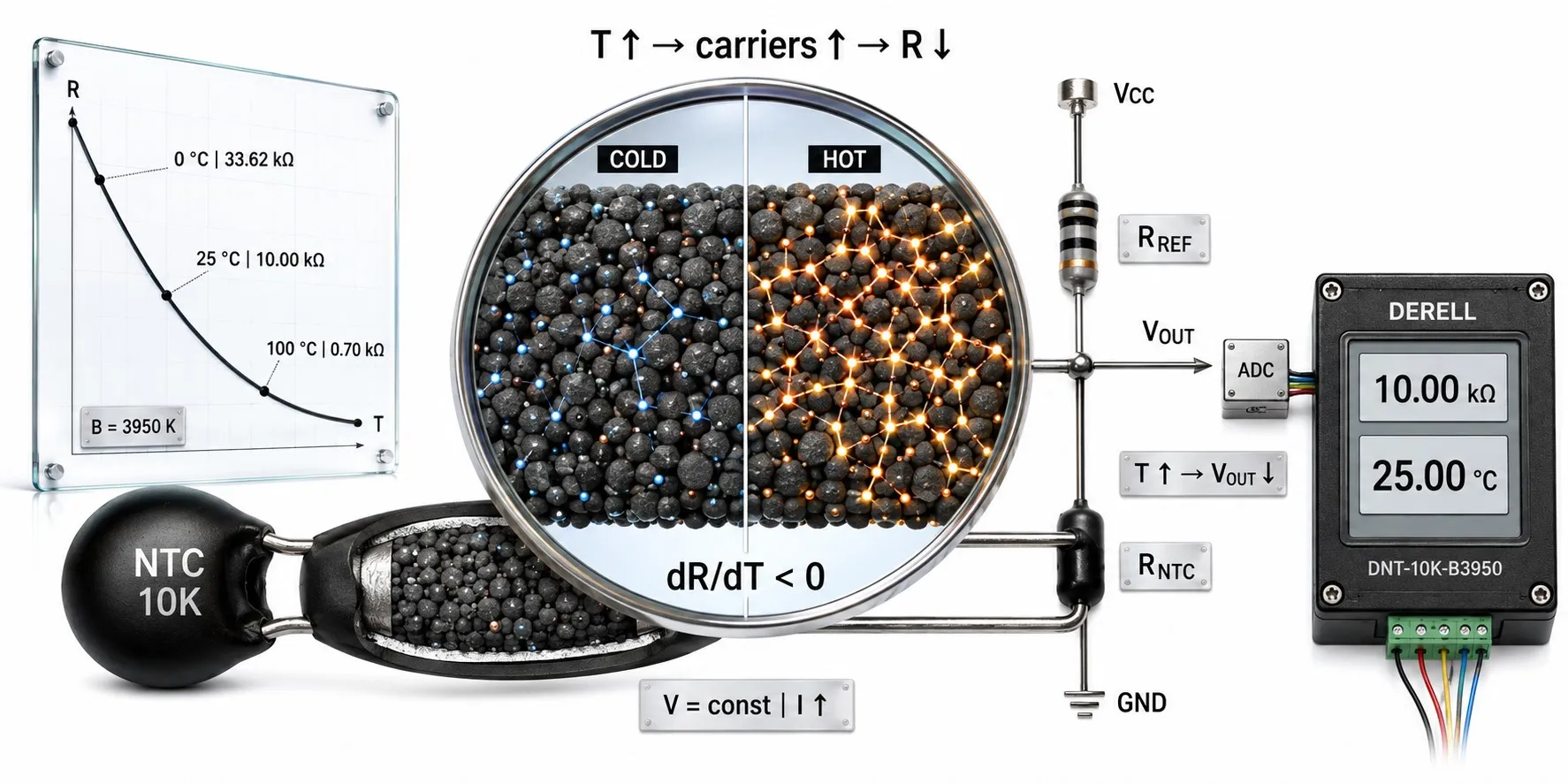
An NTC sensor is a temperature-sensitive resistor whose resistance decreases as temperature rises. NTC stands for Negative Temperature Coefficient. These semiconductor thermistors are widely used where a compact, inexpensive and electrically sensitive temperature measurement is required.
In simple terms: an NTC is relatively high in resistance when cold and lower in resistance when hot. Measurement electronics read that resistance and convert it into temperature.
The opposite general behaviour is found in a PTC thermistor, whose resistance increases with temperature. The two should not be treated as interchangeable even though both belong to the wider thermistor family.
For a broader introduction to the technologies used to measure temperature—including RTDs, thermocouples, thermistors and radiation sensors—see What Is a Temperature Sensor?.
Important clarification: an NTC is not internally composed of a thermistor, resistor and capacitor. The NTC itself is the temperature-sensitive element. A resistor, capacitor, ADC or microcontroller can be added externally as part of the circuit used to measure it.
NTC technical guide — quick navigation
How NTC works · R25 and 10K NTC · Beta value · R/T equations · Accuracy · Self-heating · Measurement circuit · NTC constructions · Compare technologies · PLC integration · Selection guide
How does an NTC thermistor work?
Temperature-sensing NTC thermistors are commonly manufactured from semiconducting ceramic materials based on metal oxides such as manganese, nickel and cobalt compounds.
As temperature rises, electrical conduction within the semiconductor becomes easier. Conductivity increases and resistance falls.
The fundamental behaviour is therefore:
Temperature ↑ → Resistance ↓
Unlike the approximately standardized platinum curve used by a Pt100 RTD, the NTC resistance–temperature relationship is strongly nonlinear and depends on the individual thermistor family.
Why is an NTC electrically very sensitive to temperature?
The percentage resistance change per degree can be much larger than that of a platinum RTD. This allows an inexpensive electronic circuit to detect small temperature changes very easily.
However, sensitivity is not the same as accuracy. A large resistance change does not automatically mean that the calculated temperature is correct.
Accuracy also depends on R25 tolerance, Beta tolerance, the real R/T curve, measurement electronics, self-heating and sensor installation.
What does 10K NTC mean?
A “10K NTC” normally means that the thermistor has a nominal resistance of 10 kΩ at 25 °C.
This is normally written:
R25 = 10 kΩ
Typical nominal resistance values include:
1K → 1 kΩ at 25 °C
5K → 5 kΩ at 25 °C
10K → 10 kΩ at 25 °C
47K → 47 kΩ at 25 °C
100K → 100 kΩ at 25 °C
The reference temperature matters. A 10K NTC does not remain at 10 kΩ when the temperature changes.
Does a 10K NTC read 10 kΩ at every temperature?
No. At lower temperatures the resistance can become many times higher than 10 kΩ, while at higher temperatures it can fall to only a small fraction of that value.
This is one of the most important differences between an NTC and a fixed resistor.
What is the Beta value of an NTC?
Beta — B value describes the slope of the NTC resistance–temperature characteristic over a specified temperature interval.
Typical notation includes:
B25/50 = 3950 K
B25/85 = 3435 K
The numbers identify the temperatures used when defining the Beta value.
B25/50 and B25/85 should not be treated as identical specifications. When selecting or replacing an NTC, both the numerical Beta value and the temperature pair must be checked.
Can two 10K NTCs behave differently?
Yes. Two devices may both be 10 kΩ at 25 °C yet have different Beta values.
They can therefore agree at room temperature and give significantly different resistance—and therefore different calculated temperatures—at 0 °C, 50 °C or 100 °C.
This is why “replace it with any 10K NTC” is not a safe engineering rule.
NTC resistance–temperature equation
A commonly used simplified relationship is:
R(T) = R0 × exp[B(1/T − 1/T0)]
where:
R(T) = resistance at temperature T
R0 = resistance at the reference temperature
B = Beta constant
T and T0 = absolute temperature in kelvin.
Temperatures must therefore be converted using:
T(K) = t(°C) + 273.15
How is the NTC temperature coefficient expressed?
Within the simple Beta model, the relative temperature coefficient can be approximated by:
αT ≈ −B / T2
The negative sign describes the defining NTC behaviour: resistance falls as temperature rises. For a B ≈ 3950 K thermistor around 25 °C, the relative change is several percent per degree Celsius, which explains why NTCs can provide very high electrical sensitivity.
Example: 10K NTC, B = 3950 K
For an idealized thermistor with R25 = 10 kΩ and B = 3950 K, approximate values are:
| Temperature | Approx. resistance |
| −20 °C | 105.4 kΩ |
| 0 °C | 33.6 kΩ |
| 25 °C | 10.0 kΩ |
| 50 °C | 3.59 kΩ |
| 75 °C | 1.49 kΩ |
| 100 °C | ≈698 Ω |
This is not a universal 10K NTC table. It applies only to the stated R25/B example. For a real sensor, use the manufacturer's resistance table or coefficients.
What is the Steinhart–Hart equation?
For wider temperature spans or more accurate conversion, manufacturers can provide Steinhart–Hart coefficients.
A common form is:
1/T = A + B ln(R) + C[ln(R)]3
For PLC or embedded-controller calculations, manufacturer-provided coefficients or an R/T lookup table are normally preferable to inventing a generic NTC curve.
How accurate is an NTC thermistor?
There is no single “NTC accuracy” that applies to every product.
Important contributors include:
R25 tolerance
Beta tolerance
real R/T curve
temperature range
electronic measurement accuracy
self-heating
thermal mounting
A specification such as 10 kΩ ±1% usually describes resistance tolerance at the reference temperature. It does not mean the final temperature measurement is ±1% at every point in the operating range.
NTC or Pt100 for precision temperature measurement?
A high-quality NTC can provide excellent results over a limited temperature range. If a standardized industrial platinum characteristic is required, compare it directly with Pt100.
For higher nominal resistance and reduced relative lead-resistance influence, also see Pt1000.
For applications where you are deciding between RTD and thermoelectric measurement, the deeper comparison is Thermocouple vs Pt100.
What is self-heating in an NTC?
Resistance cannot be measured without electrical current.
The power dissipated in the thermistor is:
P = I2R
If the measurement current is too large, the NTC heats itself, its resistance falls and the calculated temperature becomes higher than the true process temperature.
This is one reason NTC measurement circuits should use only the current necessary to obtain the required electrical resolution.
What is dissipation constant?
Dissipation constant indicates approximately how much electrical power is required to raise the thermistor temperature by 1 °C above the surrounding medium under specified conditions.
Because cooling conditions matter, the same NTC can have different self-heating behaviour in still air, flowing air, liquid or direct contact with metal.
What is thermal time constant?
Thermal time constant describes how rapidly the thermistor follows a change in environmental temperature.
A tiny bead thermistor can be extremely fast, while the same type of sensing material installed in a thick stainless-steel probe can respond much more slowly.
How is an NTC measured electronically?
One of the most common methods is to use the NTC with a fixed resistor as a voltage divider.
For example:
Vcc → Rfixed → Vout → NTC → 0 V
For this arrangement:
Vout = Vcc × RNTC / (Rfixed + RNTC)
As temperature rises, RNTC falls, so Vout also falls in this particular connection. If the positions of the NTC and fixed resistor are exchanged, the direction of the voltage change reverses.
If the divider is read by an industrial controller, the electrical measurement side is closely related to Analog Inputs and Outputs.
How should the fixed resistor be selected?
There is no universal resistor value. The best choice depends on the NTC R/T curve, supply voltage, ADC range and the temperature region where the highest measurement resolution is required.
As a practical starting point, the fixed resistor is often chosen near the NTC resistance at the centre of the most important temperature region. For a wide operating span, however, the complete divider and ADC transfer function should be evaluated rather than using a single rule of thumb.
Why is ratiometric ADC measurement useful?
If the voltage divider and ADC reference use the same supply, much of the supply-voltage variation cancels mathematically. This is known as ratiometric measurement and can reduce the dependence of the NTC reading on absolute supply accuracy.
Is a Wheatstone bridge required?
No. A Wheatstone bridge can be used in certain precision or differential measurement circuits, but it is not a universal requirement for NTC temperature measurement. A simple divider plus ADC is extremely common.
Why is a capacitor sometimes connected to an NTC input?
The capacitor is part of the measurement electronics, not the thermistor itself. It can be used to:
reduce high-frequency electrical noise
stabilize the ADC input
filter interference from switching electronics
This is particularly relevant in machines containing VFDs, servo drives and switching power supplies. The filter should not be made unnecessarily slow, because electrical filtering can add delay on top of the sensor's real thermal response time.
Can an NTC curve be linearized with resistors?
Approximately, yes. Series or parallel resistors can make the transfer curve more linear over a limited temperature region. In modern digital systems, however, software linearization using an R/T table, Beta equation or Steinhart–Hart calculation is usually more flexible.
What types of NTC thermistors are available?
NTCs are best classified by electrical characteristic and physical construction.
By R25:
1K · 5K · 10K · 47K · 100K and many other values.
By Beta characteristic:
B25/50 · B25/85 · B25/100 and manufacturer-specific R/T families.
By construction:
SMD/chip · bead · disc · glass-encapsulated · epoxy-coated · cable probe.
By application:
air · surface · liquid · battery · HVAC · automotive · electronics.
Infrared sensors and RTDs are not types of NTC. If contact measurement itself is unsuitable, jump directly to How Non-Contact Temperature Measurement Works.
SMD NTC
An SMD NTC is a small ceramic thermistor designed for PCB mounting. It is commonly used for battery-management electronics, DC/DC converters, power supplies and PCB thermal monitoring.
Bead NTC
A bead construction can provide very low thermal mass and fast response. Depending on the application it may be coated with glass or another protective material.
Glass-encapsulated NTC
Glass encapsulation can improve environmental protection and can support demanding temperatures in suitable product families. Actual chemical and temperature limits must still be checked from the specific datasheet.
Cable-probe NTC
The thermistor may be sealed in a probe with a cable for refrigeration, boilers, HVAC, water systems, battery packs and remote temperature measurement.
Temperature-sensing NTC vs inrush-current NTC
These applications should not be confused.
A sensing NTC is operated with very small measurement power so self-heating remains negligible.
An inrush-current NTC intentionally heats itself: it begins at a higher resistance when cold, limits the initial surge current, then warms and drops in resistance.
NTC vs PTC
| Characteristic | NTC | PTC |
| Temperature rises | Resistance decreases | Resistance increases |
| Typical use | Continuous sensing / compensation | Thermal limit / protection |
| Characteristic | Nonlinear decreasing curve | Increasing; switching PTC can rise sharply |
For switching-temperature behaviour and motor-winding protection, continue directly to What Is a PTC Sensor?.
NTC vs Pt100
NTC is a nonlinear semiconductor thermistor. Pt100 is a standardized platinum RTD.
NTC usually offers much higher percentage resistance sensitivity and low cost. Pt100 offers standardized R/T behaviour and broad industrial instrumentation support.
NTC vs Pt1000
Pt1000 has 1000 Ω nominal resistance at 0 °C and follows the platinum RTD characteristic.
A 10K NTC normally has 10 kΩ at 25 °C and then follows its product-specific nonlinear curve. The two sensors require different conversion algorithms.
NTC vs thermocouple
An NTC changes resistance. A thermocouple generates thermoelectric EMF.
The thermocouple principle itself is explained in What Is the Seebeck Effect?.
For the broader engineering choice between resistance measurement and thermoelectric measurement, continue to Thermocouple vs Pt100.

NTC vs non-contact temperature measurement
NTC must thermally contact the medium or component being measured.
If the target moves, cannot be touched or is beyond the practical temperature of a contact sensor, the more relevant technical path is How Non-Contact Temperature Measurement Works.
Where are NTC thermistors used?
refrigeration and HVAC
battery packs and chargers
electronic circuit boards
automotive electronics
heat pumps and boilers
power electronics
household appliances
industrial machines
In a complete control loop, the measured temperature may be sent to a controller that drives a heater, fan, valve, compressor or SSR.
Why is NTC mounting location so important?
The thermistor measures the temperature of its own body and immediate surroundings. It does not automatically measure the hottest point elsewhere in the machine.
For example, an NTC mounted on a PCB beside a power transistor does not directly measure the semiconductor junction temperature. PCB material, copper area, solder, adhesive, airflow and mounting pressure all create thermal resistance between the true hot spot and the sensor.
Poor sensor placement can therefore create a larger temperature error than the electrical tolerance of the thermistor itself.
Can an NTC connect to a PLC?
Only if the measurement method is defined correctly.
Typical options are:
Dedicated thermistor input
Voltage divider + analog input + software linearization
NTC-compatible transmitter / converter
If the PLC reads divider voltage, see What Are Analog Inputs and Outputs?.
If the temperature signal needs to travel over a long industrial cable, converting it into 4–20 mA or 0–10 V may be more suitable.
The actual conversion can be handled by a suitable temperature sensor converter.
Can an NTC be used for PID temperature control?
Yes. The NTC is only the sensing element. The measured resistance is converted into temperature and then supplied to the control algorithm.
A typical closed-loop chain is:
NTC → temperature calculation → controller / PLC → output stage → heater or cooling actuator
The output stage may operate an SSR, contactor, fan, valve, compressor or another actuator. For the control theory itself, continue to What Is PID Control?.
Why does an NTC system show the wrong temperature?
wrong R25
wrong Beta value
B25/50 and B25/85 confused
wrong R/T table
self-heating
incorrect divider resistor
ADC reference error
poor thermal contact
damaged or aged sensor
Can one 10K NTC replace another 10K NTC?
Only after checking the full characteristic.
Verify:
R25
Beta value
Beta temperature pair
R25 tolerance
Beta tolerance
temperature range
physical package and thermal time constant
How can open-circuit and short-circuit NTC faults be detected?
In a voltage-divider circuit, an open or shorted thermistor normally drives the ADC reading outside the valid temperature region.
Depending on divider orientation, an open NTC can push the input toward one supply rail while a shorted NTC pushes it toward the opposite rail.
Good control software should therefore detect sensor open circuit and short circuit as separate faults instead of simply converting every ADC value into a temperature.
Can an NTC be checked with a multimeter?
Yes, for a basic functional test. Measure the resistance at a known approximate temperature. A 10K NTC near 25 °C should be close to its specified 10 kΩ value within tolerance.
Warm the thermistor gently. Its resistance should decrease. This verifies basic NTC behaviour, but it does not prove that the device has the correct Beta curve or full temperature accuracy. Proper verification requires resistance checks at known temperature points.
How should an NTC sensor be selected?
Start by defining the actual thermistor specification:
R25 nominal resistance
R25 tolerance
Beta value
Beta temperature pair
Beta tolerance
minimum and maximum operating temperature
thermal time constant
dissipation constant
maximum measuring power/current
package or probe construction
cable and environmental requirements
Then decide whether an NTC is actually the correct temperature-sensing technology for the application.
If standardized industrial RTD measurement is required: compare directly with What Is Pt100? and What Is Pt1000?.
If the requirement is mainly an over-temperature trip rather than a continuous numerical temperature: compare with What Is a PTC Sensor?.
If the required temperature is well above the practical NTC range: continue to What Is a Thermocouple?.
For lower-temperature thermocouple work: compare Type T and Type E.
For higher industrial temperatures with improved high-temperature stability: see What Is a Type N Thermocouple?.
For extreme-temperature applications: process atmosphere becomes critical. Depending on the application, compare Type B, Type C or Type A thermocouples.
If the target moves or cannot be touched: go directly to How Non-Contact Temperature Measurement Works.
If the signal must enter a PLC as an analog value: first read What Are Analog Inputs and Outputs?. If the signal must travel a long industrial cable, continue to What Are 0–10 V and 4–20 mA?.
If the NTC is part of a closed-loop temperature controller: continue to What Is PID Control?.
Practical NTC selection summary
PCB, battery, HVAC and appliance sensing: NTC is often a strong candidate.
Standardized industrial resistance measurement: compare Pt100 / Pt1000.
Motor winding thermal trip: investigate PTC protection.
High or extreme temperature: investigate thermocouples.
Moving or inaccessible target: investigate non-contact temperature measurement.
Long industrial signal run: consider a temperature converter and 4–20 mA transmission.
Closed-loop temperature control: continue to PID control.
Main advantages of NTC thermistors
high temperature sensitivity
small physical size
fast-response potential
low cost
simple ADC interfacing
many R25 and Beta options
wide use in electronics, battery and HVAC systems
Limitations of NTC thermistors
strongly nonlinear R/T characteristic
different Beta curves among sensors with the same R25
self-heating error
product-specific R/T characteristics
more limited extreme-temperature capability than thermocouples
replacement cannot be selected from the kΩ value alone
Conclusion
An NTC thermistor is a semiconductor temperature-sensitive resistor whose resistance decreases as temperature rises.
The label “10K NTC” alone is not enough to identify the sensor. Correct selection also requires Beta value, tolerance, operating range, thermal behaviour and mechanical construction.
Reliable measurement requires the correct R/T curve, low enough measuring power, appropriate thermal mounting and correct electronic conversion.
When the application moves beyond what an NTC does best, the next technical step should be chosen deliberately: Pt100, Pt1000, PTC, thermocouple or non-contact temperature measurement.
Continue from NTC to the exact technical topic
Compare resistance-based temperature sensors
What Is a PTC Thermistor? · What Is Pt100? · What Is Pt1000? · Thermocouple vs Pt100
Understand thermocouple measurement
What Is a Thermocouple? · What Is the Seebeck Effect? · What Is a Type T Thermocouple? · What Is a Type E Thermocouple? · What Is a Type N Thermocouple?
Move into extreme-temperature measurement
What Is a Type B Thermocouple? · What Is a Type C Thermocouple? · What Is a Type A Thermocouple?
When the sensor cannot touch the target
How Non-Contact Temperature Measurement Works
Bring the measurement into a control system
What Are Analog Inputs and Outputs? · What Are 0–10 V and 4–20 mA? · What Is PID Control?
Products and interface hardware
NTC Sensor Models · PTC Sensor Models · Pt100 / Pt1000 Models · Temperature Sensor Converters