
what is ip67 protection standard?
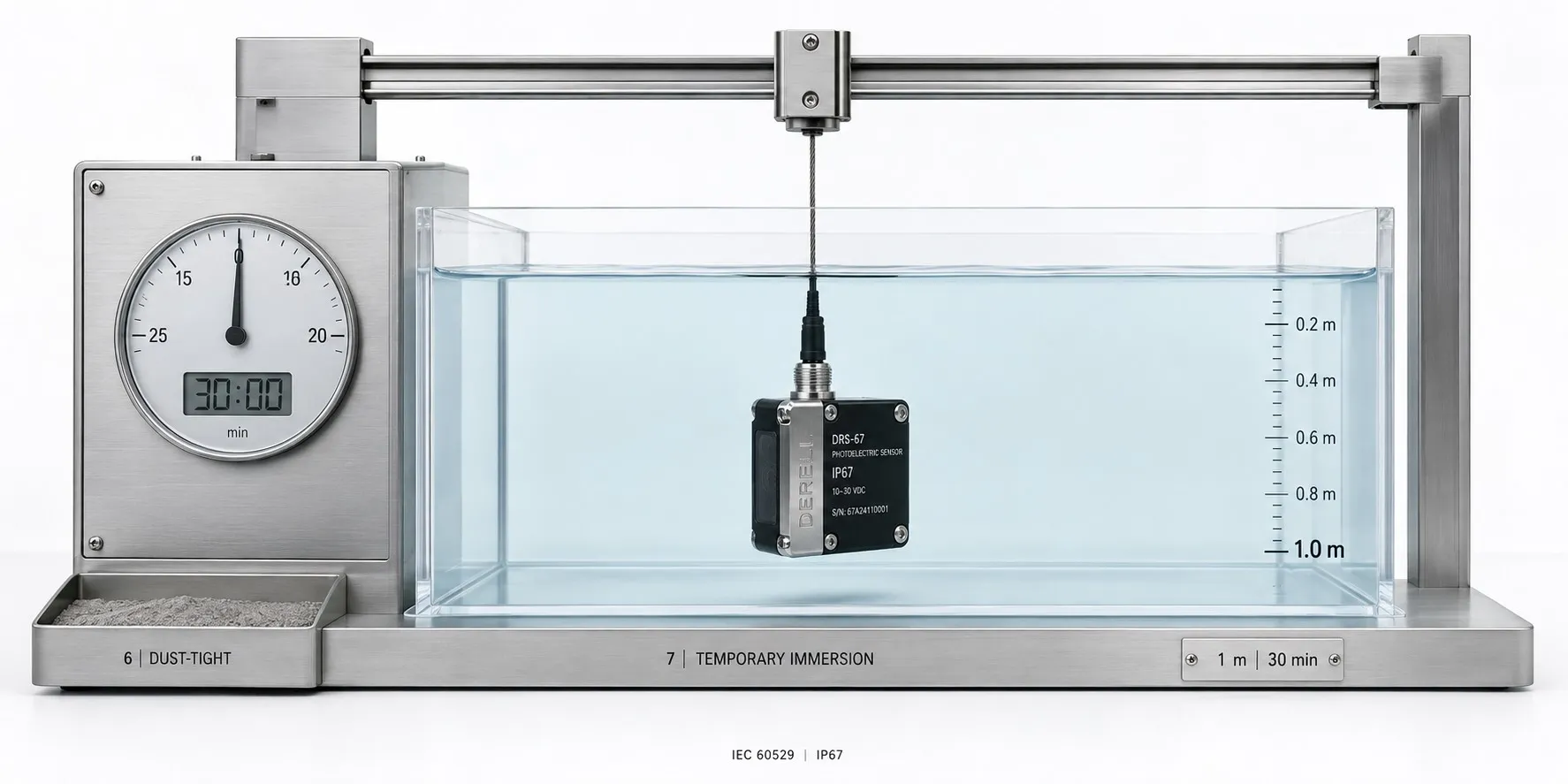
IP67 is an enclosure protection rating used for electrical and electronic equipment that requires strong protection against dust and temporary water immersion. It is one of the protection levels defined by IEC 60529, part of the wider family of IEC standards. The first digit describes protection against access and solid foreign objects, including dust, while the second digit describes protection against water. Our IP protection rating guide explains the complete coding system.
In simple terms… IP67 means that the enclosure is dust-tight and can withstand temporary immersion in water, commonly summarized as approximately 1 metre for 30 minutes under the specified test conditions. It does not mean unlimited underwater operation, unrestricted pressure washing or resistance to every liquid, chemical and harsh environment.
What does the first 6 in IP67 mean?
The first digit, 6, means that the enclosure is dust-tight. Under the applicable IEC 60529 test conditions, dust ingress is not permitted. This is the highest basic solid-particle and dust-protection level in the IEC IP classification.
This level is particularly useful for industrial sensors, machine-mounted electronics, field connection equipment and other devices exposed to fine process dust. However, the IP67 marking applies to the tested enclosure configuration. A damaged gasket, open electrical connection or incorrectly fitted cover can compromise the protection.
For example, the housing of an IP67 pressure sensor can be dust-tight while an incorrectly installed connector or cable entry prevents the complete field installation from achieving the same protection.
What does the second 7 in IP67 mean?
The second digit, 7, represents protection against the effects of temporary immersion in water. The IPX7 test is commonly described as immersion at a water level of approximately 1 metre for 30 minutes.
The exact test positioning also depends on enclosure dimensions, so the simplified “one metre for thirty minutes” description should not be interpreted as the complete test procedure. It is nevertheless the normal engineering shorthand used to distinguish IPX7 temporary immersion from other water-protection levels.
The important word is temporary. Where equipment must remain submerged for longer periods or under more demanding product-specific immersion conditions, an IP68 enclosure and its stated depth and duration should be evaluated instead.
Is IP67 fully waterproof?
“Fully waterproof” is too broad a description for IP67. The accurate statement is that the enclosure has passed a defined temporary-immersion test.
IP67 does not provide a universal guarantee for unlimited underwater use, continuous operation while submerged, seawater, hot water, chemical liquids or high-pressure cleaning.
A product may successfully withstand the IP67 immersion test while its manufacturer still prohibits normal operation underwater. Surviving temporary immersion and being designed to operate continuously underwater are different requirements.
Can IP67 equipment be used in a shower?
IP67 alone is not enough to answer that question. A shower exposes equipment to repeated spraying, different jet directions, warm water and potentially steam rather than only the temporary immersion condition represented by IPX7.
The product must also be intended by its manufacturer for that environment. For mains-powered electrical equipment, installation and electrical-safety requirements are separate from the IP enclosure rating.
An IP67 label should therefore not be treated as a general “shower safe” approval.
What is the difference between IP67 and IP68?
IP67 and IP68 both begin with 6, so both are dust-tight. Their main difference concerns water immersion.
IP67 relates to a standardized temporary-immersion condition. IP68 relates to immersion under more severe, product-specific conditions agreed or specified for the particular equipment.
There is no universal IP68 rule stating that every product must survive two metres, five metres or a particular number of hours. An IP68 rating must therefore be read together with the manufacturer's actual depth and duration specification.
IP68 should not simply be described as “IP67 but better.” It represents a different immersion condition with product-specific limits.
What is the difference between IP66 and IP67?
IP67 and IP66 are both dust-tight because they begin with 6. Their water tests, however, are different.
IP66 addresses powerful water jets. IP67 addresses temporary immersion.
The relatively uniform water pressure around an immersed enclosure is physically different from the localized impact of a powerful jet striking a gasket, connector or cable entry.
If an installation requires both powerful wash-down and temporary immersion, look for a manufacturer declaration such as IP66/IP67 or other documentation confirming that both tests have been satisfied.
What is the difference between IP67 and IP69?
IP69 concerns a different water exposure: high-pressure, high-temperature water jets. IP67 concerns temporary immersion.
The fact that 69 is numerically larger than 67 does not mean that IP69 automatically includes the IP67 immersion test. Equipment can be designed for aggressive hot-water cleaning without being intended to remain underwater.
Likewise, an IP67 device that survives temporary immersion should not automatically be exposed to hot pressure washing.
For vehicle equipment, the IP69K / ISO 20653 vehicle protection system introduces additional K-designated requirements and should be read separately from the IEC 60529 IP67 classification.
Can IP67 equipment be pressure-washed?
IP67 alone does not authorize pressure washing. Temporary immersion and a high-velocity water jet impose different stresses on an enclosure.
An IP67 sensor may survive temporary immersion while a pressure washer directed at close range can place much greater localized stress on its seals, connector or cable entry.
Where machines are regularly cleaned with hoses or pressure equipment, compare the real cleaning conditions with the relevant IP66, IP69 or other applicable wash-down rating rather than relying on IP67 alone.
Is IP67 suitable for outdoor use?
IP67 provides strong dust and water-ingress protection and is frequently useful in outdoor and field equipment. However, IP67 alone is not a complete outdoor-environment specification.
Outdoor equipment may also encounter ultraviolet radiation, freezing temperatures, heat, condensation, road salt, corrosion and chemical contamination. These conditions are not defined by the two IP digits.
A field sensor can therefore have excellent IP67 sealing while its housing material, cable or connector requires separate verification for sunlight, temperature or process chemicals.
Why is IP67 so common on industrial sensors?
IP67 is widely used on machine-mounted industrial sensors because these devices can be exposed to process dust, coolant splash, machine oil and temporary water exposure.
The enclosure rating is separate from the sensor's electrical characteristics. An inductive sensor, for example, can have an IP67 housing while its sensing distance, NPN/PNP output configuration, switching frequency and supply voltage are specified independently.
IP67 also does not automatically mean that every sensor housing or cable material is compatible with cutting fluids, hydraulic oil, acids or cleaning chemicals.
What does IP67 mean on a pressure sensor?
On a pressure sensor or pressure transmitter, IP67 describes protection of the external enclosure against dust and temporary immersion. It does not describe the pressure that the sensor can measure.
A 250 bar pressure transmitter, for example, can have an IP65, IP67 or another enclosure rating. Process pressure and enclosure immersion pressure are completely different technical characteristics.
The process connection, electrical connector and cable outlet must each be installed as specified by the manufacturer if the intended enclosure protection is to be maintained.
When is an IP67 connector really IP67?
Many sensor connectors and connector cables carry an IP67 rating. In most cases, however, that rating applies when the connection is fully mated with the specified counterpart and correctly tightened.
An open M12 connector, missing O-ring, loose cable gland or incorrectly selected cable diameter can prevent the finished connection from maintaining its declared protection.
Phoenix Contact, for example, tests M12 connector systems against IPX7 immersion requirements and specifies the protection for defined connection conditions. The connector installation therefore matters just as much as the IP number printed in the catalogue.
What does IP67 mean on an HMI panel?
When an industrial HMI panel carries an IP67 statement, check whether the rating applies to the complete device or only to its front face.
Panel-mounted HMIs often have a highly protected front bezel while the rear electronics inside the control cabinet have a much lower IP rating.
Front-face protection can also depend on the correct panel cut-out, gasket, mounting surface and tightening method. “Front IP67” and “complete device IP67” are not equivalent statements.
How should an IP67 control panel be evaluated?
An empty enclosure marked IP67 does not automatically make the completed electrical panel IP67. Cable glands, blanking plugs, door seals, pushbuttons, HMI installations and other panel components all affect the final protection.
Installing an IP54 ventilation component or an unsuitable cable gland into an IP67 cabinet can compromise the final enclosure protection.
High sealing can also make thermal management more difficult, particularly when the panel contains power electronics.
Can an IP20 VFD be installed inside an IP67 cabinet?
An IP20 AC drive or VFD can be installed inside a suitably engineered higher-rated cabinet. In that arrangement, the enclosure provides the environmental protection that the drive itself does not.
However, VFDs generate heat. Cabinet losses, internal temperature, mounting clearances, ambient temperature and the need for a heat exchanger, air conditioner or other cooling system must therefore be calculated.
A high IP rating is not useful if the enclosure causes the drive to overheat.
What about PLC systems and IP67?
Conventional cabinet-mounted PLCs and modules are generally not intended for direct immersion. Their environmental protection is usually provided by the surrounding control cabinet.
Some distributed I/O systems and field-mounted automation modules are available with high enclosure ratings such as IP67, allowing them to be mounted closer to sensors and actuators without a conventional central cabinet.
The protection level must still be checked for each module, connector and installed accessory rather than assumed for an entire PLC family.
Can IP67 equipment be used in seawater?
IP67 alone does not establish seawater resistance. Saltwater corrosion and material compatibility are separate from the IEC 60529 immersion classification.
Marine applications may require attention to stainless-steel grade, protective coatings, elastomer seals, connector metals and galvanic corrosion.
A product that passes an IP67 test in fresh water should not automatically be assumed suitable for long-term saltwater exposure.
Does IP67 mean chemical resistance?
No. IP67 is not a chemical-resistance classification. Acids, alkalis, solvents, cutting fluids, hydraulic oil, fuel and cleaning chemicals can affect enclosure materials differently from water.
For industrial sensors, the housing, cable jacket and elastomer seals should be checked against the actual process fluid.
An IP67 water-ingress rating is not evidence that a product is compatible with every industrial chemical.
Does IP67 prevent condensation?
Not necessarily. Keeping liquid water out and preventing moisture from condensing inside an enclosure are different problems.
Trapped humidity and temperature cycling can produce condensation even inside a well-sealed enclosure. A high IP rating therefore does not automatically eliminate internal moisture concerns.
Can IP67 protection deteriorate over time?
Yes. Gaskets and O-rings can age, cable glands can loosen, plastic housings can crack and connectors can suffer mechanical damage.
A product that was IP67 when new should not automatically be assumed to retain exactly the same immersion protection after years of harsh industrial service without inspection.
Seals, covers, connectors and cable entries should therefore be inspected when reliable water protection remains important to the application.
Is IP67 a certification?
No. IP67 is an enclosure protection rating, not the name of a certification body or a general product-quality certificate.
A manufacturer may support the declaration through internal testing or through an independent laboratory. For critical applications, check the exact product model, referenced standard, test configuration and available test documentation.
What does IP67 not guarantee?
IP67 provides information about dust-tight construction and temporary immersion. It does not by itself establish continuous immersion capability, powerful jet resistance, hot pressure-wash resistance, chemical compatibility, corrosion resistance, UV resistance or mechanical-impact performance.
It also does not establish explosive-atmosphere suitability, complete electrical-safety compliance or another unrelated product approval. These requirements belong to separate industrial standards and conformity processes.
What should be checked before choosing an IP67 product?
First identify the real water exposure. Will the equipment see ordinary rain, temporary flooding, powerful wash-down jets or continuous immersion?
Next, verify that the connector, cable, cable gland, covers and sealing components are suitable for the same environmental condition as the main enclosure.
Then consider operating temperature, chemicals, UV exposure, corrosion and mechanical conditions. These properties cannot be inferred from the IP67 code alone.
Finally, check the manufacturer's documentation for the exact model and installation configuration. IP67 is a valuable enclosure rating, but it is not a complete specification for every harsh environment.
IP67 in one sentence
IP67 means dust-tight and protected against temporary immersion, commonly summarized as approximately one metre of water for 30 minutes. It does not mean unlimited underwater operation or unrestricted pressure washing. IP66 addresses powerful water jets, IP67 addresses temporary immersion, IP68 addresses more severe product-specific immersion conditions, and IP69 addresses high-pressure, high-temperature water jets.
Related IP protection guides
IP Protection Ratings and IEC 60529 Guide | IP66 | IP68 | IP69 | IP69K and ISO 20653
Related automation equipment: Sensors | Pressure Sensors | Sensor Connectors and Cables | HMI Panels | PLCs and Modules | AC Drives and VFDs | Panel Components