
what is ip55 protection standard?
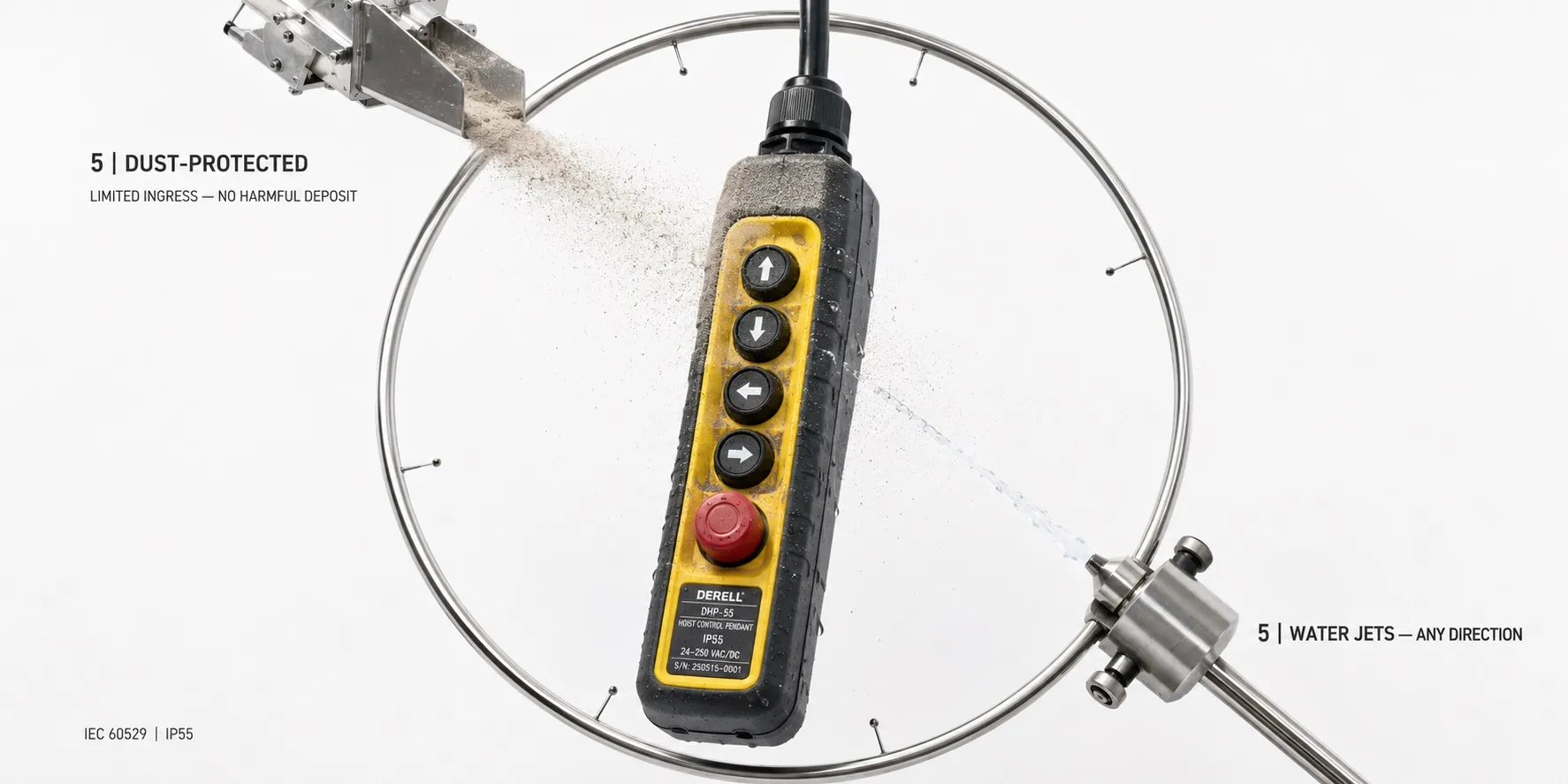
IP55 is an enclosure protection rating used for electrical and electronic equipment. It is not a separate standard by itself; it is one of the protection levels defined within IEC 60529. The first digit describes protection against access and solid foreign objects, including dust, while the second digit describes protection against water.
In simple terms… IP55 means that the enclosure is dust-protected and can withstand the specified water-jet test. Some dust may enter, but not enough to interfere with satisfactory operation or safety. Water projected against the enclosure under the defined test conditions must not produce harmful effects. IP55 is not an immersion rating and should not automatically be described as waterproof.
What does the first 5 in IP55 mean?
The first digit, 5, means that the enclosure is dust-protected. Dust ingress does not have to be completely prevented. A limited amount may enter, provided it does not accumulate in a quantity or location that interferes with satisfactory equipment operation or safety.
This distinction is important. IP55 should not be described as completely dust-tight. Full dust-tight protection is represented by a first digit of 6, as found in IP65, IP66 and IP67.
What does the second 5 in IP55 mean?
The second digit, 5, means that the enclosure is protected against water jets. Under the specified IEC test conditions, water projected by a nozzle against the enclosure from different directions must not produce harmful effects.
This is more demanding than simple splashing-water protection. For example, IP54 uses water digit 4, which relates to splashing water, whereas IP55 uses water digit 5 for water jets.
However, an IP55 marking does not mean that any pressure washer can be used at any distance, pressure, flow rate or temperature. The IP test is performed under defined conditions. If equipment will be routinely washed down, the manufacturer's cleaning instructions and environmental limits must also be checked.
Is IP55 waterproof?
Calling IP55 simply “waterproof” can be misleading. A more accurate description is protected against water jets under the specified test conditions. IP55 does not establish protection for temporary or continuous immersion.
If an application includes a realistic risk of the equipment being submerged, an immersion rating such as IP67 or an appropriate IP68 rating may be relevant. The actual depth, duration and operating conditions still have to match the manufacturer's specification.
Water jets and immersion are different exposure conditions and use different tests. A higher-looking second digit should therefore not be treated as proof that every different water test has also been passed.
What is the difference between IP54 and IP55?
IP54 and IP55 have the same dust protection level. Both start with 5, so both are dust-protected rather than completely dust-tight.
The difference is the second digit. IP54 protects against splashing water, while IP55 protects against water jets. For equipment that may be exposed to directed water rather than occasional splashing, IP55 addresses the more demanding water condition of the two.
What is the difference between IP55 and IP65?
A common mistake is to say that IP65 provides a higher water-jet level than IP55. It does not. IP55 and IP65 both end in the digit 5, so both use the same basic IPX5 water-protection level.
The difference is the first digit. IP55 is dust-protected, meaning limited dust ingress may be permitted under the standard's criteria. IP65 is dust-tight, meaning dust ingress is prevented under the specified test conditions.
Therefore:
IP55 = dust-protected + protected against water jets.
IP65 = dust-tight + protected against water jets.
The water protection is not what separates the two ratings. The important difference is the enclosure's resistance to dust ingress. Our IP65 and IP66 guide explains the higher solid-particle protection levels in more detail.
What is the difference between IP55 and IP66?
IP55 and IP66 differ in both digits.
The first digit changes from 5 to 6. IP55 is dust-protected, whereas IP66 is dust-tight. The second digit also changes from 5 to 6. IP55 is tested against water jets, while IP66 is tested against powerful water jets.
IP66 can therefore address a more demanding dust and water-jet environment than IP55. Even so, IP66 should not automatically be interpreted as approval for unlimited pressure washing, steam cleaning or immersion. The real cleaning process must be compared with the manufacturer's stated conditions.
What is the difference between IP55 and IP67?
IP67 is dust-tight because its first digit is 6. Its second digit, 7, relates to the effects of temporary immersion in water. IP55, by contrast, relates to water jets rather than immersion.
These should not be viewed simply as “55 is lower and 67 is higher.” They describe different environmental tests. If equipment may be exposed both to wash-down jets and temporary flooding or immersion, the manufacturer should confirm protection for both conditions.
Is IP55 suitable for outdoor use?
An IP55 rating alone does not prove universal outdoor suitability. It provides useful information about dust and water ingress, but outdoor installations may also be affected by ultraviolet radiation, temperature extremes, condensation, corrosion, salt atmosphere, chemicals, ice and mechanical impact.
For example, an IP55 enclosure may provide adequate ingress protection against rain and directed water exposure while its material or coating is unsuitable for long-term sunlight or a highly corrosive location. Outdoor selection should therefore consider the IP rating together with material, operating temperature, corrosion resistance and the manufacturer's environmental specification.
Where is IP55 used in industrial automation?
IP55 is commonly encountered on industrial motors, field enclosures, machine-mounted electrical equipment and some control cabinets. It can also be offered as an enclosure option on certain industrial drives.
Not every component inside an IP55 installation needs to carry the same rating. An IP20 variable frequency drive, for example, may be installed inside a suitable higher-rated enclosure, provided thermal management, clearances and the manufacturer's installation requirements are satisfied.
The same applies to a PLC and its modules. The PLC itself may be intended for protected installation inside a cabinet, while the completed cabinet provides the environmental protection required at the machine or process location.
IP55 control panels and enclosure components
The protection rating of a completed control panel depends on more than the empty enclosure. Door gaskets, cable glands, pushbuttons, indicator lamps, ventilation components and other panel components can affect the final degree of protection.
For example, drilling an additional hole and fitting an unsuitable cable gland can compromise the original protection level. A damaged door gasket, missing blanking plug or incorrectly tightened fitting can have the same effect.
The IP marking on the original enclosure should therefore not automatically be treated as the rating of a finished, modified control panel. The completed assembly and its installation details have to preserve the required enclosure protection.
What about HMI panels?
An industrial HMI may have one IP rating for its front face while the electronics behind the panel have a lower enclosure rating. This is common because the front bezel is exposed to the operator and machine environment, while the rear is intended to remain inside the electrical cabinet.
The specified front-face protection normally depends on correct panel cut-out dimensions, gasket positioning, mounting surface and fastening. A poorly installed HMI can therefore compromise the protection of an otherwise correctly selected enclosure.
What about sensors and field connections?
For field equipment such as pressure sensors, the IP rating of the sensor housing is only one part of the installation. Electrical connectors, mating plugs, cable seals and covers must also be installed as specified if the intended protection is to be maintained.
A sealed sensor housing does not make an open connector water-resistant. Likewise, the maximum process pressure that a pressure sensor can measure is a different specification from the IP rating of its external enclosure.
Can an IP55 rating be lost after installation?
Yes. An enclosure may have been designed and tested for IP55, but incorrect installation or later modifications can reduce the protection actually provided in service.
Common examples include incorrectly sized cable glands, unused holes left without suitable plugs, damaged seals, loose covers, deteriorated gaskets and connectors that are not fully mated.
Maintenance matters as well. Seals can age, plastics can crack and fittings can loosen. The IP marking on the nameplate does not mean that a damaged or incorrectly reassembled enclosure continues to provide its original protection indefinitely.
Does IP55 protect against condensation?
Not necessarily. IEC 60529 classifies protection against external water ingress, but internal condensation can occur because of temperature and humidity changes even when liquid water does not enter directly through the enclosure.
Outdoor cabinets and equipment exposed to repeated heating and cooling may therefore require separate condensation-control measures such as enclosure heaters, suitable ventilation systems or other thermal-management methods. These measures must be selected without compromising the required IP rating.
Is a higher IP number always better?
No. The correct IP rating is the one that matches the actual environmental exposure. Selecting by the largest number alone can lead to incorrect assumptions, particularly when comparing water jets with immersion.
A highly sealed enclosure can also create other engineering issues. For example, electronic equipment such as drives generates heat. Increasing enclosure sealing without considering heat dissipation can raise internal temperature and may require a different enclosure size, cooling method or equipment derating.
IP protection should therefore be treated as one part of enclosure engineering, not as a universal quality score.
What does IP55 not guarantee?
IP55 mainly describes enclosure protection against solid foreign objects, dust and water under specified test conditions. By itself, it does not establish resistance to every chemical, corrosion, ultraviolet radiation, mechanical impact, extreme temperatures or internal condensation.
It also does not establish electrical safety, EMC compliance, functional safety or suitability for explosive atmospheres. Those requirements are addressed through other standards and conformity procedures within the broader field of industrial standards.
How should an IP55 product be selected?
Start by defining the actual exposure. Will the equipment see ordinary indoor dust, heavy process dust, rain, occasional splashing, directed hose water, routine wash-down, temporary flooding or immersion? These conditions are not interchangeable.
Then check the complete product specification, including the stated IP rating, referenced standard, mounting position, connector condition, required seals and accessories, operating temperature and cleaning limitations.
For a machine or control panel, the IP rating of individual parts should not be confused with the protection of the completed assembly. Installation quality and every opening through the enclosure remain important.
IP55 in one sentence
IP55 means dust-protected and protected against water jets. It is not completely dust-tight, it is not an immersion rating, and it does not authorize unrestricted high-pressure washing. IP65 has the same water digit but higher dust protection; IP66 is dust-tight and addresses powerful water jets; IP67 addresses temporary immersion as a different water exposure condition.
Related IP protection guides
IP Protection Ratings and IEC 60529 Guide | IP54 | IP65 and IP66 | IP66 | IP67 | IP68
Related automation equipment: Panel Components | AC Drives and VFDs | PLCs and Modules | HMI Panels | Pressure Sensors
```