
what is ip54 protection standard?
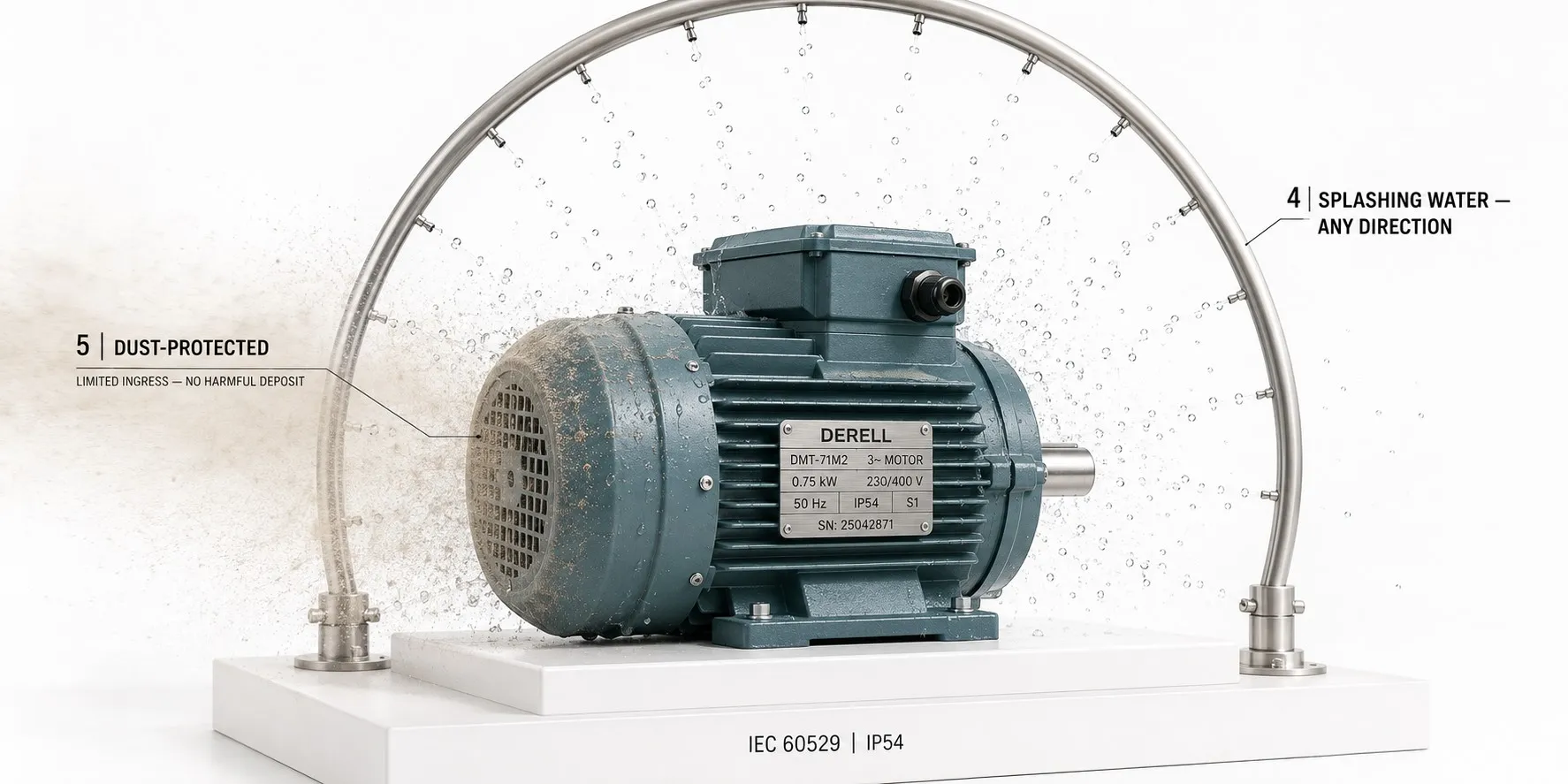
IP54 is an enclosure protection rating used for electrical and electronic equipment. It is not a separate standard by itself; it is one of the protection levels defined within IEC 60529. The first digit describes protection against access and solid foreign objects, including dust, while the second digit describes protection against water.
In simple terms… IP54 means that some dust may enter the enclosure, but not in a quantity that interferes with satisfactory operation or safety, and the enclosure is protected against water splashing from any direction. It is not dust-tight, it is not a water-jet rating and it does not mean that the equipment can be submerged in water.
What does the first 5 in IP54 mean?
The first digit, 5, means that the enclosure is dust-protected. Complete exclusion of dust is not required. Limited dust ingress may occur, provided it does not enter in a quantity or location that interferes with satisfactory operation or safety.
For this reason, IP54 should not be described as completely dust-tight. Dust-tight protection uses the first digit 6, as found in IP65, IP66 and IP67.
The first characteristic numeral also relates to protection against access to hazardous parts. However, describing IP54 simply as protection against “objects larger than 1 mm” is technically incorrect. Protection associated with 1 mm solid foreign objects belongs to first digit 4; first digit 5 represents the higher dust-protected level.
What does the second 4 in IP54 mean?
The second digit, 4, means that the enclosure is protected against splashing water from any direction. Under the specified test conditions, water splashed against the enclosure must not produce harmful effects.
This does not mean that IP54 has no water protection. It does. However, splashing water is different from a directed water jet, powerful wash-down, temporary immersion or continuous immersion.
Where directed water jets are expected, IP55 addresses a different water test. Where more powerful water jets are involved, the requirements associated with IP66 may be relevant.
Is IP54 waterproof?
The word “waterproof” is too broad to describe an IP54 enclosure accurately. IP54 means protection against splashing water under the specified test conditions. It does not state that the enclosure can withstand a hose, pressure washer or immersion.
A few drops or splashes during normal operation are very different from deliberately washing a machine with a hose. Temporary flooding is another condition again. For temporary immersion, a rating such as IP67 addresses the relevant type of test.
It is better to ask what type of water exposure an enclosure has been tested for than simply ask whether it is waterproof.
Is IP54 suitable for rain?
Because the second digit is 4, IP54 provides protection against water splashing from different directions. This may be appropriate for some equipment exposed to rain, depending on the installation and manufacturer's environmental specification.
IP54 alone, however, is not a universal outdoor-use approval. Outdoor equipment may also be exposed to ultraviolet radiation, high and low temperatures, condensation, freezing, salt atmosphere, corrosion, chemicals and mechanical impact.
A correctly selected outdoor product should therefore be evaluated for both its IP rating and the manufacturer's permitted environmental conditions.
What is the difference between IP54 and IP55?
IP54 and IP55 have the same dust protection level. Their first digit is 5, so both are dust-protected but not completely dust-tight.
The difference is the second digit. IP54 addresses splashing water, while IP55 addresses water jets. The change from 4 to 5 therefore concerns the water test, not the dust protection.
If equipment may occasionally receive splashes, IP54 can address that type of exposure. If water will be deliberately directed toward the enclosure, the application should be evaluated against the appropriate water-jet rating rather than assuming that all wet conditions are equivalent.
What is the difference between IP54 and IP65?
IP54 and IP65 differ in both digits. IP54 is dust-protected and protected against splashing water. IP65 is dust-tight and protected against water jets.
IP54 = dust-protected + splashing-water protection.
IP65 = dust-tight + water-jet protection.
This can make an important difference in industrial environments containing very fine dust, such as stone processing, cement production, woodworking or other dusty processes. The IP65 and IP66 guide explains the higher enclosure protection levels in more detail.
What is the difference between IP54 and IP66?
IP66 provides a different level of protection in both parts of the code. IP54 is dust-protected, while IP66 is dust-tight. IP54 addresses splashing water, while IP66 addresses powerful water jets.
Even so, IP66 should not automatically be interpreted as permission to use any pressure washer. Water pressure, flow, nozzle, distance, temperature and exposure time still matter. High-pressure and high-temperature cleaning involves separate test conditions.
What is the difference between IP54 and IP67?
IP67 is dust-tight and addresses the effects of temporary immersion under specified test conditions. IP54 is dust-protected and addresses splashing water.
This comparison shows why IP numbers should not be treated as one simple waterproofing scale. Splashing, water jets and immersion represent different exposure conditions and different tests.
If a machine can experience both wash-down and temporary flooding, the equipment specification should explicitly address both conditions rather than relying only on the largest number printed after “IP”.
Where is IP54 used in industrial automation?
IP54 protection can be found on motors, field enclosures, machine housings and some industrial control equipment where moderate dust and splashing water are expected but routine wash-down or immersion is not part of normal operation.
An AC drive or VFD, for example, may itself be IP20 and be installed inside a suitable IP54 or higher-rated control cabinet. In that case, the drive's own rating and the completed cabinet rating are two different specifications.
The same principle applies to a PLC and its modules. Internal control electronics may be intended for protected cabinet installation while the enclosure surrounding them provides the required protection against the machine environment.
What determines the IP54 rating of a control panel?
The protection of a completed electrical panel depends on the complete enclosure system, not only the empty cabinet. Door seals, cable glands, pushbuttons, indicator lamps, ventilation openings and other panel components can all affect the final protection level.
For example, installing a fan, filter or cable gland with unsuitable ingress protection can compromise an enclosure that originally had IP54 protection before modification.
Low-voltage control-panel design also includes requirements beyond ingress protection. The broader assembly requirements are discussed in our IEC 61439 guide for low-voltage switchgear and controlgear assemblies.
How does IP protection work on an HMI panel?
An industrial HMI panel can have a higher IP rating on its front face than on the electronics behind the panel. This is common because the front surface is exposed to the operator and machine environment while the rear is located inside the control cabinet.
The declared front-face protection may depend on the specified panel cut-out, gasket, mounting surface and fastening method. Incorrect installation can therefore reduce the protection achieved after the HMI has been fitted to the cabinet.
Is IP54 enough for a field sensor?
That depends on the actual installation. A pressure sensor located inside a machine where it sees moderate dust and occasional splashing may have very different requirements from a sensor installed outdoors or in a wash-down area.
The sensor housing is also only one part of the installation. Electrical connectors, mating plugs, cable seals and covers must preserve the required protection. An open connector or damaged seal can defeat the purpose of the enclosure rating.
The sensor's process-pressure rating should not be confused with its IP rating either. One describes the pressure applied through the measurement connection; the other describes protection of the external enclosure.
Can IP54 protection be lost after installation?
Yes. The specified protection depends on the enclosure being installed and maintained in the required condition. Additional holes, unsuitable cable glands, missing blanking plugs, damaged seals or incorrectly closed covers can reduce the actual ingress protection.
Maintenance also matters. Gaskets can age, plastic parts can crack and fittings can loosen. An IP54 marking on the original product does not guarantee that a damaged or incorrectly reassembled enclosure will continue to provide the same protection throughout its life.
Does IP54 prevent condensation?
No. Protection against external water ingress and condensation inside an enclosure are different issues. Temperature and humidity changes can cause moisture to condense inside a cabinet even when rain or splashing water does not enter through the enclosure.
Outdoor or intermittently heated panels may therefore require enclosure heaters, appropriate ventilation or other condensation-control methods. Any solution used must also preserve the required ingress-protection level.
Is a higher IP rating always better?
No. The objective is to select a rating suitable for the real operating environment, not simply the largest IP number available.
A more tightly sealed enclosure can also make cooling more difficult. VFDs, power supplies and other electronic devices generate heat, and a highly sealed cabinet may require a larger enclosure, heat exchanger, air-conditioning system or equipment derating.
Correct enclosure design balances ingress protection, thermal management, installation conditions and maintenance requirements.
What does IP54 not guarantee?
IP54 primarily describes enclosure protection against access, solid foreign objects, dust and water. By itself, it does not specify ultraviolet resistance, chemical resistance, corrosion resistance, salt-spray performance, operating-temperature range, mechanical impact resistance or electromagnetic compatibility.
It also does not mean that equipment is approved for an explosive atmosphere or that it satisfies every electrical safety requirement. Those subjects are covered through other requirements within the broader field of industrial standards.
IP54 in one sentence
IP54 means dust-protected and protected against splashing water from any direction. It is not dust-tight, it is not a water-jet rating and it is not an immersion rating. IP55 has the same dust protection but addresses water jets; IP65 is dust-tight and addresses water jets; IP66 addresses powerful water jets; and IP67 addresses temporary immersion as a different type of exposure.
Related IP protection guides
IP Protection Ratings and IEC 60529 Guide | IP55 | IP65 and IP66 | IP66 | IP67 | IP68
Related standards: Industrial Standards | IEC Standards | IEC 61439
Related automation equipment: Panel Components | AC Drives and VFDs | PLCs and Modules | HMI Panels | Pressure Sensors