
what is IP30 Protected?
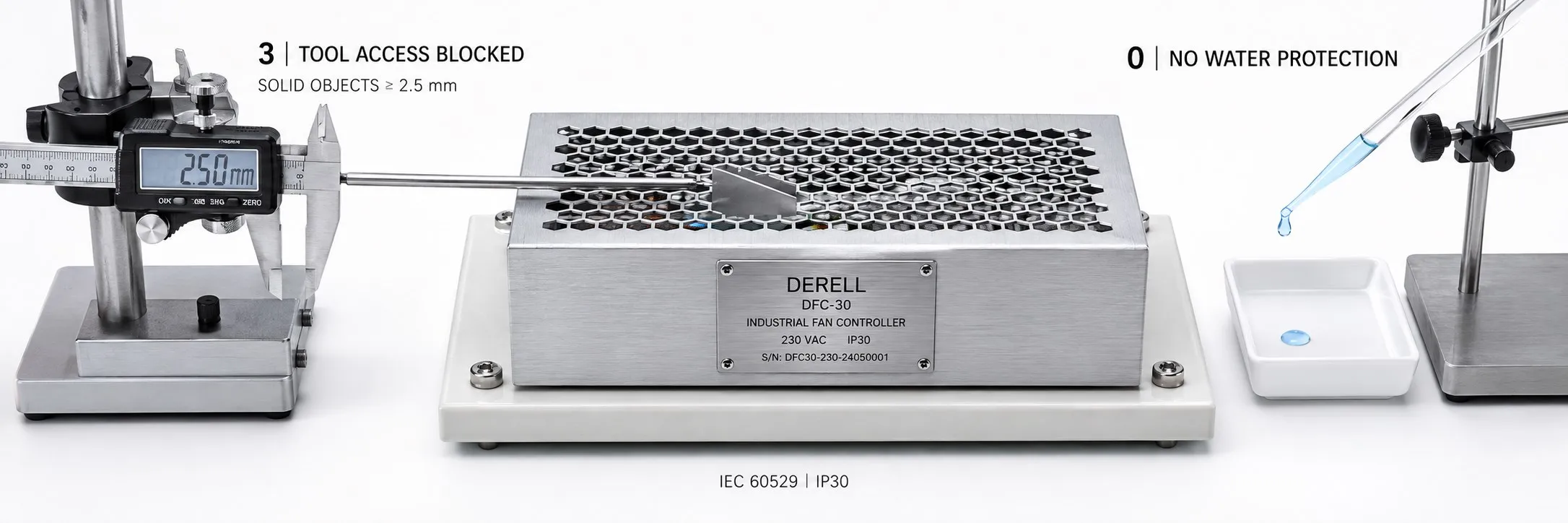
IP30 is an enclosure protection rating used for electrical and electronic equipment. It is not a separate standard by itself; it is one of the protection levels defined within IEC 60529. The first digit describes protection against access to hazardous parts and solid foreign objects, while the second digit describes protection against water.
In simple terms… IP30 means that the enclosure provides protection against solid foreign objects approximately 2.5 mm and larger, while no water protection is specified. It can help prevent tools and relatively thick wires from reaching hazardous parts, but it does not provide a defined protection level against fine dust, rain, dripping water or splashing.
What does the first 3 in IP30 mean?
The first digit, 3, represents protection against solid foreign objects in the 2.5 mm class. Under the applicable test conditions, the specified test probe must not gain access to hazardous parts inside the enclosure.
In practical industrial terms, this level helps restrict access by objects such as certain tools, thick wires and similar foreign objects. The first digit also relates to protection against access to hazardous parts with a tool, not simply whether an object can physically fit through an opening.
IP30 should not be described as dust-protected. Fine dust particles are far smaller than 2.5 mm, and the IP3X level does not define how much fine dust may enter the enclosure. Defined dust protection begins at IP5X, while IP6X represents the dust-tight level.
What does the second 0 in IP30 mean?
The second digit, 0, means that no protection against water is specified by the IP30 classification.
An IP30 enclosure therefore should not be described as rain-resistant, splash-resistant or waterproof based on its IP rating. The solid-object protection represented by the first digit does not provide any corresponding water protection.
IP30 = protection against solid foreign objects in the 2.5 mm class + no specified water protection.
Is IP30 dustproof?
No. IP30 does not have a defined fine-dust protection level. It limits the entry of larger foreign objects, but fine airborne particles may still enter depending on the enclosure construction.
For this reason, saying that IP30 is “not completely dustproof” can be misleading because it may suggest that some standardized dust protection has been tested. A more accurate statement is that IP30 does not specify a dust-protection level.
Where dust is an important environmental concern, an enclosure such as IP50 provides a defined dust-protected classification. More severe dusty environments may require an IP6X dust-tight enclosure.
Is IP30 waterproof?
No. Because the second digit is 0, the IP30 rating does not contain a standardized claim for protection against water.
This does not mean that every IP30 product will immediately fail if a drop of water touches it. It means that the IP30 classification itself provides no verified water-protection level. Any additional resistance to moisture or liquids would have to come from separate manufacturer specifications.
What is the difference between IP20 and IP30?
IP20 and IP30 both end in 0, which means neither rating specifies protection against water.
The difference is the first digit. IP20 uses first digit 2 and provides protection associated with 12.5 mm solid foreign objects and finger access. IP30 uses first digit 3 and reduces the relevant object size to approximately 2.5 mm, providing protection against access with smaller tools and similar objects.
IP20 = protection associated with finger-size access + no water protection.
IP30 = protection associated with 2.5 mm tools and foreign objects + no water protection.
What is the difference between IP30 and IP40?
IP30 and IP40 also share the same water digit of 0.
The difference is the solid-object protection. IP30 addresses objects approximately 2.5 mm and larger, while IP40 addresses objects approximately 1 mm and larger. IP40 therefore provides greater protection against smaller wires and foreign objects.
Neither IP30 nor IP40 is classified as dust-protected, and neither provides a water-protection claim.
What is the difference between IP30 and IP50?
The transition from IP30 to IP50 is significant because first digit 5 introduces a defined dust-protection level.
IP30 restricts foreign objects in the 2.5 mm class. IP50 is dust-protected: limited dust ingress may be permitted, but it must not occur in a quantity or location that interferes with satisfactory operation or safety.
Both IP30 and IP50 end in 0, so neither provides a standardized water-protection claim.
IP30 = 2.5 mm-class solid-object protection + no water protection.
IP50 = dust-protected + no water protection.
What is the difference between IP30 and IP54?
IP30 and IP54 address substantially different environmental conditions.
IP30 provides protection against solid foreign objects in the 2.5 mm class but has no defined dust protection. IP54 has a first digit of 5 and is therefore dust-protected.
On the water side, IP30 has no specified protection, while IP54 provides protection against splashing water from any direction.
An environment containing fine process dust and occasional water splashing therefore requires very different enclosure protection from a clean, dry room where IP30 may be considered.
Is IP30 suitable for outdoor use?
An IP30 marking alone does not establish suitability for outdoor use. Because the second digit is 0, the rating provides no standardized protection against rain or other water exposure.
Outdoor installations can also expose equipment to ultraviolet radiation, high and low temperatures, condensation, freezing, salt atmosphere, corrosion and chemicals. These conditions are not described by the two digits of an IP30 rating.
IP30 is therefore generally more relevant to dry, protected indoor installations where small tools or foreign objects must be prevented from reaching hazardous parts.
Where can IP30 be used?
IP30 may be suitable in protected indoor environments where water exposure and severe fine-dust contamination are not expected, but access to hazardous electrical or mechanical parts with small tools must be restricted.
Electrical rooms, internal machine compartments, protected control equipment and some indoor industrial installations can fall into this category.
The enclosure rating should still be selected according to the actual installation. Operating temperature, ventilation, contamination, electrical safety, maintenance practices and manufacturer mounting requirements remain important.
Is IP30 enough for an electrical control panel?
Whether IP30 is sufficient depends on where the panel is installed. In a dry, clean and controlled electrical room, IP30 can be suitable for some applications where the main requirement is restricting access by tools and foreign objects.
If the environment contains fine dust, dripping water, cleaning water, splashing liquids or significant moisture, IP30 may not provide the required environmental protection.
The protection of a completed control panel also depends on more than the empty enclosure. Cable entries, covers, gaskets, pushbuttons, ventilation components and other panel components can affect the final ingress protection.
IP30 and PLC installations
Many PLCs and modules are intended to operate inside a control cabinet rather than directly in an exposed industrial environment. The protection rating of the PLC itself and the protection rating of the surrounding enclosure can therefore be different.
An enclosure arrangement that works well in a clean control room may be unsuitable in a stone-processing plant, woodworking machine or another production area containing large quantities of fine process dust.
The required IP level should always be based on the environment at the actual installation point, not simply on the equipment type.
IP30 and variable frequency drives
IP30 enclosure configurations are encountered on some industrial AC drives and VFDs, particularly equipment intended for protected indoor installation.
Environmental protection is only one part of VFD enclosure design. Drives generate heat, so internal cabinet temperature, power losses, mounting clearances, airflow and manufacturer temperature limits must also be considered.
Increasing enclosure sealing can improve protection against contamination but may reduce natural cooling. The enclosure has to protect the drive without creating a thermal problem.
IP30 and industrial power supplies
Many DIN-rail industrial power supplies are intended to operate inside a protective electrical enclosure. In these installations, much of the environmental protection is provided by the surrounding cabinet rather than the power supply itself.
If fine dust, liquids or foreign objects smaller than the IP30 test level can enter the panel, the limits of IP30 must be taken into account when selecting the complete enclosure.
How should IP30 be interpreted on an HMI?
An industrial HMI panel may have different IP ratings for its front and rear sections. The front bezel exposed to the operator and machine environment can have a higher rating, while the electronics behind the panel may have a lower enclosure rating.
Always check whether the stated IP rating applies to the complete HMI, the front face only or a particular installed configuration. Correct panel cut-out dimensions, gasket installation and mounting method can also affect the protection achieved in service.
Does IP30 protect against condensation?
No. IP30 has a water digit of 0, and internal condensation is also a different phenomenon from external liquid entering an enclosure.
Changes in temperature and relative humidity can cause moisture to condense inside a cabinet even in an apparently dry location. This can occur when equipment cools overnight or when production areas experience large temperature swings.
Where condensation is possible, enclosure heating, thermal management or other humidity-control measures may need to be evaluated separately.
Can IP30 protection change after installation?
Yes. The original enclosure rating does not automatically remain unchanged after modifications.
Large open cable entries, missing covers, unsuitable ventilation openings or incorrectly installed accessories can reduce protection against solid foreign objects and access to hazardous parts.
The completed machine or panel should therefore be considered in its final installed condition, including all openings, accessories and modifications.
What does IP30 not guarantee?
IP30 describes a particular level of enclosure protection against access to hazardous parts and solid foreign objects. It does not provide a defined fine-dust or water-protection level.
The rating also does not specify ultraviolet resistance, corrosion resistance, chemical resistance, mechanical-impact resistance, operating-temperature range or electromagnetic compatibility.
An IP30 marking does not by itself mean that equipment is approved for explosive atmospheres, satisfies every electrical safety requirement or carries a particular product certification. These requirements are addressed separately through the relevant industrial standards and conformity processes.
What should be checked before choosing IP30?
First determine whether water or fine process dust is present. IP30 is mainly intended to restrict access by tools and foreign objects in the 2.5 mm class; it should not be selected as a dust or moisture protection rating.
If protection against smaller foreign objects is required, IP40 may be relevant. If fine dust is a concern, IP50 or a higher dust-protection level should be considered. Where water splashing is present, IP54 or another rating appropriate to the actual water exposure may be needed.
Finally, check the manufacturer's documentation for the exact product model, mounting arrangement and environmental limits. IP30 is a defined enclosure classification, not a general quality or durability score.
IP30 in one sentence
IP30 means protection against solid foreign objects in the 2.5 mm class, with no specified protection against water. It does not provide a defined fine-dust protection level. Compared with IP20 it restricts smaller objects; IP40 extends protection to the 1 mm class; and IP50 introduces a defined dust-protected level.
Related IP protection guides
IP Protection Ratings and IEC 60529 Guide | IP20 | IP40 | IP50 | IP54
Related automation equipment: Panel Components | PLCs and Modules | HMI Panels | AC Drives and VFDs | Power Supplies