
What is an Ethernet address (MAC address)?
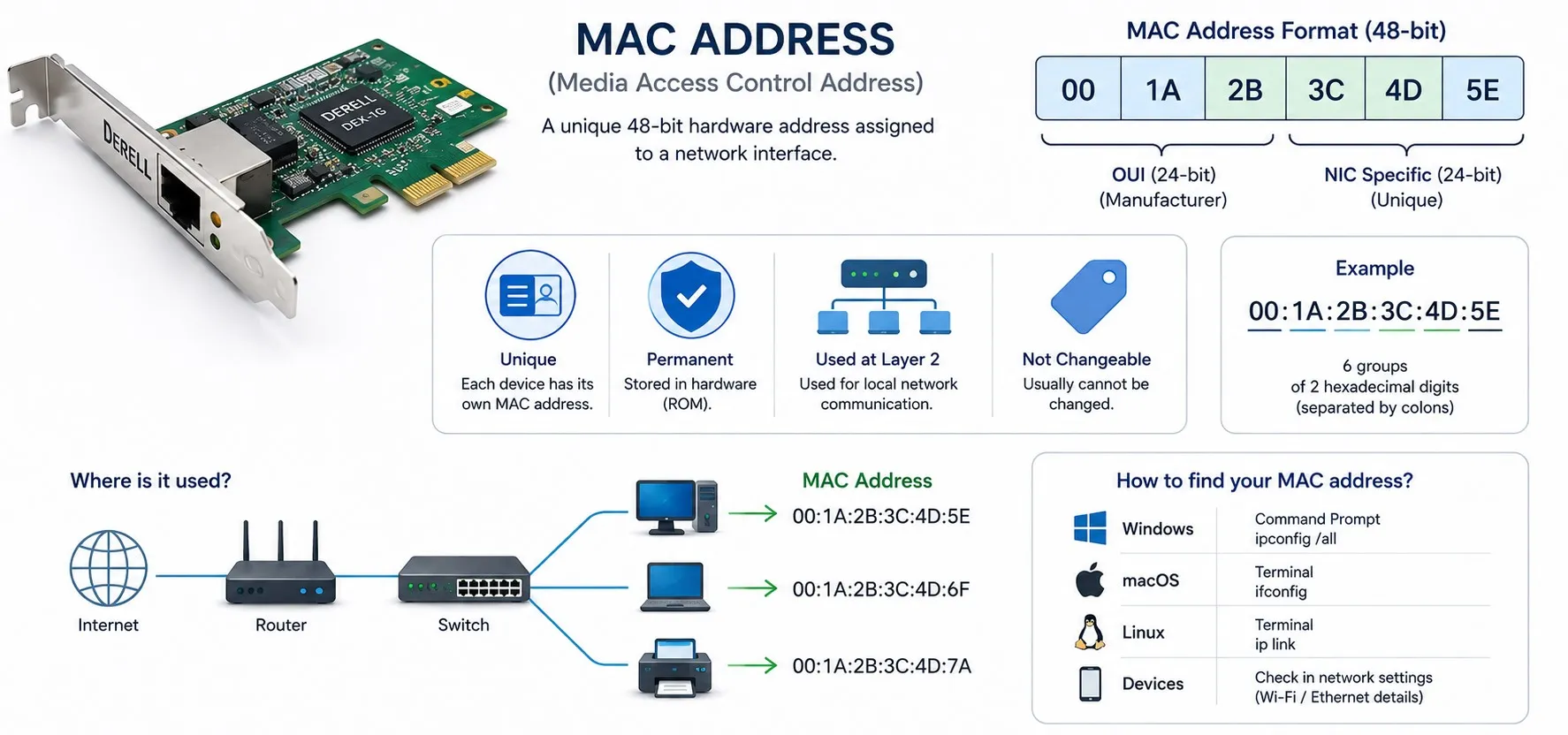
An Ethernet address or MAC address (Media Access Control address) is the Layer-2 address information used by an Ethernet interface when sending and receiving frames. A conventional Ethernet MAC address is 48 bits, or 6 octets, and is commonly written in hexadecimal form such as 00:1A:2B:3C:4D:5E. The IEEE Registration Authority uses the term EUI-48 for universally unique 48-bit identifiers used as MAC addresses. [1]
It is misleading to treat a MAC address as an immutable device serial number. An interface may have a manufacturer-assigned universal address, but locally administered addresses, virtual interfaces, redundancy mechanisms and software-selected MAC addresses also exist. IEEE and IETF documentation explicitly supports both global and local 48-bit MAC address space. [2]
How do you read a MAC address?
| 02 | 1A | 2B | 3C | 4D | 5E |
| 6 octets = 48 bits. Example notation: 02:1A:2B:3C:4D:5E | |||||
| Two special bits in the first octet: the least-significant bit is I/G (Individual/Group), and the next bit is U/L (Universal/Local). | Because the first octet is 02, this is an example of an individual/unicast + locally administered address; “02” should not be treated as a vendor OUI. | ||||
What does a MAC address do?
An Ethernet frame contains both a Destination MAC and a Source MAC. The transmitting interface places its Layer-2 address in the source field and the intended local destination address in the destination field. An Ethernet switch can learn where a source MAC was seen and use destination MAC information when forwarding later frames.
The MAC address is therefore an address for local Layer-2 delivery. An IP address belongs to Layer 3 and is used for logical addressing and routing. The same device can use both, but they do different jobs. See Ethernet frame structure for the field layout and How does Ethernet work? for the complete data path.
What is the difference between a MAC address and an IP address?
| Feature | MAC address | IP address |
|---|---|---|
| Layer | Layer 2 / Data Link | Layer 3 / Network |
| Main job | Local Ethernet frame delivery | Logical addressing and routing between networks |
| Typical format | 48-bit: 00:1A:2B:3C:4D:5E | IPv4 such as 192.168.1.20, or an IPv6 address |
| Used by | NICs, Ethernet switches and Layer-2 functions | IP stacks and routers |
| Can it change? | Yes; local, virtual and software-selected addresses are possible. | Yes; static, DHCP and other assignment methods are common. |
Does ARP “convert” an IP address into a MAC address?
That phrase is common, but a more accurate description is that ARP learns a mapping between a protocol address and a local hardware address for IPv4 communication. RFC 826 defines the Address Resolution Protocol for obtaining a 48-bit Ethernet address corresponding to a protocol address. [3] ARP is not an internal function of Ethernet itself; it is a separate protocol carried over Ethernet.
For example, if an HMI needs to reach a PLC at 192.168.1.50 on the same subnet, it can learn the MAC address for the relevant IPv4 next hop and then send the IP packet inside an Ethernet frame addressed to that MAC. See the Ethernet protocol and Ethernet data transmission for the layer separation.
What is an OUI? Do the first three bytes always identify the manufacturer?
The traditional explanation says that the first 24 bits are an OUI identifying the manufacturer and the remaining 24 bits are assigned by that manufacturer. That model is useful for universally assigned EUI-48 addresses derived from an MA-L/OUI allocation, but it is not a universal rule for every MAC address you will see today.
The IEEE Registration Authority now provides MA-L, MA-M and MA-S address blocks in different sizes. An MA-L includes an OUI and supplies roughly 224 EUI values; MA-M supplies about 220, and MA-S about 212. IEEE also defines an OUI as a globally unique 24-bit organizational identifier. [1]
More importantly, the leading octets of a locally administered address should not be interpreted as a vendor OUI. RFC 9542 explains that when the Local bit is set, the address is not controlled as a global assignment by the owner of the corresponding IEEE prefix. [2] A vendor lookup based only on the first three octets can therefore be wrong.
What do the U/L and I/G bits mean?
Two bits in the first octet of a 48-bit MAC address have special meaning. RFC 9542 describes the M bit for group/multicast addressing and the X bit for universal/local addressing. [2]
| Bit | When 0 | When 1 | Practical meaning |
|---|---|---|---|
| I/G – least-significant bit | Individual / unicast | Group: multicast or broadcast | Does the address select one interface or a group? |
| U/L – second least-significant bit | Universal / global assignment | Local address space | Is the address in globally assigned IEEE space or local/other structured usage? |
For example, an address beginning with 02:xx:xx:xx:xx:xx has the group bit clear and the local bit set, making it a typical locally administered unicast example. FF:FF:FF:FF:FF:FF is the Ethernet broadcast address and targets all relevant receivers in the same broadcast domain.
Unicast, multicast and broadcast MAC addresses
| Type | Purpose | Example | Typical switch behaviour |
|---|---|---|---|
| Unicast | One Layer-2 destination | 00:1A:2B:3C:4D:5E | If the destination is learned, forward to the relevant port. |
| Multicast | A group of receivers | 01:00:5E:… commonly appears in IPv4 multicast mapping | Replicated according to multicast handling and switch configuration. |
| Broadcast | All receivers in the broadcast domain | FF:FF:FF:FF:FF:FF | Normally flooded to the other applicable ports in the same VLAN/broadcast domain. |
IANA publishes reserved unicast and multicast blocks under its 00-00-5E OUI and related IEEE 802 number assignments. [4] These special-purpose group addresses should not be interpreted like ordinary device serial identifiers.
How does a switch learn MAC addresses?
A switch examines the source MAC of incoming Ethernet frames and learns that the address was seen on a particular port. When a later frame has a known destination MAC, the switch can forward it toward the learned port. Unknown-unicast traffic may be flooded to other appropriate ports in the same VLAN. See Ethernet switch vs. hub for the forwarding process.
Do not confuse the switch's MAC table with a host's ARP cache. The MAC table maps Layer-2 addresses to switch ports. An ARP cache maps IPv4 addresses to local hardware/MAC addresses. They exist for different purposes and often on different devices.
Is a MAC address really unique?
Globally assigned EUI-48 addresses are intended to be universally unique, and IEEE RA distributes address blocks for that purpose. [1] But not every MAC address observed on a network is a globally assigned EUI-48. Locally administered addresses, virtualization, containers/VMs, redundancy solutions and software-selected addresses can operate outside that global assignment model.
Two practical consequences follow: a MAC address is not an absolute device identity, and duplicate MAC addresses are possible. If the same unicast MAC appears at two different places in the same Layer-2 network, a switch's learned location can move between ports and communication may become unstable.
What is MAC spoofing?
MAC spoofing means selecting a source MAC value in software, the operating system or device configuration rather than simply using the original manufacturer-assigned value. That technique is not automatically malicious: it can be used for testing, virtualization, failover and special network designs. It can also be abused for impersonation.
That is why a simple “allowed MAC address list” is not strong identity authentication by itself. OT security should combine segmentation, switch-port policy, mechanisms such as 802.1X or MACsec where appropriate, and security at the application-protocol layer. See Ethernet network security.
What is MAC address randomization?
Wireless clients can use changing or randomized MAC addresses to reduce long-term tracking based on a fixed hardware address. IEEE 802.11bh-2024 defines mechanisms intended to preserve services when WLAN stations use randomized or changing MAC addresses. [5] IEEE also explains that software-created alternate MAC addresses can help reduce tracking based on a stable globally unique address. [6]
This behaviour is far more visible in Wi-Fi than in fixed industrial Ethernet ports, where a stable manufacturer-assigned or controlled local address is common. The broader rule remains the same: seeing a MAC address in software does not prove that the value is physically immutable.
Why do MAC addresses matter in PLC, HMI and drive networks?
The MAC address of a PLC, HMI, drive or other industrial Ethernet device can be useful for switch diagnostics, DHCP reservations, ARP inspection, discovery and troubleshooting. If a switch reports the same MAC constantly moving between two ports, investigate bridging loops, duplicate addressing or topology problems.
A MAC address does not tell you which industrial protocol the device supports. Two Ethernet devices from the same vendor may still use different upper-layer protocols. Support for EtherNet/IP, PROFINET or EtherCAT must be verified from the actual device documentation.
Can you identify the manufacturer from a MAC address?
If the address is a globally assigned EUI-48, IEEE Registration Authority public assignment data can identify the owner of the relevant prefix. That still does not prove the final product brand. The NIC may be OEM hardware, the product may be sold under another brand, or the visible address may be virtual or locally administered.
A better workflow is to inspect the Local bit first. Only if the address is in globally assigned space should an IEEE prefix lookup be treated as meaningful vendor-assignment information. IEEE publishes OUI/MA-L, MA-M and MA-S resources through its official MAC address program. [1]
How do you troubleshoot a MAC-address problem in the field?
1. Does the MAC shown by the device match the source MAC learned by the switch?
2. On which port is the switch learning that MAC?
3. Is the same address moving repeatedly between ports?
4. For IPv4, does the ARP cache show the expected IP-to-MAC mapping?
5. Is the address being searched in the correct VLAN?
6. Is virtualization, redundancy or a locally assigned MAC in use?
7. Could MAC filtering or port security be blocking traffic?
8. If Layer 2 is healthy, is the fault actually in IP configuration or the application protocol?
This approach reduces unnecessary hardware replacement when “the MAC is visible but the PLC still does not communicate.” For the physical interface see Ethernet cards / NICs; for the bytes inside the frame see Ethernet frame structure; and for upper protocols see protocols that can operate over Ethernet.
In one paragraph
A MAC address is the 48-bit address used for Layer-2 frame delivery on Ethernet. Globally assigned addresses may be EUI-48 values, but not all MAC addresses are permanent vendor-controlled global identifiers. The group and universal/local bits in the first octet help identify the address type. Unicast selects one destination, multicast a group, and broadcast every relevant receiver in the same broadcast domain. A switch learns MAC addresses from frame sources, while ARP maps IPv4 protocol addresses to local hardware addresses. A MAC address by itself is not an authentication or security mechanism.
Related Ethernet guides
What is Ethernet? • How does Ethernet work? • Ethernet protocol • Ethernet frame structure • Ethernet card / NIC • Switch vs. hub • Ethernet data transmission • Protocols over Ethernet • Ethernet security • Ethernet speeds • Ethernet cable types • Gigabit Ethernet • Industrial communication
Technical sources
- IEEE Registration Authority: EUI-48/EUI-64, MA-L, MA-M, MA-S and OUI definitions. IEEE RA FAQ / IEEE MAC Address program ↩
- RFC 9542: 48-bit MAC identifier structure, group/multicast bit, universal/local bit and global/local address spaces.