
How has Ethernet evolved and what are the future trends?
Hi everyone,
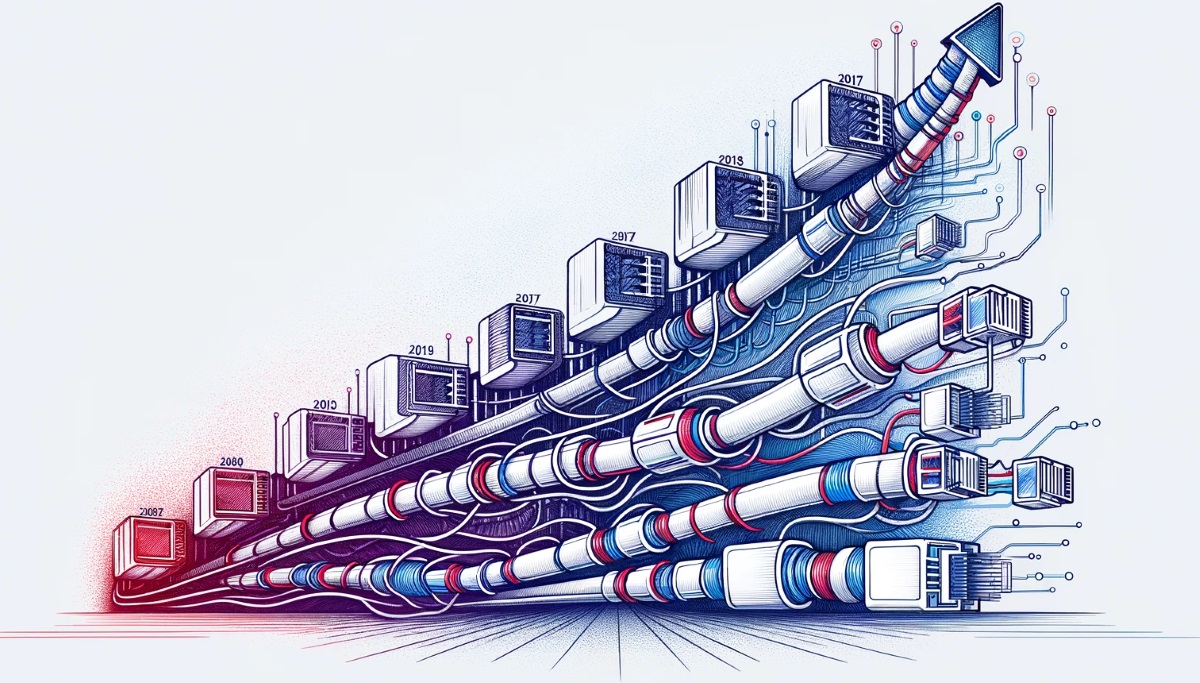
Ethernet, as a technology standard, has seen considerable evolution since its inception in the 1970s. It has adapted to the needs of an increasingly internet-dependent world, offering faster speeds and more reliable internet connections. Here's a brief overview of its evolution and potential future trends:
Evolution of Ethernet:
Initial Development: Ethernet was developed at Xerox PARC between 1973 and 1974. It was initially designed to operate at a peak of 2.94 megabits per second, a groundbreaking speed at the time.
Standardization and Adoption: The standardization of Ethernet in the 1980s (IEEE 802.3) was a significant step forward. This move helped in its wide adoption, making it the predominant network technology.
Speed Improvements: Over the years, Ethernet speed capacities have seen a substantial increase - from 10 Megabits per second (10BASE-T), to Fast Ethernet (100 Mbps), then Gigabit Ethernet (1 Gbps), 10 Gigabit Ethernet (10 Gbps), and more recently to 100 Gbps and even 400 Gbps.
Integration of Advanced Technologies: The integration of full-duplex technology and the development of switching Ethernet and Power over Ethernet (PoE) have significantly expanded the applications and efficiency of Ethernet networks.
Future Trends:
Higher Speeds: As data transmission requirements continue to grow, especially with the rise of data centers, cloud computing, and complex web services, Ethernet is expected to evolve to provide even higher transmission rates (potentially up to terabits per second).
Improved Fiber Optic Technologies: Future Ethernet developments are likely to leverage more advanced fiber optic technologies, which can provide higher bandwidth and longer transmission distances, critical for the backbone of the internet and other long-range communications.
Energy-Efficient Ethernet: With growing concerns about energy consumption, energy-efficient Ethernet (IEEE 802.3az) and other green technologies will become more prevalent, reducing power consumption while maintaining performance.
Integration with AI and IoT: As the Internet of Things (IoT) and artificial intelligence (AI) technologies continue to expand, Ethernet is expected to evolve to meet the specific needs of these domains, offering more reliable, real-time networking capabilities.
Security Enhancements: Given the increasing sophistication of cyber threats, future Ethernet standards will need to emphasize enhanced security features to ensure safe data transmission.
Flexible Ethernet (FlexE): FlexE provides a way to use Ethernet equipment more efficiently by allowing the aggregation of multiple Ethernet links. It's gaining traction for its potential to improve network scalability and efficiency.
In summary, Ethernet has continually evolved to meet the increasing demands of global internet traffic, data transmission, and network communication. Its future developments are expected to focus on speed, efficiency, security, and meeting the specific requirements of emerging technologies.
"Platforms established on an EtherNET foundation have become increasingly popular in many sectors of industry. This technology, which is both practical and offers time/place savings, has evolved and branched out over time and has been embedded in third-party platforms as well. Below, we have tried to answer some of the main questions we received from our valued visitors about EtherNET."
- What is Ethernet?
- How does Ethernet work?
- What is the history of Ethernet?
- What types of Ethernet cables are there?
- What are the differences between Ethernet and Wi-Fi?
- What are the different speeds of Ethernet?
- What is the Ethernet protocol?
- What is an Ethernet card and what does it do?
- What is the difference between an Ethernet switch and a hub?
- What protocols can operate over Ethernet?
- What are the advantages and disadvantages of Ethernet?
- What is Power over Ethernet (PoE)?
- What is the structure of an Ethernet frame?
- What is an Ethernet address (MAC address)?
- How has Ethernet evolved and what are the future trends?
- What is Gigabit Ethernet?
- What security protocols are used in Ethernet networks?
- What is the relationship between Ethernet and TCP/IP?
- How is data transmitted in an Ethernet network?
- What is the maximum length of an Ethernet cable?
+ Back to Automation main page
Your shopping cart is empty!