
Ac motor vs Dc motor?
Hello DC Drive and motor friends,
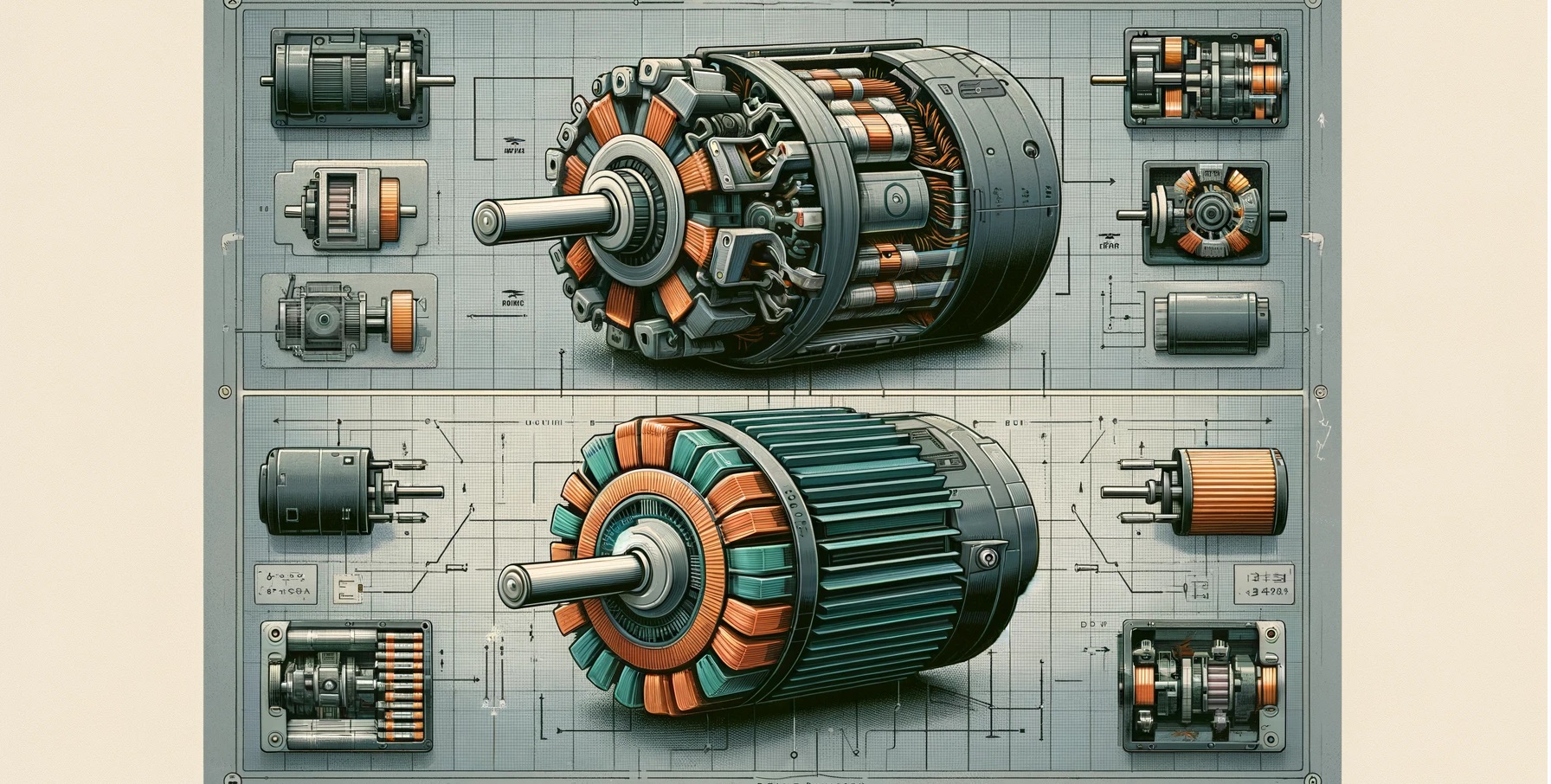
AC (Alternating Current) motors and DC (Direct Current) motors serve similar purposes but have several key differences in operation, construction, efficiency, and applications. Below is a detailed comparison of the two:
Construction
AC Motors
Rotor and Stator: Consist mainly of a rotor and a stator.
No Brushes: Generally, do not use brushes and commutators.
Types: Includes Synchronous and Asynchronous (Induction) motors.
DC Motors
Rotor and Stator: Also have a rotor (armature) and stator but include a commutator and brushes.
Brushes: Uses brushes for commutation.
Types: Includes Brushed DC, Brushless DC, and variants like Series, Shunt, and Compound motors.
Operating Principle
AC Motors
Magnetic Field: Rotating magnetic field generated in stator.
Current Type: Uses alternating current.
DC Motors
Magnetic Field: Created by direct current and commutation.
Current Type: Uses direct current.
Speed Control
AC Motors
Variable Frequency Drives: Typically, speed is controlled by varying the frequency of the AC supply.
DC Motors
Variable Voltage: Speed is more easily controlled by varying voltage.
Torque
AC Motors
Torque Curve: Usually produce less torque at low speeds.
DC Motors
High Starting Torque: Can provide high torque at low speeds.
Efficiency and Maintenance
AC Motors
Efficiency: Generally more efficient and require less maintenance due to the absence of brushes.
DC Motors
Maintenance: Require more frequent maintenance due to brush and commutator wear.
Applications
AC Motors
Industry: More common in industrial applications due to efficiency and lower maintenance.
Home Appliances: Used in fans, blowers, and pumps.
DC Motors
Small Appliances: Common in small appliances and electronics.
Automotive: Used in electric cars and other battery-operated vehicles.
Specialized Tasks: Applications that require high torque at low speeds.
Pros and Cons
AC Motors
Pros: Efficient, low maintenance, simple speed control with VFDs.
Cons: Complex control systems, generally more expensive upfront.
DC Motors
Pros: Easier and more precise control, high starting torque.
Cons: More maintenance, less efficient in some cases.
Conversion and Generators
AC Motors
Inverters: Can be run as generators but require an inverter to produce DC.
DC Motors
Generators: Can be easily reversed to function as a generator producing DC.
Lifespan
AC Motors
Generally longer due to fewer wear components.
DC Motors
Generally shorter due to brush and commutator wear.
Noise
AC Motors
Generally quieter because they don't have brushes and commutators that can cause sparking and noise.
DC Motors
Can be noisier due to the commutation process.
This is not an exhaustive list, but it should give you a comprehensive understanding of the differences between AC and DC motors. Each type has its own advantages and disadvantages, and the best choice depends on the specific application.
"Despite a decline in their industrial use (at least for high-power applications), DC motors are still commonly found. However, they continue to be efficiently used in lower power applications. Below, we have attempted to answer the most frequently asked questions about DC drives by our visitors.
- What are the types of DC motors?
- What is a brushless DC (BDCL) motor?
- What are the advantages of DC motors?
- DC Motors and Efficiency Ratio?
- Can DC motors reach high speeds?
- What is its lifespan of a DC Motor?
- How does it differ from AC motors?
- What is the maintenance for DC motors?
- What is DC Drive?
+ Back to DC Motor Homepage -
These questions often encompass the types of queries that many people might have about DC motors. Every user or student will have their own unique questions or interpretations depending on the specific situation or application. The answers provided are not binding and are not definitive. 'Feel free to share the above article, citing it as a source.' 05.2019
Your shopping cart is empty!