
What is Differential pressure sensor?
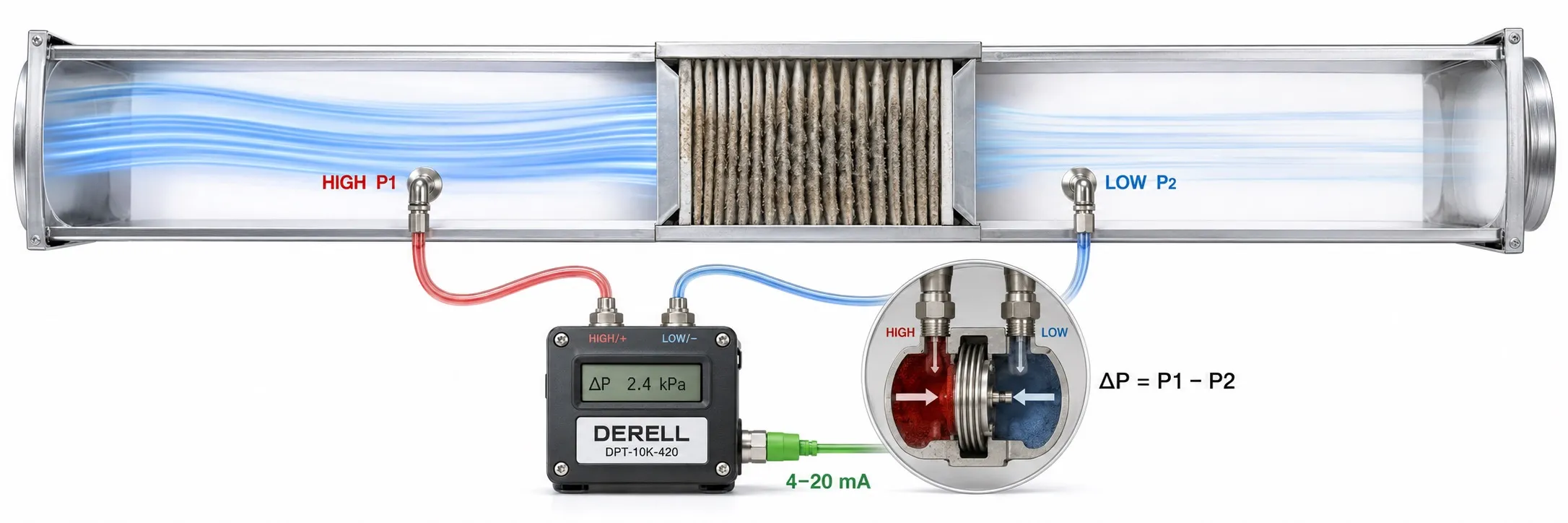
What two pressure points can tell you
A differential pressure sensor compares the pressure at two locations and converts ΔP = P1 - P2 into an electrical measurement. Those locations might be upstream and downstream of a filter, two points in an air duct, or the bottom and top of a tank. The resulting differential pressure supports maintenance decisions, flow measurement or level monitoring, depending on the installation.
A conventional device has two process ports, usually marked P1, H or + and P2, L or -. The reference used by a pressure sensor determines whether it measures absolute, gauge or differential pressure. A DP device does not necessarily report both individual pressures; its primary measurement is their difference.
From diaphragm movement to a usable signal
The pressures act on opposite sides of a sensing element. The relationship between pressure and force explains the net load that deflects the diaphragm. Piezoresistive sensing detects a resistance change; capacitive sensing detects a change in capacitance. Designs using a strain gauge convert mechanical strain into resistance changes. Electronics condition this small signal and provide temperature compensation according to the device design.
A complete transmitter may provide 4-20 mA, 0-10 V or digital communication. A differential pressure switch normally changes its contact state at a threshold. Continuous measurement and threshold detection serve different purposes: a filter alarm switch cannot directly replace the transmitter required by an analog input.
Select Start to cycle through three examples, or Stop / reset to return to the first. The example transmitter maps 0-500 Pa linearly to 4-20 mA. Diaphragm deflection is exaggerated for clarity; this is not a flow or filter-loading simulation. Reduced-motion settings display a static example.
One measurement principle, several applications
Filter monitoring: Pressure is compared before and after the filter. At the same flow rate and similar fluid conditions, a loaded filter usually produces a higher pressure difference. Fan speed, valve position and flow changes also affect the reading. A low DP after the fan stops does not mean the filter is clean. Alarm limits should follow the filter manufacturer's data and the actual operating conditions.
HVAC and clean rooms: Common tasks include air filter monitoring, duct pressure control and maintaining small pressure differences between rooms. Readings are often expressed in Pa or mbar. Keep pressure units consistent: 1 mbar = 100 Pa and 1 bar = 100,000 Pa. A sensor intended for air is not automatically suitable for liquids.
Flow measurement: An orifice plate or Venturi creates a pressure difference that can be converted into flow using the appropriate calculation. With fixed geometry and density, Q is approximately proportional to √ΔP. Under those conditions, four times the DP corresponds to roughly twice the flow. Check whether the transmitter output is linear in differential pressure or already includes square-root extraction for flow. DP is one of several technologies used in flow meters.
Level in a closed tank: The lower connection senses liquid pressure and the upper connection senses the gas pressure above it. With suitable piping and known density, the common gas pressure cancels, leaving the hydrostatic pressure associated with liquid height. The simplified relationship is h = ΔP / (ρg). Density changes, transmitter elevation and any wet reference leg require additional consideration.
Pumps and valves: Comparing pump suction and discharge pressure can show the pressure rise produced by the pump. Across a valve or pipe restriction, the measurement may represent a pressure drop. A pressure difference is not always an energy loss; the locations of the measuring points and the operating state determine its meaning.
A small DP range can sit on a high line pressure
Treat the differential measurement range, permitted static line pressure and one-sided overload limit as separate specifications. If P1 is 10.0 bar and P2 is 9.9 bar, the difference is only 0.1 bar, but the instrument still operates on a line pressure of about 10 bar. A low-range DP sensor is suitable only if its other pressure ratings also cover the installation.
Also check wetted materials, seals, medium compatibility, operating temperature, accuracy, response time, process connections and output type. The relationship between pressure and temperature can affect process conditions; temperature can also influence sensor zero, fluid density and sensing lines. Compare pressure sensors and pressure sensor prices only after confirming that the specifications fit the application.
Installation and commissioning
Reversed P1/P2 connections may produce a negative reading or an out-of-range result; negative DP is measurable only when the device supports it. Blocked sensing lines, leaks, trapped air in liquid lines and condensation in gas lines can all distort readings. Line slopes, drains, vents and manifold arrangements should follow the medium requirements and manufacturer instructions. The pressure measurement guide explains the broader methods.
Check zero by applying equal pressure to both sides, and perform any zero adjustment using the manufacturer's procedure. Confirm that the PLC maps 4 mA to the lower range value and 20 mA to the upper range value. In the illustrated 0-500 Pa example, 200 Pa corresponds to 10.4 mA. If the output represents flow after square-root extraction, this linear DP scaling does not apply.