
What is the unit of pressure?
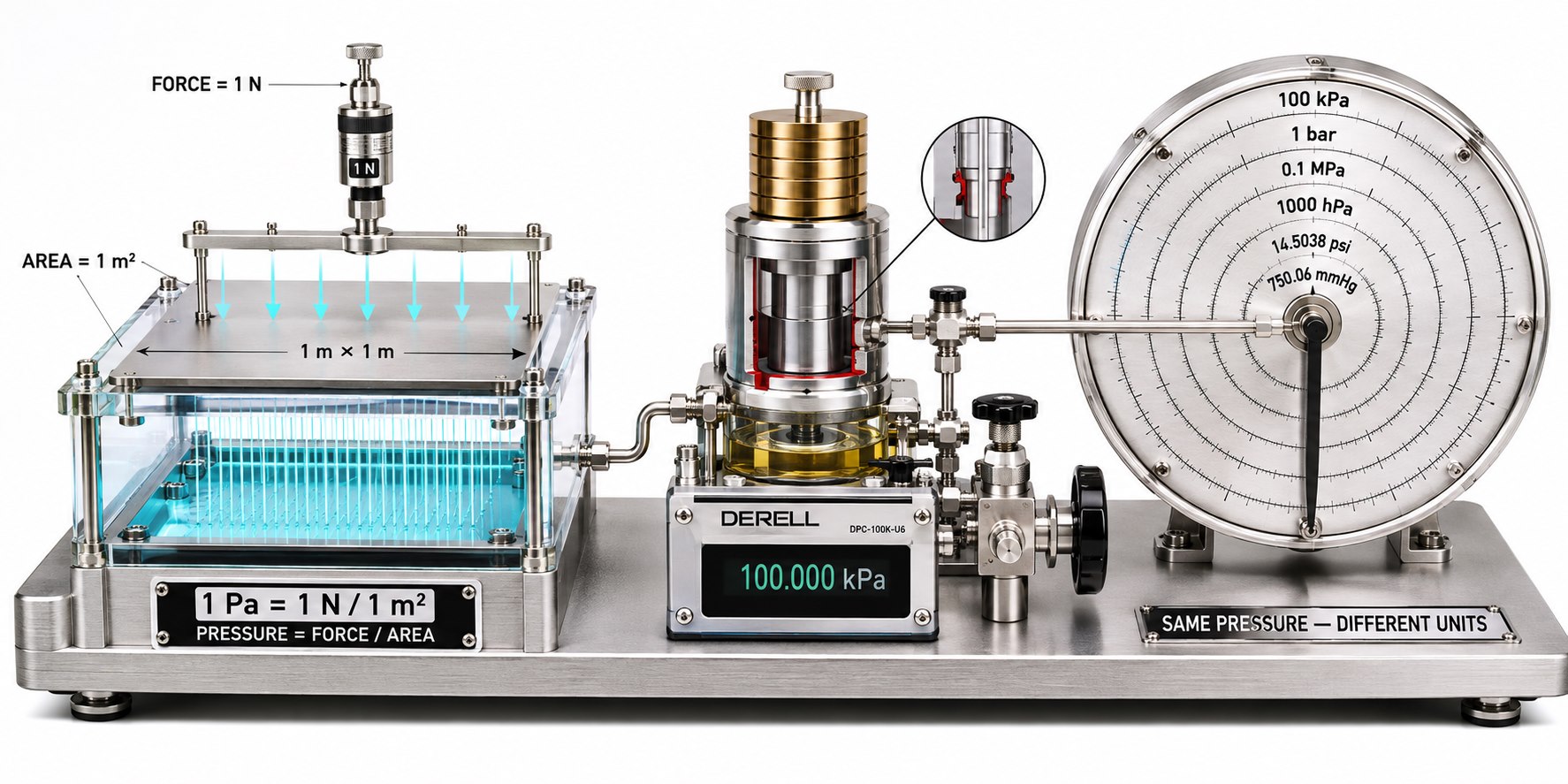
The SI unit of pressure is the pascal (Pa). One pascal is defined as one newton of perpendicular force acting over one square metre:
1 Pa = 1 N/m²
The pascal is a very small unit for most industrial systems, so pressure is commonly expressed in kPa, MPa or bar. Other fields may use psi, hPa, mbar, Torr, mmHg, inHg or metres of water column.
For the physical definition, see what pressure is; for practical instruments, see how pressure is measured.
What is a pascal (Pa)?
The pascal is named after French mathematician and physicist Blaise Pascal and is the SI-derived unit of pressure.
1 Pa = 1 N/m²
Because one pascal is small, engineers usually work with larger multiples:
1 kPa = 1,000 Pa
1 MPa = 1,000 kPa = 1,000,000 Pa
A useful industrial relationship is:
100 kPa = 0.1 MPa = 1 bar
What is bar?
The bar is not an SI unit, but it is extremely common in hydraulics, pneumatics, compressed-air systems, pumps and process equipment.
1 bar = 100,000 Pa = 100 kPa = 0.1 MPa
Therefore:
10 bar = 1 MPa
100 bar = 10 MPa
250 bar = 25 MPa
For industrial hydraulic applications, see hydraulic pressure sensors and transmitters.
Are mbar and hPa the same?
Yes, numerically:
1 mbar = 1 hPa = 100 Pa
This is why an older weather chart showing 1013 mbar and a modern chart showing 1013 hPa represent the same pressure value.
Meteorology now commonly uses hectopascals (hPa).
For the weather and atmospheric side of pressure, see atmospheric pressure and its measurement and barometric pressure.
What is a standard atmosphere (atm)?
The standard atmosphere is a defined reference pressure:
1 atm = 101,325 Pa = 101.325 kPa = 1.01325 bar
It can also be written as:
1 atm = 1013.25 hPa
The actual atmospheric pressure at a location is not always exactly 1 atm because it changes with altitude and weather conditions.
What is psi?
psi means pounds per square inch. It is widely used in the United States and appears frequently on tyres, compressors, hydraulic equipment and imported machinery.
Approximate conversions are:
1 psi ≈ 6.895 kPa ≈ 0.06895 bar
and:
1 bar ≈ 14.504 psi
Examples:
6 bar ≈ 87 psi
10 bar ≈ 145 psi
100 psi ≈ 6.90 bar
For compressed-air applications, see air and compressor pressure measurement.
How do you convert MPa to bar?
The conversion is simple:
1 MPa = 10 bar
So:
0.5 MPa = 5 bar
1 MPa = 10 bar
16 MPa = 160 bar
25 MPa = 250 bar
MPa is particularly common in hydraulic specifications, Asian machinery manuals and high-pressure technical documentation.
What are Torr and mmHg?
mmHg means millimetres of mercury. It is widely known from medical blood-pressure measurement and is also used in vacuum and scientific work.
Approximately:
1 mmHg ≈ 133.322 Pa
The Torr is defined as exactly one seven-hundred-and-sixtieth of a standard atmosphere:
1 Torr = 1/760 atm ≈ 133.322 Pa
For most everyday calculations, 1 Torr and 1 mmHg are practically equivalent, but they are not defined in exactly the same way.
Also:
760 Torr = 1 atm
Torr, mbar and pascal are all common in vacuum engineering.
What is inHg?
inHg means inches of mercury. It appears in aviation, weather reporting and some vacuum applications, particularly in North American documentation.
Approximately:
1 inHg ≈ 3.386 kPa ≈ 33.864 hPa
Standard atmospheric pressure is approximately:
29.92 inHg
What is metres of water column?
Pressure can also be expressed as the equivalent height of a water column.
Common forms include:
mH₂O
mWC
mmH₂O
Approximately:
1 mH₂O ≈ 9.807 kPa ≈ 0.0981 bar
and:
1 bar ≈ 10.2 mH₂O
Water-column units are especially useful in pumps, HVAC systems, fans, level measurement and low-pressure fluid systems.
The relationship comes from:
ΔP = ρ × g × h
For the underlying physics, see hydrostatic pressure.
What is kgf/cm²?
Older machines, hydraulic presses and some Asian equipment may use kgf/cm², sometimes casually written as kg/cm².
The technically correct unit is kilogram-force per square centimetre.
1 kgf/cm² ≈ 98.0665 kPa ≈ 0.9807 bar
Therefore:
1 bar ≈ 1.0197 kgf/cm²
Bar and kgf/cm² are close in value, but they are not identical.
Are gauge, absolute and differential pressure units?
No. These terms describe the reference used for the measurement, not a separate pressure unit.
For example:
5 bar gauge means 5 bar above local atmospheric pressure.
5 bar absolute means 5 bar above absolute vacuum.
Common labels include:
barg → bar gauge
bara → bar absolute
psig → psi gauge
psia → psi absolute
The basic relationship is:
Pabsolute = Pgauge + Patmospheric
For pressure difference between two points, see differential pressure.
Which units are used for vacuum?
Vacuum systems cover a very wide pressure range, so several units are used:
Pa
kPa
mbar
Torr
mmHg
In vacuum work, the pressure reference is often more important than the unit itself.
For example:
-0.8 bar gauge
does not mean that absolute pressure is negative.
If local atmospheric pressure is roughly 1 bar, then:
-0.8 bar gauge ≈ 0.2 bar absolute
Which pressure unit should a sensor use?
There is no single best unit for every pressure sensor. The engineering unit normally follows the machine, process or control system in which the sensor is installed.
For example, approximately the same range may be specified as:
0–10 bar
0–1 MPa
0–145 psi
The numerical range is only part of the specification. The device must also be checked for gauge, absolute or differential reference.
With a 4–20 mA transmitter, the PLC or controller can usually display the same physical pressure in bar, kPa, MPa or psi after scaling.
For these instruments, see pressure indicators and control instruments.
Quick pressure-unit conversions
1 bar = 100 kPa = 0.1 MPa ≈ 14.504 psi
1 MPa = 10 bar ≈ 145.04 psi
1 psi ≈ 6.895 kPa ≈ 0.06895 bar
1 atm = 101.325 kPa = 1.01325 bar = 1013.25 hPa
1 mbar = 1 hPa = 100 Pa
1 mmHg ≈ 133.322 Pa
1 Torr ≈ 133.322 Pa
1 mH₂O ≈ 9.807 kPa ≈ 0.0981 bar
1 kgf/cm² ≈ 0.9807 bar
Pressure conversion examples
How many psi is 6 bar?
6 × 14.504 ≈ 87 psi
How many bar is 2.5 MPa?
2.5 × 10 = 25 bar
How many kPa is 500 mbar?
500 mbar = 500 hPa = 50 kPa
How many bar is 100 psi?
100 × 0.06895 ≈ 6.90 bar
How many MPa is 250 bar?
250 / 10 = 25 MPa
For calculations involving pressure rather than unit conversion alone, see how pressure is calculated and pressure equations.
Where are different pressure units used?
Pa and kPa: SI calculations, laboratory work and lower-pressure applications.
MPa: Hydraulics, high-pressure systems and machinery specifications.
bar: Hydraulics, pneumatics, compressors, pumps and general industrial process work.
psi: US machinery, tyres, compressors and hydraulic equipment.
hPa and mbar: Atmospheric pressure and meteorology.
mmHg: Medical blood pressure and some vacuum applications.
Torr: Vacuum engineering and scientific work.
mH₂O / mWC: Pumps, HVAC, fans, water systems and low-pressure measurement.
Common pressure-unit mistakes
Confusing bar and barg: bar is the unit; gauge describes the reference.
Reading MPa as though it were bar: 1 MPa equals 10 bar, not 1 bar.
Using rough psi conversion: 100 psi is approximately 6.9 bar, not 10 bar.
Treating Torr and mmHg as exactly the same definition: their practical values are almost identical, but their definitions differ slightly.
Assuming negative absolute pressure in a vacuum: negative displayed values normally refer to gauge pressure.
Assuming atmospheric pressure is always exactly 1 bar: real atmospheric pressure changes with altitude and weather.
Pressure units in simple terms
The SI pressure unit is the pascal, but engineering uses several practical units. Bar, MPa and psi dominate many machine and process applications; hPa is common in meteorology; Torr, mmHg and mbar remain useful in vacuum and specialised measurement.
When reading a specification, do not look at the unit alone. The pressure reference must also be known. 5 bar gauge and 5 bar absolute do not describe the same physical condition.
Related pressure topics
Fundamentals and calculations:
What is pressure? |
How is pressure measured? |
Calculating pressure |
Pressure equations |
Pressure and force
Atmosphere and environment:
Atmospheric pressure |
Barometric pressure |
Pressure at altitude |
Pressure and weather
Liquids and gases:
Hydrostatic pressure |
Pressure in gases |
Pressure and temperature |
Pressure and density
Industrial pressure measurement:
Hydraulic pressure sensors |
Air and compressor pressure measurement |
Pressure indicators and controllers |
Pressure measurement topics |
Pressure FAQ |
Pressure sensors and control applications
When converting pressure units for real equipment, also check the manufacturer's pressure reference and technical documentation. Gauge, absolute and differential values cannot be converted into one another by unit conversion alone.
You may share this article with attribution to Otomasyon AVM.