
What is a transformer?
Hello dear friends,
A transformer is an electrical device that transfers electrical energy between two or more circuits through electromagnetic induction. It allows for the changing of voltage levels, making it crucial for power distribution systems.
Here's a detailed overview:
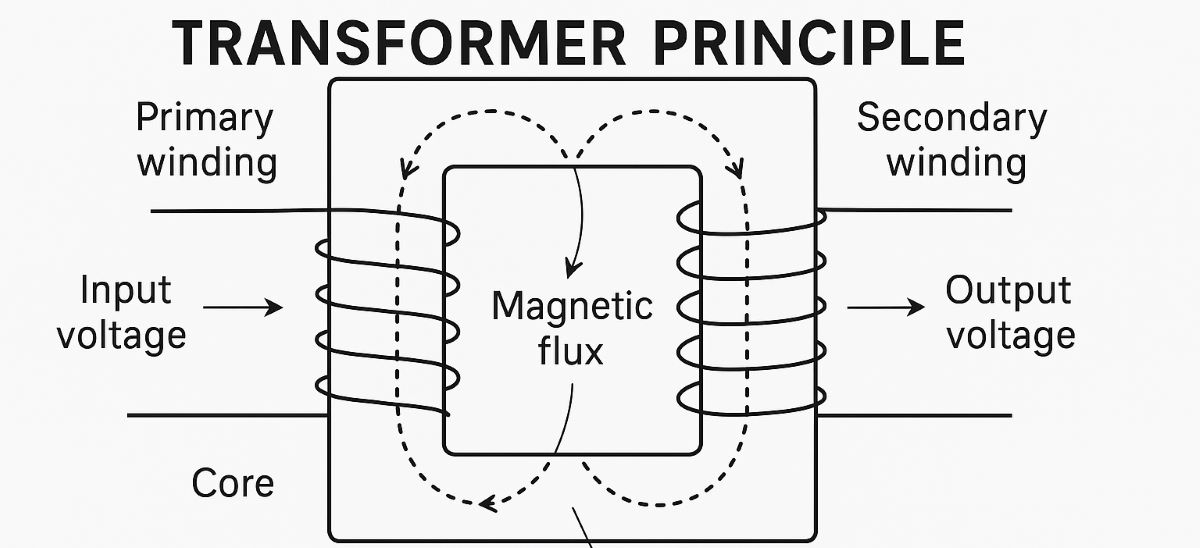
Basic Principle: Transformers work on the principle of electromagnetic induction, which is based on Faraday's law. When an alternating current (AC) flows through a coil (the primary), it generates a changing magnetic field. This magnetic field induces a voltage in a nearby coil (the secondary).
Components: A typical transformer consists of:
Primary and Secondary Windings: Coils of wire wound around the core.
Core: Typically made from iron or ferrite, which helps in the magnetic coupling of the windings.
Types: There are several types of transformers based on their use, construction, and purpose:
Transformers are electromagnetic devices used to transfer energy. There are various types of transformers, designed to meet different application needs and requirements. Here are some basic types of transformers:
Power Transformers
Used to meet large energy needs.
Preferred in large-scale systems like power plants and distribution networks. (more >)
Distribution Transformers
Have lower capacity and are used to distribute energy to end-users.
Used in cities, neighborhoods, buildings, etc. (more >)
Auto-Transformers
A type of transformer where a single winding serves as both the primary and secondary.
More compact and economical but may lack in terms of isolation. (more >)
Isolation Transformers
Provide electrical isolation between the primary and secondary.
Used in special applications like medical devices and sensitive electronic equipment. (more >)
Impedance Transformers
Used in electronic circuits to match different impedance levels. (more >)
Current Transformers
Scale down high current levels to measurable lower current levels.
Used for measurement and protection purposes. (more >)
Frequency Transformers
Facilitate energy transfer between electrical circuits operating at different frequencies. (more >)
Pulse Transformers
Used for the transfer of electrical pulses. (more >)
Audio Transformers
Specially designed for audio frequencies. (more >)
Output Transformers
Used in electronic devices like radios and televisions, generally for audio amplification. (more >)
Step-Up and Step-Down Transformers
Used to increase (Step-Up) or decrease (Step-Down) voltage levels. (more >)
Voltage regulators
Voltage regulators are devices used in electrical circuits to maintain a certain output voltage level. (more >)
Transformers and Tesla
The connection between transformers and Nikola Tesla is historically significant. (more >)
This is just a basic list, and there are many specialized types and variations of transformers to meet different application requirements.
Applications:
Power Distribution: Transformers are vital in increasing (stepping up) or decreasing (stepping down) voltage levels to transmit power efficiently over long distances and then distribute it to homes and businesses.
Electrical Devices: Many electronic devices use transformers to convert the mains voltage to a lower voltage suitable for the device.
Signal Processing: Small transformers can be used in communication devices for impedance matching or isolation.
Advantages:
Efficient Power Transmission: By stepping up the voltage for long-distance transmission and stepping it down for distribution, transformers enable efficient power transmission with minimal losses.
Safety: Provides electrical isolation, which can prevent electrical shocks or short circuits.
Limitations:
Doesn't Work with DC: Transformers require a changing magnetic field, which means they work only with alternating current (AC) and not direct current (DC).
Losses: Although transformers are generally efficient, there are still some energy losses, mainly due to resistance in the windings and hysteresis in the core.
In summary, transformers are fundamental devices in electrical engineering, enabling the safe and efficient transmission and use of electrical energy.
"The topic of transformers and electronic components is broad in scope, encompassing a diverse range of products. Here are the answers to the most common questions posed by our valued visitors."
- Step-Up and Step-Down Transformers
-------------
- What is an integrated circuit?
- What is a crystal oscillator?
- What is an LED (Light Emitting Diode)?
- What is a radio frequency (RF) module?
- What is a ceramic resonator?
+ Back to Main page
"These
questions often include those that many people might have about the
component parts of electronic devices. Each user or student will have
their own specific questions depending on a particular situation or
application. The answers provided are not binding and do not express
absolute certainty. You are free to share the article above, citing it as a source. 04/2020."