
What is a photodiode?
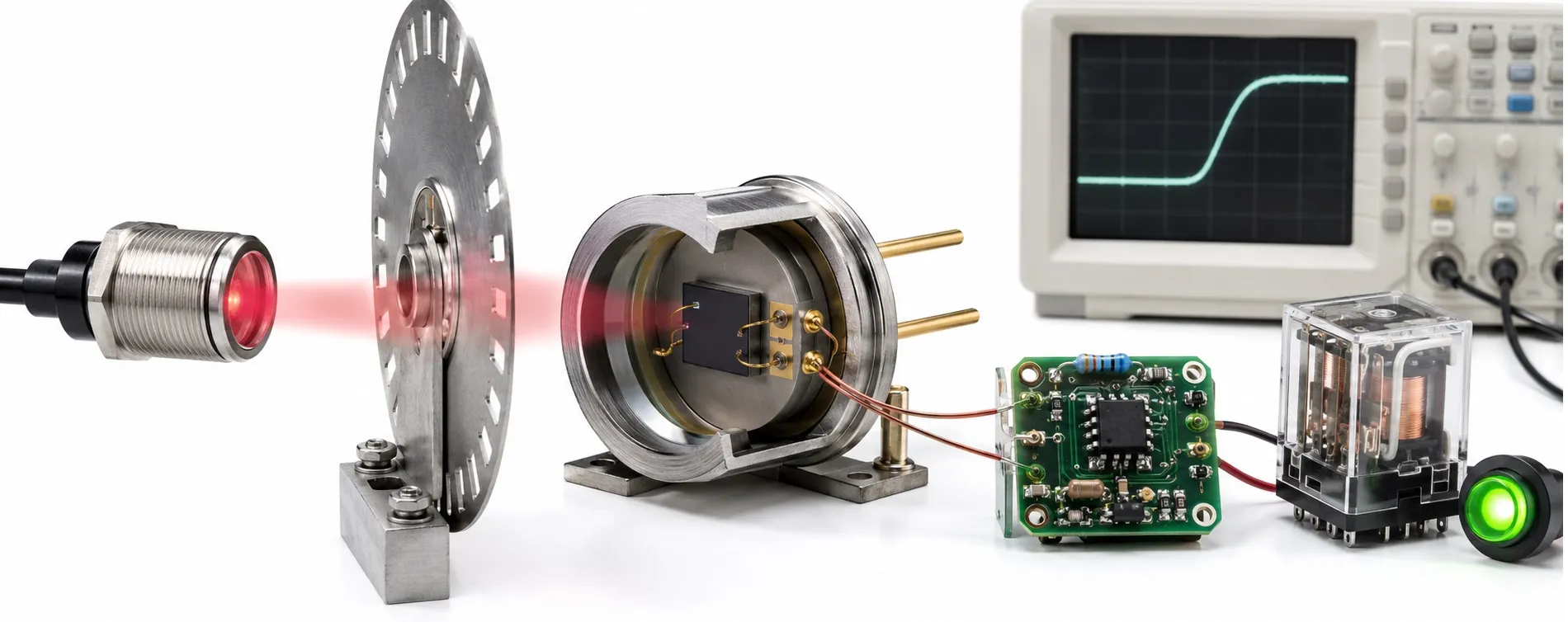
What is a photodiode?
A photodiode is a semiconductor detector that converts incident light into electric current. It uses a light-sensitive diode structure. Within its suitable operating range, the resulting photocurrent is approximately proportional to the optical power reaching its active surface. Photodiodes detect the presence, level or variation of light in systems ranging from optical communications to industrial sensors.
A photodiode detects light; an LED normally produces it. Most applications need an amplifier and signal-processing circuit to make the photodiode’s small signal usable.
How does light become an electrical signal?
A photon absorbed by the semiconductor can create an electron–hole pair if it has sufficient energy. A hole represents a missing electron and behaves as a positive charge carrier. The junction’s electric field helps separate and collect these carriers, producing a measurable current in the external circuit.
Not every incident photon becomes a collected electron. Reflection, absorption depth and carrier recombination affect conversion. The result depends on the detector’s material and structure, as well as the light’s wavelength.
Zero bias and reverse bias
Zero bias — photovoltaic operation: A photodiode can detect light without an externally applied bias voltage. Its built-in junction field remains present, allowing photocurrent generation. This mode can suit precise measurements of low light levels. A detector that needs no bias voltage does not make its readout amplifier power-free.
Reverse bias — photoconductive operation: The cathode is held at a more positive potential than the anode. An appropriate reverse voltage can widen the depletion region and reduce junction capacitance, helping the detector respond faster. However, dark current and its associated noise can increase. Choose the bias using the component’s specified operating limits.
Speed and sensitivity must be considered together. Reverse bias is not the best choice for every measurement, and zero bias is not restricted to slow applications. Performance depends on both the photodiode and its readout circuit.
What does responsivity mean? A worked example
Responsivity specifies how much photocurrent a detector produces per unit of optical power at a particular wavelength. Denote it by S(λ), measured in A/W. For linear operation without internal gain, approximately Iph = S(λ)·Popt, where Popt is the optical power actually reaching the active surface.
Example: At the chosen wavelength, a photodiode has a responsivity of 0.5 A/W and receives 20 µW. Its photocurrent is Iph = 0.5 × 20 µW = 10 µA. Under the same conditions, 40 µW produces approximately 20 µA. Dark current and measurement errors are neglected in this example.
The watt value here is not the lamp’s electrical consumption; it is the optical power arriving at the detector. Also, lux and W/m² are different quantities. Lux includes the human eye’s wavelength-dependent sensitivity, so accurate illuminance measurements require suitable optical filtering and calibration.
How is a small photocurrent measured?
A common solution is a transimpedance amplifier (TIA) built around an operational-amplifier integrated circuit. It converts photocurrent into voltage. With a feedback resistor Rf, the ideal magnitude of the light-induced output change is |ΔVout| = Iph·Rf.
For the 10 µA photocurrent above and Rf = 100 kΩ, the output changes by approximately 1 V. Whether it rises or falls depends on the photodiode orientation and circuit reference. A practical design also accounts for the amplifier’s supply voltage, output range, input bias current and noise.
A suitable capacitor across the feedback resistor can help set stability and bandwidth. The resulting analog signal can be digitised by an ADC and read by a microcontroller. A larger feedback resistor produces a larger signal, but speed, noise and output saturation must also be checked.
Photodiode, phototransistor, LDR and LED compared
| Component | Basic behaviour | Main characteristic |
|---|---|---|
| Photodiode | Produces a light-dependent current. | Fast, linear measurements with a suitable circuit. |
| Phototransistor | Amplifies the light response through transistor gain. | Typically greater output current; speed and linearity may differ. |
| LDR | Its resistance changes with light. | Simple light-level detection; usually a slower response. |
| LED | Emits light when forward current flows. | Normally used as a light source. |
An optocoupler combines an emitter and receiver to provide electrical isolation. Its receiver may use a phototransistor, photodiode or another structure; it is a different component from a standalone photodiode.
Photodiode types and spectral response
A PN photodiode uses a basic junction structure. A PIN photodiode includes a lightly doped region between the P and N regions and can be designed for different speed and capacitance requirements. An avalanche photodiode (APD) creates internal gain using controlled high reverse bias; noise, voltage and temperature behaviour must be considered alongside gain.
Silicon and InGaAs, meanwhile, identify the material. Silicon photodiodes are common for visible and near-infrared detection; InGaAs devices are used at longer near-infrared wavelengths. UV detection also requires an appropriate material and window. A single photodiode does not detect every wavelength from ultraviolet to infrared with equal sensitivity.
Applications in automation and optical systems
Object and position detection: The receiver in a photoelectric sensor can detect a broken beam or light reflected from a target. Optical encoders convert light–dark transitions into position and speed information. Magnetic encoders use a different sensing principle.
Carrying signals with light: In optical communications, a photodiode converts light pulses into electrical signals. In fibre-optic sensors, guiding light and evaluating it with a suitable receiver can simplify detection in confined spaces. For fast applications, the bandwidth of the entire receiver circuit matters, not just the detector.
PLC connection: A bare photodiode’s µA-level current is not the signal expected by a standard 24 V PLC digital input. A suitable amplifier, threshold circuit or analog signal conditioner is required. Complete industrial sensors can provide this conversion through their output electronics; connect them according to their specifications.
Imaging and energy: Photodiodes can form the light-sensitive part of pixels in CMOS image sensors. Solar cells also use photovoltaic conversion, but their main purpose is producing electrical energy rather than measuring light precisely.
Which specifications matter?
Wavelength response and responsivity must match the light source. Active area affects optical alignment; a larger area often brings greater capacitance, creating a trade-off with speed. Consider rise time, junction capacitance and the required bandwidth together.
Dark current is the small leakage current measured under reverse bias without illumination; it depends on temperature and bias. Noise, including the amplifier’s contribution, determines the weak-light detection limit. Check allowable reverse voltage, package window and the linear output range as well. A faster detector or a larger active area does not automatically improve every application.