
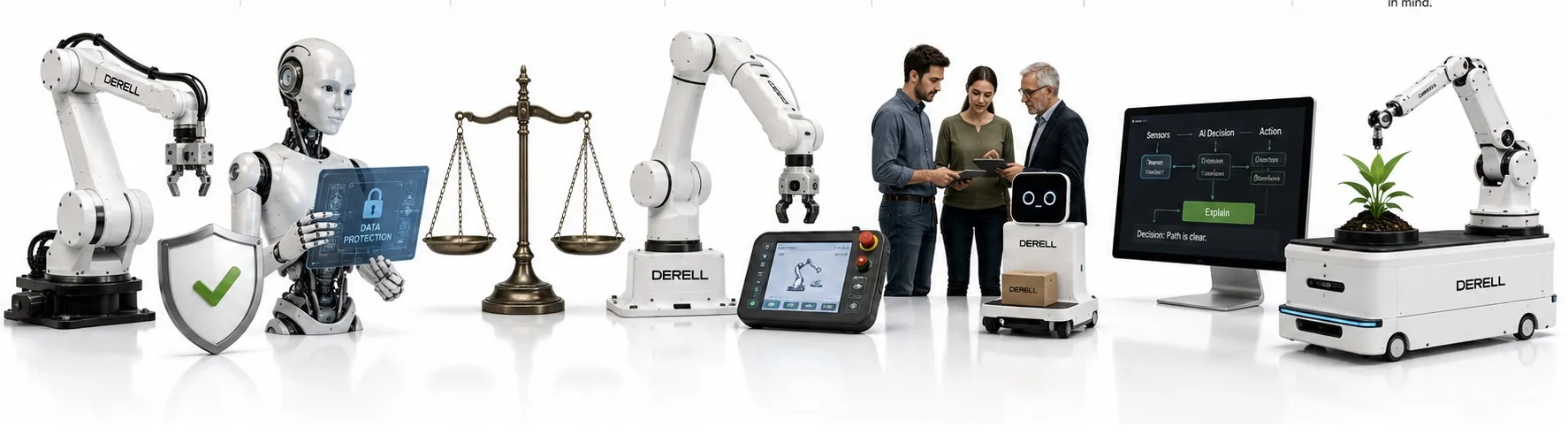
What are the ethical considerations in robotics?
Hello, colleagues,
Robotics ethics considers how a robot affects human safety, privacy, fairness and human dignity, alongside its ability to complete a task. When evaluating robotic systems, an important question is: Who benefits from this technology, who faces its risks, and who takes action when something goes wrong?
Not every robot uses artificial intelligence. Understanding the relationship between AI and robotics and different types of robots helps clarify this point. A recruitment algorithm, for example, is not a physical robot by itself. Basic distinctions, such as the difference between a robot and a machine, help keep ethical discussions focused on the technology involved.
Does greater autonomy remove responsibility?
Autonomy means that a system can select its own actions within defined limits; it does not transfer responsibility to the machine. As with autonomous vehicles, the consequences of design, operation and maintenance decisions need to be considered together. The roles of manufacturers, software developers, operating organizations and users should be clear. Robot programming should define permitted behavior, who receives fault reports, and how problems will be addressed.
Transparency and meaningful human oversight
Transparency involves more than showing everyone the source code. Users should understand what a robot can do, what data it uses, and where it may make mistakes. When explaining how a robot works, decision logs and version records can support later investigation of incidents. “The system decided to do it” is not a sufficient explanation on its own.
Human oversight requires more than someone watching a screen. That person needs enough information to understand the situation, the authority to intervene, and time to act. Operating limits should account for the limitations of robotics technology. Systems should provide ways to question incorrect decisions and, when necessary, intervene safely.
Privacy: Does a robot need to record everything?
Sensors and actuators allow robots to interact with their surroundings. A system with cameras or microphones may also collect images, speech or location information about people while performing its task. The purpose of data collection, access permissions and retention period should be defined in advance. The ability to collect information does not make collecting it necessary. For example, a robot delivering supplies along a corridor may not need to record every conversation to do its job.
Physical safety and cybersecurity belong together
Collisions, trapping hazards, unexpected movement and misuse are part of safety assessments in robotics. If faster operation increases risks to workers, production figures alone are an inadequate measure of success. Maintenance, operator training and reassessment after changes remain important throughout the system's use.
For connected robots, industrial cybersecurity can also have physical consequences. Unauthorized access or altered commands may affect movement. Access control, update management and the robot's behavior when a connection fails should be considered during design. Reliability needs to be assessed during faults as well as normal operation.
Bias, fairness and accessibility
In robots that use machine learning, training data may not adequately represent some users or environments. However, fairness is not only a dataset issue: interfaces, physical design and test conditions also matter. For example, a hypothetical service robot with a screen beyond a wheelchair user's reach presents an accessibility problem. Testing with different user groups should examine who struggles behind an apparently good average success rate.
Workers and the distribution of economic benefits
The impact of robotics on employment and the economy cannot be captured by saying that all jobs will disappear. Some tasks may be automated, some roles may change, and new skills may be needed. In industrial robot applications, retraining, worker participation and transition planning deserve attention from the start. Working conditions should be assessed alongside productivity gains. Using worker data for constant surveillance or unexplained performance scores also deserves scrutiny.
Care, education and human relationships
When evaluating robots in medicine and healthcare, a person's preferences, privacy and access to human support matter. The task supported by the robot should be clearly distinguished from who makes healthcare decisions. Helping someone should not reduce their say in what happens to them.
The appearance of a humanoid robot does not prove that it understands like a person or experiences emotions. Robots used in everyday life also require honest communication: users should know they are interacting with a machine and understand its limits. The role of human relationships and appropriate supervision needs particular consideration for children and people who need care.
Environmental impact extends across the life cycle
Energy consumption, production materials, maintenance, spare parts and waste at the end of use should be considered together. A robot's environmental benefits should be assessed against the impact of another way of doing the same job. This makes repairability and a long service life important. WEEE and electronic waste provide useful background on managing electronic components that are no longer in use. Automation does not automatically make a solution environmentally friendly.
Military use and decisions involving lethal force
A remotely controlled vehicle is different from an autonomous weapon system that selects targets and applies force without human intervention. In the latter case, human control, civilian protection and predictable outcomes are particularly important. The ICRC advocates international limits on autonomous weapon systems because of these risks. Decisions involving life and death require consideration beyond technical performance measures.