
ATEX Zone 20 Combustible Dust Atmospheres
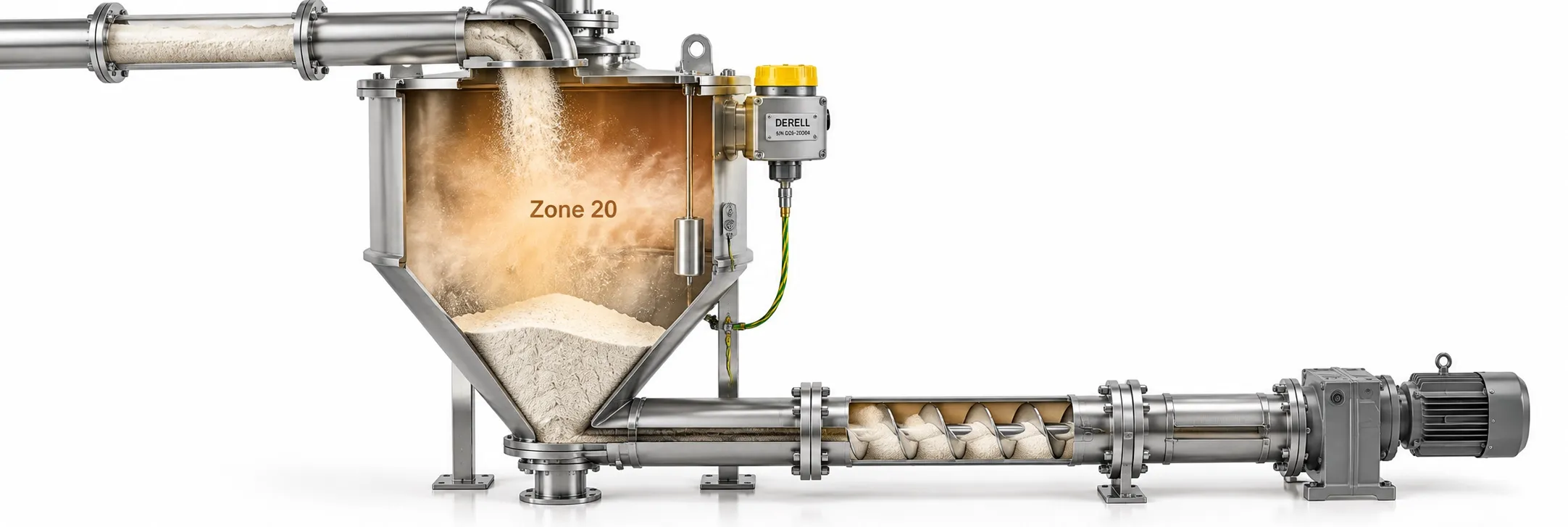
ATEX Zone 20: combustible dust atmospheres and equipment selection
Zone 20 identifies an area where an explosive atmosphere formed by combustible dust suspended in air occurs continuously, for extended periods or frequently. It is an area classification, rather than a measure of dust quantity or explosion severity. ATEX zone classification considers how often the cloud occurs and how long it remains.
Flour, sugar, wood and certain metal dusts can form explosive mixtures under suitable conditions. Dusts do not all behave alike. Particle size, moisture and material properties matter; use the necessary test data for the actual process dust.
How Zone 20 differs from Zones 21 and 22
| Dust zone | Presence of an explosive dust cloud | General equipment selection* |
|---|---|---|
| Zone 20 | Continuous, prolonged or frequent | 1D / Da |
| Zone 21 | Expected occasionally during normal operation | 1D or 2D / Da or Db |
| Zone 22 | Not expected during normal operation; brief if it occurs | 1D, 2D or 3D / Da, Db or Dc |
*Categories and EPLs belong to different classification systems; the table summarises their usual selection relationship. Certificate scope, dust group, temperature and conditions of use must also match the application. Read ATEX equipment categories alongside equipment protection levels (EPLs).
Where might Zone 20 occur?
Depending on the process, the dirty side of filters, parts of silo interiors and the inside of dust conveying equipment may be Zone 20. An entire silo or its surrounding room is not automatically Zone 20. Assess internal volumes, filling points and external areas separately. IEC 60079-10-2 addresses dust area classification; its 2026 edition has been published.
Zone 0, Zone 1 and Zone 2 apply to gas, vapour and mist atmospheres. Hybrid mixtures containing gas and dust require additional assessment; gas area classification does not replace the dust assessment.
What do 1D and Da mean for Zone 20?
In non-mining ATEX applications, II 1D identifies Group II, Category 1 equipment for dust. The general selection approach for Zone 20 is Category 1D and, in the IEC system, EPL Da. A device marked only 2D / Db or 3D / Dc is not suitable for Zone 20 on the strength of those markings.
ATEX and IECEx are different conformity systems. The EU product framework relates to 2014/34/EU, and the workplace framework to 1999/92/EC. 94/9/EC is the former product directive. Product conformity must be considered alongside the installation's explosion protection assessment and area classification.
Dust group, protection method and IP rating
In the IEC system, IIIA covers combustible flyings, IIIB non-conductive dust and IIIC conductive dust. These subdivisions differ from ATEX Group II. A IIIB marking alone does not establish suitability for conductive dust.
Ex t dust ignition protection by enclosure relies on enclosure protection and surface temperature limitation; Ex ta is its form intended for EPL Da. Appropriately certified intrinsic safety systems may also be an option; verify electrical compatibility of the complete system. A protection method's name alone is insufficient.
IP65 or IP67 alone does not establish ATEX conformity. An IP rating describes ingress protection. An Ex d gas protection marking likewise does not independently establish dust suitability. Consider IEC 60079-0 general requirements and the complete product Ex marking.
Why surface temperature and dust layers matter
Dust equipment may carry a maximum surface temperature stated in °C. Selection depends on cloud and layer ignition temperatures and the actual layer thickness. Thick deposits can impair cooling and ignite at lower temperatures. T1–T6 gas temperature classes alone should not be used to select dust equipment.
Editor's note — a filter example: A level sensor's probe may extend into Zone 20 while its connection head is in another zone. Check how the certificate defines the probe, head and installation boundary. The phrase “ATEX sensor” does not mean every part can be installed in every zone.
Installation, cleaning and maintenance
During Ex installation design and erection, check cable entries, seals, mounting and ambient temperature. Assess earthing and bonding for electrostatic hazards; these measures do not remove every ignition source. Friction, hot bearings and mechanical sparks also matter.
Controlling dust deposits is part of the area assessment. Cleaning that disperses dust with compressed air can create a hazardous cloud. Select suitable cleaning methods and equipment, and retain inspection and maintenance records. Required explosion venting, suppression and isolation measures follow from process assessment. A Zone 20 designation does not establish explosion protection for the whole installation.
Related topics: ATEX zones · Zone 21 · Zone 22 · EPL · Ex t