
What are the ATEX classifications?
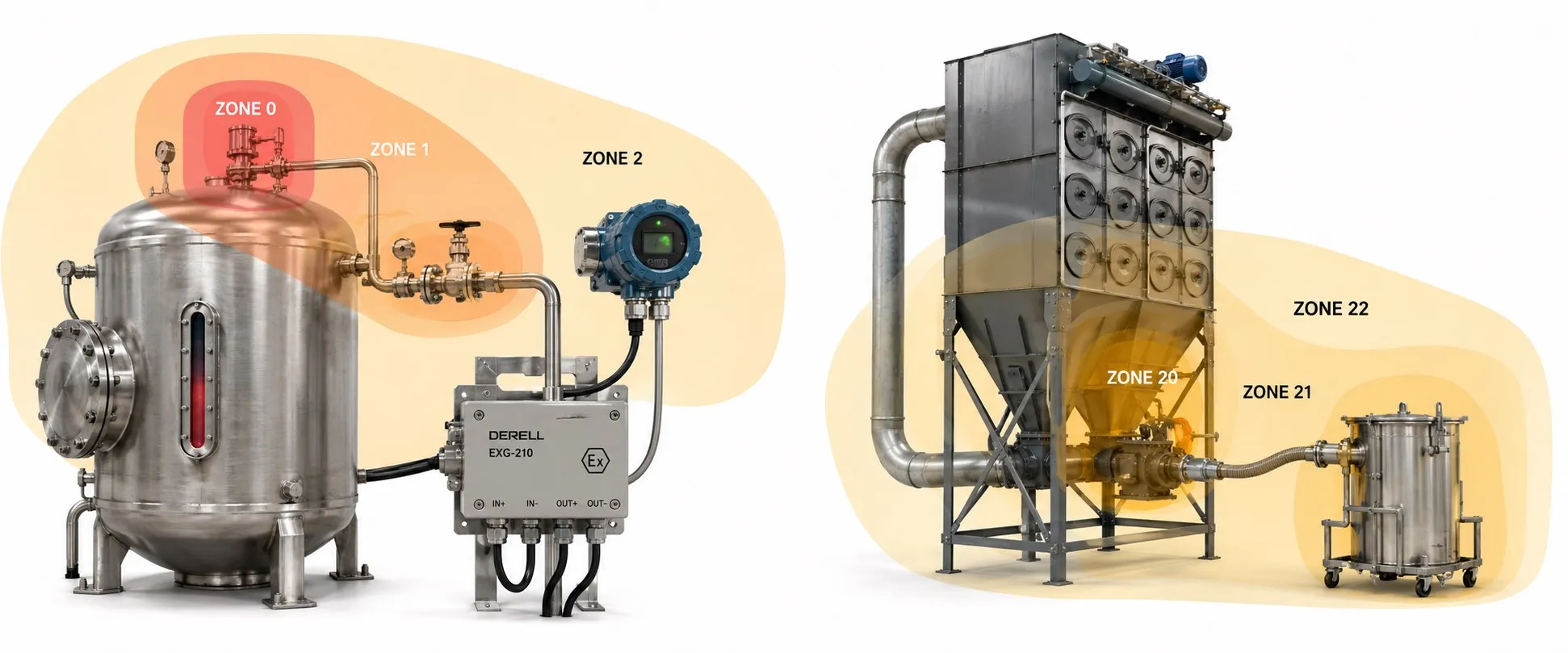
Zones describe the atmosphere; categories describe equipment
An ATEX zone describes how often an explosive atmosphere may be present and how long it may persist. An equipment category and an EPL describe the equipment's protection level. Consequently, a zone, a category and a temperature class are different concepts. Equipment selection within the ATEX framework requires these details to be assessed together.
Gas, vapour and mist use Zones 0, 1 and 2; airborne combustible dust clouds use Zones 20, 21 and 22. A zone number does not indicate explosion size or equipment quality. Zone 1 means that an atmosphere is expected to arise occasionally during normal operation. An atmosphere that is not expected in normal operation and remains briefly if it occurs corresponds to Zone 2.
Editor's note: “Suitable for Zone 1” is not enough information to select equipment. Gas suitability does not establish dust suitability. The G/D designation, gas or dust subgroup, temperature limit, ambient-temperature range and specific conditions of use must also match the application.
Category and EPL mapping for all six zones
The following table shows the general selection framework for non-mining ATEX Group II applications. G denotes gas and D denotes dust. Ga/Gb/Gc are gas equipment protection levels; Da/Db/Dc are dust equipment protection levels.
| Atmosphere | Zone | Explosive-atmosphere occurrence | Suitable categories | Suitable EPLs |
|---|---|---|---|---|
| Gas / vapour / mist | Zone 0 | Present for extended periods, repeatedly or without interruption. | 1G | Ga |
| Gas / vapour / mist | Zone 1 | Expected to arise occasionally during ordinary operation. | 1G, 2G | Ga, Gb |
| Gas / vapour / mist | Zone 2 | Not expected in ordinary operation; if present, remains briefly. | 1G, 2G, 3G | Ga, Gb, Gc |
| Combustible dust cloud | Zone 20 | Present for extended periods, repeatedly or without interruption. | 1D | Da |
| Combustible dust cloud | Zone 21 | Expected to arise occasionally during ordinary operation. | 1D, 2D | Da, Db |
| Combustible dust cloud | Zone 22 | Not expected in ordinary operation; if present, remains briefly. | 1D, 2D, 3D | Da, Db, Dc |
The higher protection levels shown can also serve lower-risk zones, provided that the atmosphere type and every other condition of use are satisfied. For example, 2G/Gb equipment can be considered for Zones 1 and 2, but is insufficient for Zone 0. Likewise, 2D/Db equipment can be considered for Zones 21 and 22; this does not establish gas suitability. The risk assessment may require a higher protection level.
Distinguish Group I from Group II
ATEX Group I covers relevant mining applications exposed to firedamp and/or combustible dust hazards, using categories M1 and M2. ATEX Group II covers explosive-atmosphere applications outside that mining scope and has categories 1, 2 and 3. These represent very high, high and normal levels of protection, respectively. Describing Group II as having only two categories is incomplete.
The II in an ATEX equipment-group designation is also distinct from the technical gas subgroups IIA, IIB and IIC. Dust markings may include IIIA, IIIB or IIIC. Read each code within its relevant classification framework.
How is the zone boundary established?
Area classification considers the source of release, material properties, process conditions and the effectiveness and availability of ventilation. A zone is a three-dimensional volume, rather than just a line on the floor. IEC 60079-10-1 provides the relevant technical framework for gas atmospheres; IEC 60079-10-2 addresses dust atmospheres. One universal distance or hourly threshold cannot classify every installation.
For example, a solvent tank's interior, a filling point and the general working area may have different conditions. In a dust-handling plant, a filter interior, a transfer point and the surrounding area also require separate assessment. Dust layers are more than a housekeeping issue: they may become airborne combustible clouds or interfere with equipment cooling. An absence of visible airborne dust at a particular moment does not establish an absence of hazards.
Temperature class is not ambient temperature
The T1–T6 temperature classes limit equipment's maximum surface temperature in gas applications under its specified assessment conditions. The operating and fault conditions considered depend on the equipment protection level and applicable requirements.
| Gas temperature class | Maximum equipment surface temperature |
|---|---|
| T1 | 450 °C |
| T2 | 300 °C |
| T3 | 200 °C |
| T4 | 135 °C |
| T5 | 100 °C |
| T6 | 85 °C |
T4 limits maximum surface temperature to 135 °C; it does not authorize operation in an ambient temperature of 135 °C. The ambient-temperature limit must be checked separately. Dust equipment commonly states surface temperature directly, for example T135 °C; suitability also depends on the ignition characteristics of the dust cloud and dust layer.
What do protection methods and documents establish?
Ex d means flameproof enclosure protection, not fire-insulated cabling. Ex e is increased safety, while Ex i is intrinsic safety. Read the protection type, EPL and specific conditions together. A high IP protection rating alone does not establish Ex conformity.
Compare the product model, marking, declaration of conformity, instructions and relevant certificate where required. ATEX products do not all follow the same third-party certification route. An IECEx certificate is not automatically equivalent to completion of ATEX procedures. An X certificate suffix indicates specific conditions of use; U identifies an Ex component requiring further assessment within the final equipment.
Maintain the classification in service
Correct equipment selection must be accompanied by suitable Ex installation and erection. Incorrect cable entries, wiring contrary to instructions or modified enclosures may compromise protection. Ex inspection and maintenance help maintain the suitability of electrical installations in service. Inspection intervals depend on site conditions; the same interval should not be imposed on every installation. Changes to the process, ventilation or substances used require review of the area classification and explosion protection document.
Related topics
ATEX legislation, The IECEx system, Gas-area classification, Dust-area classification.
Temperature classes, Ex d protection, Ex i protection, Inspection and maintenance.
Sources
HSE: gas and dust zones and equipment-group definitions
HSE: hazardous-area classification and ignition sources
European Commission JRC: preventing ignition sources and site inspection
EU-OSHA: Directive 1999/92/EC and employer responsibilities
IEC 60079-10-1:2020: classification of explosive gas areas
IEC 60079-10-2:2026: explosive dust areas and dust-layer assessment
IEC 60079-17:2023: Ex electrical installation inspection and maintenance
IECEx technical presentation: Ex protection methods and markings
European Commission: ATEX application guidelines, January 2026, sixth edition