
What are the advantages and disadvantages of Ethernet?
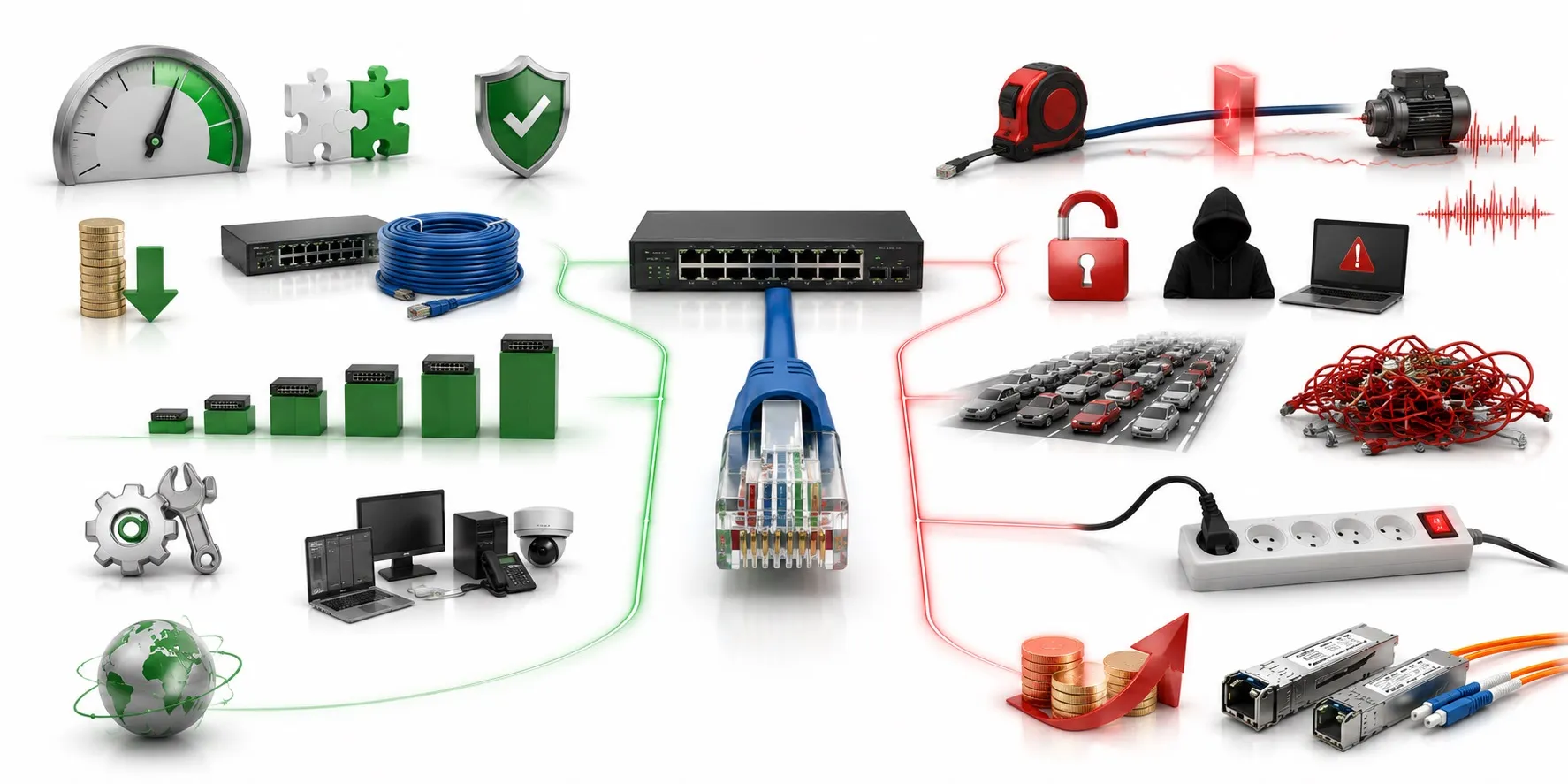
Ethernet's greatest strength is not one headline feature; it is the size and maturity of the ecosystem built around it. The same standards family can support a small PLC–HMI link, plant SCADA, cameras and data loggers, while also scaling into enterprise and data-center networks. Its limitations appear when distance, deterministic timing, cybersecurity or network-management complexity become important.[1]
Two common corrections: Wi‑Fi is not “wireless Ethernet”; it belongs to the IEEE 802.11 family, while Ethernet is IEEE 802.3. Also, Ethernet standardization does not guarantee that any two RJ45 devices understand the same application protocol. Physical/MAC compatibility and application interoperability are separate questions.
1. Advantage: an exceptionally broad, long-lived standards ecosystem
Ethernet has been developed for decades as an open IEEE standards family, so network interfaces, switches, cabling, fiber modules, diagnostic tools and software support are widely available. The history of Ethernet shows how the same family evolved from early 10 Mbit/s systems to Gigabit Ethernet and much higher speeds.[2]
But a shared physical standard does not guarantee application-level interoperability. Two endpoints can establish a 1000BASE-T link and still fail to exchange useful data if they implement different higher-layer protocols. The protocols operating over Ethernet therefore matter just as much as the connector.
2. Advantage: a very wide range of link speeds
Ethernet can serve low-cost plant devices and high-bandwidth infrastructure within the same standards family. A field device may only need 100 Mbit/s, while an uplink may use 1 Gbit/s or much more. The important distinction is that Ethernet link speed is not the same as useful application throughput; frame overhead, upper-layer protocols and congestion reduce the payload rate.
This scalability makes Ethernet attractive for IIoT and edge computing, where small gateways and high-bandwidth servers can live in the same architectural family.
3. Advantage: copper and fiber allow different physical designs
Ethernet media include twisted-pair copper, fiber and several specialized physical layers. Copper is inexpensive and easy to terminate; fiber can provide longer reach, high bandwidth and electrical isolation. The correct engineering question is therefore not “Which Ethernet cable?” but “Which PHY and medium fit this environment?”
In industrial plants, that flexibility matters because a drive cabinet and an office corridor do not have the same EMC conditions. Fiber can be chosen not only for distance but also for electrical isolation and noise immunity.
4. Advantage: modern switched full-duplex Ethernet eliminates the classic collision problem
CSMA/CD and collisions mattered in old shared, half-duplex hub networks. With modern Ethernet switches and full-duplex links, classic collision behavior is not the normal operating model. Cisco explicitly notes that collisions should not occur on full-duplex interfaces.[3]
That does not make latency disappear. Queueing, oversubscription, multicast/broadcast load and upper-layer protocol behavior can still create delay.
5. Advantage: many industrial and IT protocols can share the Ethernet foundation
Ethernet defines the lower communication foundation rather than the meaning of application data. That is useful because IP/TCP/UDP, OPC UA, Modbus TCP, EtherNet/IP, PROFINET and vendor protocols can all use Ethernet infrastructure. PLCs, HMIs, sensors, data acquisition and supervisory systems can therefore share a common physical technology.
The limitation is hidden in the same advantage: a common cable does not mean a common protocol. Device support still has to be checked at model and profile level.
6. Advantage: PoE can combine data and power
Power over Ethernet (PoE) can deliver communication and power over the same copper connection to compatible endpoints. Cameras, access points and selected edge devices can therefore need less field wiring. This can simplify remote data collection and distributed monitoring.
PoE is not universal, and it is not intended to power high-energy machine loads. PSE/PD class, cable conditions and power budget still have to be checked.
7. Advantage: diagnostic and management tools are mature
Link state, negotiated speed/duplex, MAC tables, port counters, VLANs, SNMP, packet capture and managed-switch diagnostics give engineers many ways to observe a network. Understanding the Ethernet frame and MAC addressing helps separate “link is up” from “application data is working.”
Within OtomasyonAVM, that path can continue from the network into the actual PLC device, HMI, SCADA and protocol pages rather than stopping at generic cable advice.
8. Disadvantage: copper reach is limited
Many common twisted-pair Ethernet PHYs are engineered around a channel length in the 100 m class, but that is not a universal limit for all Ethernet technologies. Fiber and other PHYs can extend much farther. The maximum Ethernet cable length therefore depends on the actual physical layer and medium.
In a large plant, this can mean additional switches, fiber uplinks or distributed cabinets, increasing infrastructure and maintenance points.
9. Disadvantage: plain Ethernet does not provide a hard real-time control guarantee
IEEE 802.3 defines Ethernet frame transport; it does not promise that a particular process value will arrive every 250 µs. Tightly synchronized machines often add an industrial real-time architecture such as EtherCAT, PROFINET IRT/TSN or another real-time Ethernet system.
The EtherCAT vs traditional Ethernet comparison makes the distinction clear: high link speed is not the same metric as a deterministic control cycle.
10. Disadvantage: management complexity grows with network size
A two-device Ethernet link can be simple. A plant network with dozens of switches, VLANs, uplinks, firewalls and hundreds of endpoints becomes a separate engineering system. Wrong VLANs, duplicate IP addresses, loops, multicast problems or broadcast load can create intermittent faults even when all physical links appear healthy.
Large SCADA and IIoT installations therefore need topology documentation, address planning and managed-switch discipline.
11. Disadvantage: security is not solved by Ethernet itself
An Ethernet connection is not automatically a secure connection. Authentication, authorization, segmentation, firewalls, 802.1X/MACsec and upper-layer TLS/IPsec controls may be required depending on the system. NIST SP 800-82 Rev.3 treats segmentation and controlled OT boundaries as core security practices.[4]
In automation, this should be read together with Ethernet network security and the wider industrial cybersecurity material.
12. Disadvantage: physical installation quality still matters
Ethernet's popularity does not make it immune to bad crimps, weak shielding, inappropriate flex cable, wet connectors, EMI or poor industrial ingress protection. These faults often appear as intermittent CRC errors, renegotiation or link drops rather than a clean open circuit.
“Easy to install” may be true for an office patch lead; a machine containing high-power servo drives still needs disciplined industrial cabling.
13. The same feature can be an advantage or a limitation
| Feature | When it helps | When it becomes a constraint |
|---|---|---|
| High speed | Cameras, data collection, HMI/SCADA, files and upper-level systems | Link speed alone does not guarantee deterministic control |
| Common infrastructure | Easy access to devices, cables and switches | The same RJ45 can hide incompatible application protocols |
| Copper cabling | Low cost and easy installation | Distance and EMC limitations |
| Switched topology | Flexible star layouts and segmentation | More configuration and fault points in large networks |
| IP integration | Easy IIoT, edge and enterprise integration | Cybersecurity boundaries become more important |
| PoE | One cable for compatible remote low/medium-power endpoints | Power class, cabling and PD compatibility still matter |
14. What does a real machine architecture look like?
In a packaging machine, standard Gigabit Ethernet may be ideal for the HMI, maintenance laptop, cameras and upper-level data collection. The same machine may use EtherCAT for a synchronized 12-axis motion section. That is not a contradiction; different network layers can solve different jobs in the same machine.
Similarly, an Ethernet-capable PLC may use its port for programming, monitoring or Modbus TCP without that port automatically providing PoE or hard-real-time motion performance.
15. Bottom line
Ethernet's strengths are ubiquity, speed range, standardization, broad protocol/device support, copper/fiber flexibility, mature diagnostics and extensions such as PoE. Its limitations include copper reach, lack of a built-in hard-real-time guarantee, larger-network management complexity, dependence on installation quality and the need to design cybersecurity separately.
The useful question is not “Is Ethernet good or bad?” It is what data must move, over what distance, with what timing guarantee and across what security boundary?
Related OtomasyonAVM guides
• What is Ethernet?
• How does Ethernet work?
• Ethernet cable types
• Ethernet speeds
• Ethernet switch vs hub
• Power over Ethernet (PoE)
• Gigabit Ethernet
• Ethernet network security
• Data transmission in Ethernet
• Maximum Ethernet cable length
• EtherCAT vs traditional Ethernet
• Industrial communication
Technical references
[1] IEEE 802.3 — Ethernet standards family and scope. IEEE 802.3
[2] IEEE Standards Association — Ethernet 50th Anniversary, technology evolution and ecosystem. IEEE Ethernet 50
[3] Cisco — Ethernet half/full duplex and collision behavior. Cisco Ethernet
[4] NIST — SP 800-82 Rev.3, OT network segmentation and layered security. NIST SP 800-82 Rev.3