
About Wago
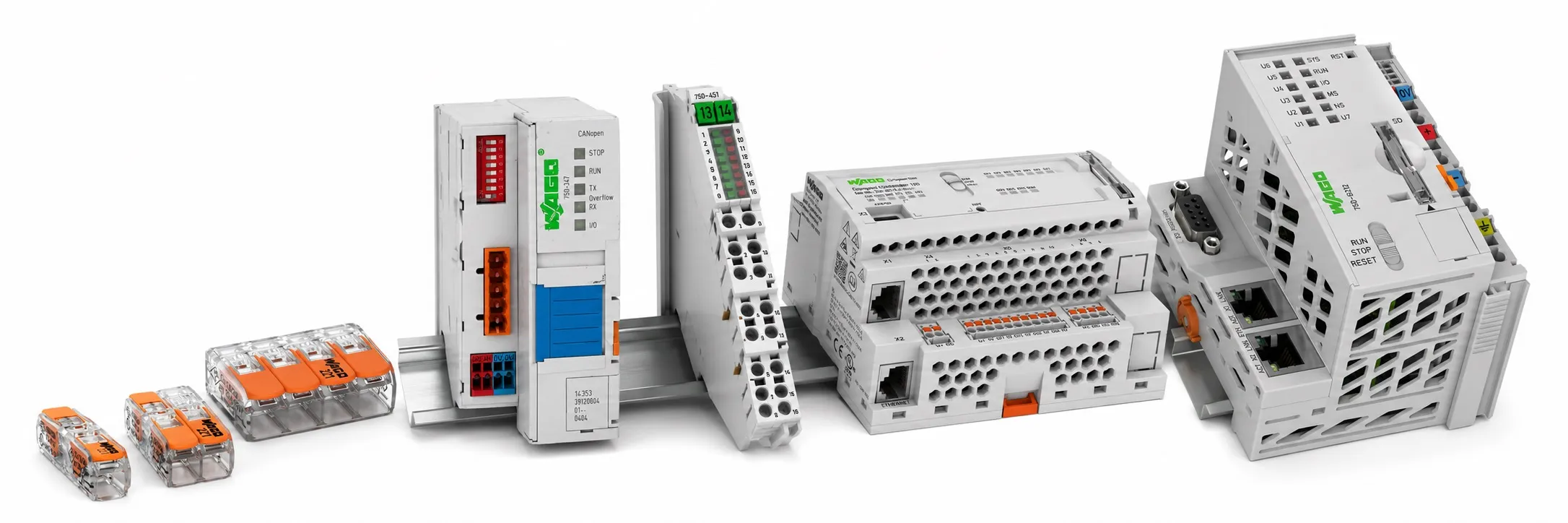
About WAGO: From Electrical Connections to Industrial Automation
WAGO is an international group rooted in Minden, Germany, with activities in electrical connection technology and automation. The company, whose current legal name is WAGO GmbH & Co. KG, has developed along two complementary paths: spring connection systems that connect conductors and modular automation solutions that process data from machines, buildings and energy infrastructure.
Understanding WAGO involves more than examining an individual terminal block or PLC. Its history shows how electrical connections, field signals and software come together within a system. This explains the relationship between switchgear and connection components and PLC and HMI technology within its portfolio.
1951: The Beginning in Minden
The origins of the company go back to Heinrich Nagel and Friedrich Hohorst, who acquired rights to a patent for a push-button, screwless leaf-spring terminal in 1950. WAGO Klemmenwerk GmbH was founded in Minden on April 27, 1951. During the early years, the company developed the spring connection concept into products and built up production.
SUPRAFIX products followed in the 1950s. In 1957, spring terminal blocks for standard DIN rails were introduced. Connection technology was becoming a family of products that could be arranged systematically inside electrical panels.
1974 and 1977: PUSH WIRE and CAGE CLAMP
PUSH WIRE® junction box connectors arrived in 1974, providing connections for solid conductors. In 1977, terminal blocks with CAGE CLAMP® were introduced. By accommodating different conductor types, CAGE CLAMP expanded the industrial use of spring connection technology.
A spring connection uses a mechanism to press the conductor against a current-carrying contact surface. The mechanical function of the spring and the electrical function of the contact work together. Selection still depends on conductor type, cross-section, current, voltage and operating conditions; each connection product has its own specifications.
The 1990s: Production Growth and the Move into Automation
Around the time of German reunification, WAGO developed its production operation in Sondershausen. Sales companies were also established in additional countries. These developments helped the business grow into an international organization.
The WAGO I/O System 750 was introduced at Hannover Fair in 1995. Its modular design combined input/output modules with couplers for different fieldbus technologies. The move from connection technology into data acquisition and control became a defining step in WAGO's development.
I/O modules transfer signals from sensors to a control system or carry output commands to field devices. Analog signals, digital inputs and specialized measurement tasks require different modules. A fieldbus coupler and a programmable controller also perform different functions. For background, see what is a PLC?
The 2000s: TOPJOB S and WAGO Turkey
In March 2003, the repurchase of Spirent's shares returned WAGO to full family ownership. The same year saw the introduction of TOPJOB® S and Push-in CAGE CLAMP®. Suitable solid conductors and ferruled fine-stranded conductors could be inserted directly, simplifying the connection process.
Other milestones included the WINSTA® pluggable connection system in 2001, 222 Series connectors in 2004 and the establishment of WAGO Turkey in 2007. The portfolio expanded to address different requirements in panel wiring and building installations.
The 2010s: Lever Connectors, Controllers and Digitalization
The compact 221 Series connectors were introduced in 2014, followed by TOPJOB S rail-mounted terminal blocks with levers in 2018. Levers operate the clamping mechanism, while features such as transparent housings on applicable products help users visually check the connection.
Automation milestones included the flexROOM® building automation solution in 2012 and the PFC controller family in 2013. CODESYS is one of the software environments used to develop control programs. WAGO's DIMA approach in 2014 addressed modular process automation, while WAGO Cloud in 2017 connected field data with cloud services.
The 2020s and the 75th Anniversary
WAGO established its SOLUTIONS business unit in 2021 and introduced the Compact Controller 100 in 2022. System solutions for energy, buildings and industry became a prominent direction. 2026 marks the company's 75th anniversary. According to WAGO's published results, group revenue reached €1.34 billion in 2025.
Product Areas and Engineering Approach
The portfolio includes rail-mounted terminal blocks, connection connectors, I/O systems, controllers, HMI devices, industrial networking components and software. These areas relate to automation requirements involving PLCs, HMI panels, power supplies and control devices.
Development and testing facilities in Minden support the assessment of products against standards and application requirements. Technical evaluation should refer to the exact product code, data sheet, wiring diagram and approvals for the particular model. Specifications for one member of a product family should not be assumed to apply to every other model.
WAGO pages: WAGO Second-Hand Main Page · WAGO Second-Hand Contact
Related sections: Second-hand models and categories · High-speed counters · Analog signal control · Sensor accessories · Motion control
Official sources: Foundation · 1970s · 1990s · 2000s · 2010s · 2020s · 2025 results and anniversary