
OH (Heatsink OvrTmp)
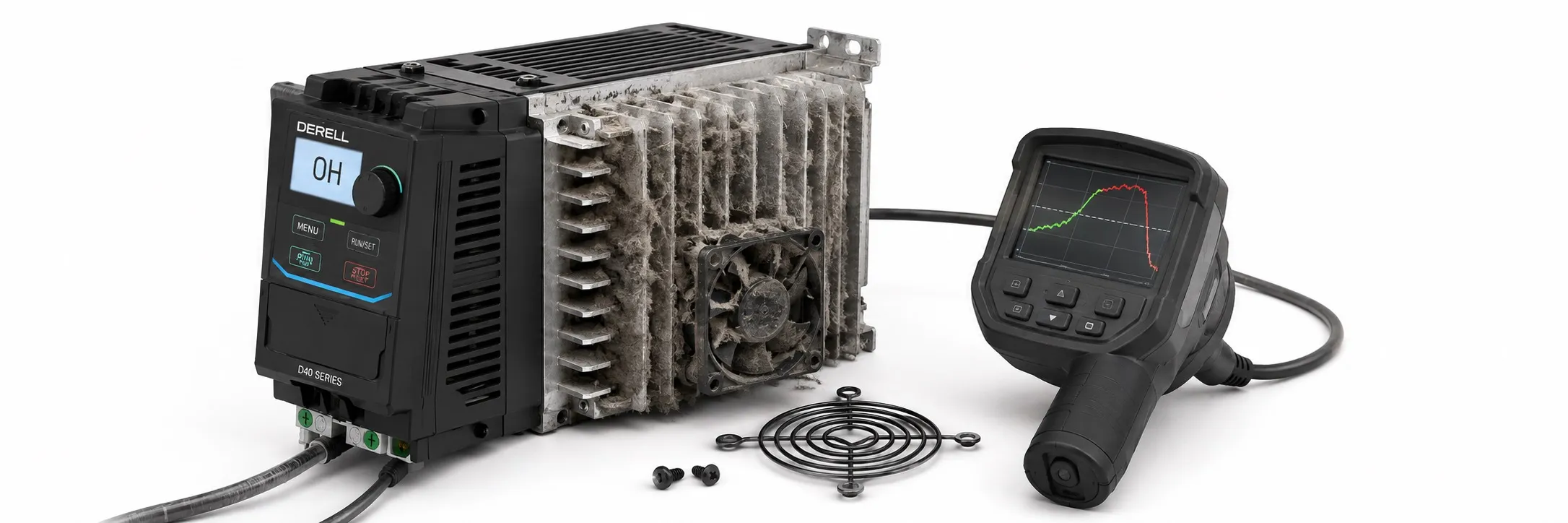
What Does an OH / Heatsink Overtemperature Fault Mean on a VFD?
OH, Heatsink Overtemperature or Cooling Fin Overheat generally means that the VFD has detected excessive temperature at its heatsink or power-module thermal monitoring point.
In simple terms, the drive is saying:
“I am generating heat faster than I can get rid of it.”
That makes OH a thermal-balance problem rather than simply a “bad fan” fault.
Two sides have to be considered:
Heat generation: motor current, drive load, semiconductor conduction losses, switching losses and carrier frequency.
Heat removal: heatsink condition, cooling fan, enclosure airflow, ambient temperature and installation spacing.
For the complete fault family, see the OtomasyonAVM VFD Fault Codes guide.
What is the heatsink actually cooling?
The VFD's power semiconductors generate heat whenever they conduct motor current and whenever they switch.
That heat flows through the power module into the heatsink and is then transferred to the surrounding cooling air.
The simplified thermal path is:
Semiconductor junction → module/case → heatsink → airflow → enclosure/ambient
If heat production increases or any part of this cooling path becomes ineffective, heatsink temperature rises.
Common causes of an OH fault
High ambient temperature: the drive is already drawing in hot cooling air.
Dust-clogged heatsink: dust between heatsink fins reduces airflow and heat-transfer area.
Cooling-fan failure: the fan may have stopped, slowed because of worn bearings or lost airflow.
Poor enclosure ventilation: hot discharge air can recirculate back into the VFD intake.
Blocked panel filters: even a healthy drive fan cannot move enough air through a heavily clogged enclosure filter.
Heat from nearby equipment: braking resistors, transformers or adjacent drives can raise inlet-air temperature.
Heavy drive loading: higher output current increases semiconductor conduction losses.
High carrier frequency: more switching events can increase inverter switching losses.
Undersized drive: a VFD continuously operating near its thermal limit has little cooling margin.
High altitude: lower air density can reduce cooling performance and may require manufacturer derating.
Yaskawa's current HV600 documentation lists high ambient temperature and insufficient airflow among the primary OH causes, while ABB's current firmware guidance points to ambient conditions, fan operation, dirty heatsink fins and drive-versus-motor sizing. :contentReference[oaicite:6]{index=6}
Does a stopped fan always mean the fan is defective?
No.
Some drives use temperature-controlled or operating-state-controlled fans rather than running the fan continuously.
A stationary fan on a cold, unloaded drive may therefore be normal.
The important question is whether the fan starts when the drive temperature and operating condition require cooling.
Why does carrier frequency affect VFD temperature?
Every IGBT switching transition dissipates a small amount of energy.
Increasing carrier frequency increases the number of switching transitions per second.
This can reduce audible motor switching noise, but it can also increase inverter switching loss and thermal stress.
For this reason, many manufacturers apply output-current derating at higher carrier-frequency settings.
OH vs Motor Overtemperature
They are not the same fault.
OH / Heatsink Overtemperature generally protects the VFD power electronics.
Motor overtemperature refers to the temperature of the motor itself, often estimated thermally or measured using a thermistor.
For example, older and current Yaskawa families distinguish heatsink-overheat faults from motor-thermistor overheat faults; OH/OH1 can refer to heatsink temperature, while OH3/OH4 on certain series relate to motor temperature monitoring. :contentReference[oaicite:7]{index=7}
Fault-code naming is manufacturer-specific, so always confirm the exact manual.
OH vs Motor Overload
Motor overload protection is intended primarily to protect the motor's thermal capacity.
Heatsink overtemperature protects the drive's own thermal system.
The two can still be related: a heavily loaded motor makes the drive carry more current, which can increase power-stage losses and heatsink temperature.
Why does a dirty heatsink matter so much?
A heatsink depends on airflow through its fins.
When those passages become packed with dust, the drive loses both effective cooling surface and airflow.
ABB explicitly states that dirty heatsink fins can lead to overtemperature warnings and faults. :contentReference[oaicite:8]{index=8}
Cleaning should follow the manufacturer's electrical-safety and ESD procedures rather than simply blowing uncontrolled compressed air into the electronics.
What if OH occurs immediately after power-up?
If the drive is physically cold yet reports an overtemperature fault immediately, a genuine thermal overload is less likely.
Possible areas to investigate include:
temperature-sensor or measurement-circuit problems, an external-overheat input, stored fault logic, or simply a manufacturer code that does not mean what you assumed it meant.
This is why the exact fault description should be checked before dismantling the cooling fan.
What if OH appears only after heavy load?
Check actual motor current, VFD sizing, normal-duty/heavy-duty rating, carrier frequency and cooling condition.
If the drive operates happily at light load but repeatedly trips after the motor reaches high current, the thermal margin may be too small.
What if OH happens only in the afternoon?
Ambient and enclosure temperature become strong suspects.
A VFD that runs correctly at 25°C in the morning can have significantly less thermal margin in a 45°C enclosure later in the day.
Measure the temperature rather than estimating it by touch.
What if opening the enclosure door stops the OH fault?
That is a strong clue that enclosure ventilation deserves attention.
Check inlet filters, outlet vents, panel fans, air conditioner capacity, drive spacing and hot-air recirculation.
Leaving the door permanently open is not a proper solution because enclosure IP protection and electrical safety can be compromised.
Does an OH fault mean the IGBT is damaged?
Not by itself.
A hard-short IGBT often produces an overcurrent or short-circuit event much faster than the heatsink can gradually reach an OH threshold.
However, abnormal semiconductor losses, poor thermal transfer or unequal cooling can create unusual temperature behaviour.
ABB, for example, provides dedicated IGBT-temperature and excessive temperature-difference faults on some drive families. :contentReference[oaicite:9]{index=9}
Should you simply reset an OH fault?
Not repeatedly.
The drive should be allowed to cool, and the reason for the excess temperature should be identified.
Repeatedly operating the VFD near or above its thermal limit can shorten the life of cooling fans, capacitors and power-semiconductor assemblies.
A practical OH troubleshooting sequence
1. Confirm the exact manufacturer's meaning of the code. Heatsink, motor or external overtemperature?
2. Record when the fault occurs. Immediately, under load, during hot weather or only with the enclosure closed?
3. Measure ambient and enclosure temperature.
4. Verify fan operation under the conditions when cooling should be active.
5. Inspect heatsink fins and cooling passages for dust.
6. Inspect enclosure inlet and outlet filters.
7. Check actual motor current and VFD loading.
8. Check carrier-frequency setting and manufacturer derating.
9. Confirm VFD sizing and duty rating.
10. Check nearby heat sources and hot-air recirculation.
11. If all cooling conditions are correct, temperature sensing and the power module may require service-level diagnosis.
Editor's field note
When I see an OH fault, I don't begin with “Is the fan spinning?”
I begin with four numbers:
Ambient temperature.
Enclosure temperature.
Heatsink temperature.
Motor current.
Then I inspect airflow.
A perfectly healthy fan cannot cool a drive effectively if it is sucking 48°C air from a badly ventilated enclosure.
And a cool enclosure does not help much if the heatsink passages are packed with dust.
OH troubleshooting is really about finding where the thermal path has broken down.
VFD OH / Heatsink Overtemperature FAQ
What does OH mean on a VFD?
It commonly indicates that the heatsink or monitored power-module temperature has exceeded the permitted level.
Does OH mean the motor is overheating?
Usually not. Motor overtemperature is commonly a separate protection function.
If the fan is not spinning, is it definitely faulty?
No. Some drives control the fan according to temperature or operating state.
Can dust cause an OH fault?
Yes. Clogged heatsink fins and panel filters can drastically reduce cooling performance.
Can high carrier frequency cause overheating?
It can increase switching losses and reduce the drive's available thermal margin.
What if OH appears only at high load?
Check motor current, VFD sizing, duty rating, carrier frequency and cooling.
What if OH only happens in hot weather?
Ambient and enclosure cooling are strong suspects.
What if OH appears immediately on a cold drive?
Check the exact code definition, temperature sensing and external-overheat inputs rather than assuming a real heatsink thermal event.
Will installing a larger fan always fix OH?
No. Excess load, dirty heatsink, poor enclosure airflow or high ambient temperature can remain the real cause.
Can I keep resetting OH?
The cause should be corrected and the drive allowed to cool before normal operation resumes.
Related VFD fault topics
VFD Fault Codes · Motor Overload Protection