
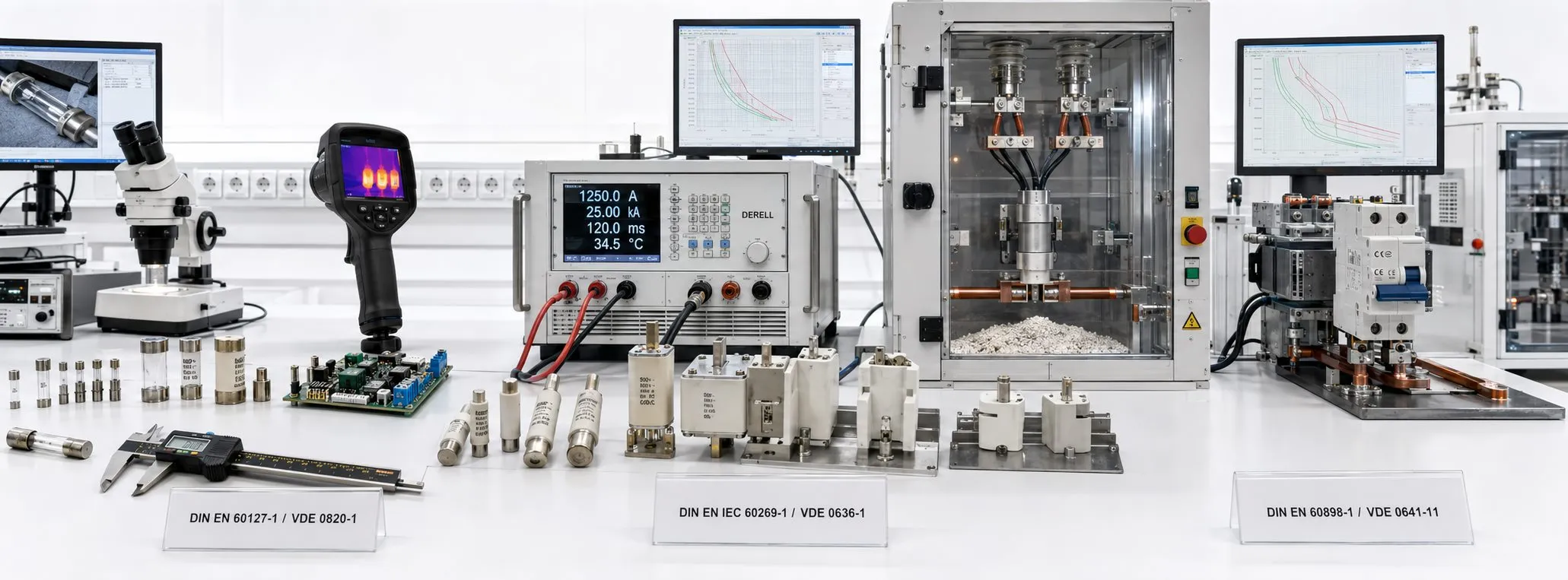
VDE Standards for Fuses: A Guide to the Right Reference
A useful fuse specification starts with the product family. An NH fuse-link in a distribution assembly, a miniature fuse inside an electronic instrument and a resettable circuit breaker perform related protective functions, but they are assessed under different standards. A general statement such as “VDE compliant” leaves too much unanswered.
VDE is the German association for electrical, electronic and information technologies. Electrotechnical standardization in Germany is carried out through DKE within DIN and VDE. Product testing and certification are separate activities. Keeping these roles distinct makes datasheets and approval documents easier to interpret.
Identify the Device Before Choosing the Standard
An electrical fuse interrupts a circuit through the operation of a fusible element. The operated fuse-link is replaced. A circuit breaker uses a switching mechanism and can generally be reset after the fault has been addressed and the device checked as required. This distinction matters when navigating overcurrent protection standards.
| Product or subject | Main reference | What it addresses |
|---|---|---|
| Low-voltage fuses | VDE 0636 / IEC 60269 family | General requirements and application-specific fuse provisions |
| Miniature equipment fuses | VDE 0820 / IEC 60127 family | Fuses protecting electrical and electronic equipment |
| AC circuit breakers for household and similar installations | VDE 0641-11 / EN 60898-1 | AC miniature circuit breakers within the document's scope |
| Industrial circuit breakers | VDE 0660-101 / EN IEC 60947-2 | The relevant industrial circuit-breaker requirements |
| Fuse-combination switching devices | VDE 0660-107 / EN IEC 60947-3 | Switches, disconnectors and fuse-combination units |
| Radio-interference references in older documentation | VDE 0871 | Historical EMC requirements, rather than fuse protection characteristics |
This map identifies the main routes. The applicable part, edition, amendments and product scope still need to be checked against the equipment documentation.
VDE 0636 and the IEC 60269 Family
VDE 0636 groups requirements associated with IEC 60269 low-voltage fuses, together with relevant national provisions. The subject extends beyond ampere ratings to operating characteristics, interruption performance, marking and verification.
The common foundation: VDE 0636-1 corresponds to the general requirements in IEC 60269-1. Application-specific parts build on that foundation.
Industrial fuse systems: VDE 0636-2 and IEC 60269-2 concern systems intended for electrically skilled or instructed persons. The distinction is based on the intended users and system arrangements, not simply on higher current ratings.
Systems for unskilled users: VDE 0636-3 and IEC 60269-3 cover the additional requirements for this user group. That classification does not authorize work on exposed energized installation parts.
Semiconductor protection: VDE 0636-4 is associated with IEC 60269-4. Photovoltaic and battery protection also have dedicated parts within the family.
VDE 0820: The Equipment-Fuse Route
A small fuse fitted inside an instrument or appliance may belong to the IEC 60127 miniature-fuse family, represented in Germany by relevant VDE 0820 parts. For example, DIN EN IEC 60127-1 carries the designation VDE 0820-1.
Glass or ceramic construction alone does not establish the applicable standard or performance. Check dimensions, voltage, breaking capacity and the specified fast-acting or time-delay characteristic. Two fuse-links can occupy the same holder while behaving differently during an overload or fault.
Where Circuit Breakers and Fuse-Switches Fit
Household AC miniature circuit breakers are addressed by the relevant VDE 0641 provisions associated with the IEC 60898 family. They should not be specified using the product requirements for replaceable fuse-links.
VDE 0660 covers a broader range of switchgear, controlgear and, in relevant parts, assemblies. A fuse-combination unit may be assessed under IEC 60947-3, while its fuse-link belongs to IEC 60269. The switching device and the replaceable protective element can have different product standards.
Why VDE 0871 Does Not Belong in a Fuse Specification
VDE 0871 is a historical radio-interference and EMC reference. Its 1978 main document, for example, has been withdrawn. It does not define a fuse's current rating, breaking capacity or overcurrent protection class. An old equipment manual may mention it, but that reference answers a different engineering question.
Turn the Standards Reference into a Usable Specification
Once the product family is established, compare the rated current, operating voltage, AC/DC suitability, breaking capacity and time-current characteristic. For DC fuse applications, use the manufacturer's stated DC ratings and circuit conditions.
With industrial fuses, also identify the class, such as gG, aM, aR or gR. The partial-range classes aM and aR cannot be treated as equivalent to a full-range fuse merely because the ampere values match.
Semiconductor protection fuses require attention to I²t and coordination data. When protecting a variable frequency drive, follow the documented protection arrangement. A faster fuse is not automatically a better replacement.
A Standards Claim and a VDE Certificate Are Different Evidence
A manufacturer may cite a standard in a datasheet or declaration. A test report records a particular assessment. VDE certification and authorization to use a certification mark are separately verifiable. When certification is required, the certificate must cover the actual model and relevant characteristics.
The official VDE certificate search provides a way to check product and certificate details. An approval belonging to another model from the same manufacturer does not establish certification for the product being purchased.
Can a Fuse from Another Manufacturer Be Substituted?
Standardized dimensions and characteristics make comparison possible. Interchangeability still depends on the application. A proper replacement-fuse assessment considers electrical ratings, class, holder compatibility, power dissipation and any required coordination.
Before replacing an operated fuse, establish the cause of operation, isolate the circuit safely and verify that it is de-energized. Increasing the current rating to stop repeated operation can compromise the original protection design.