
about Vacon
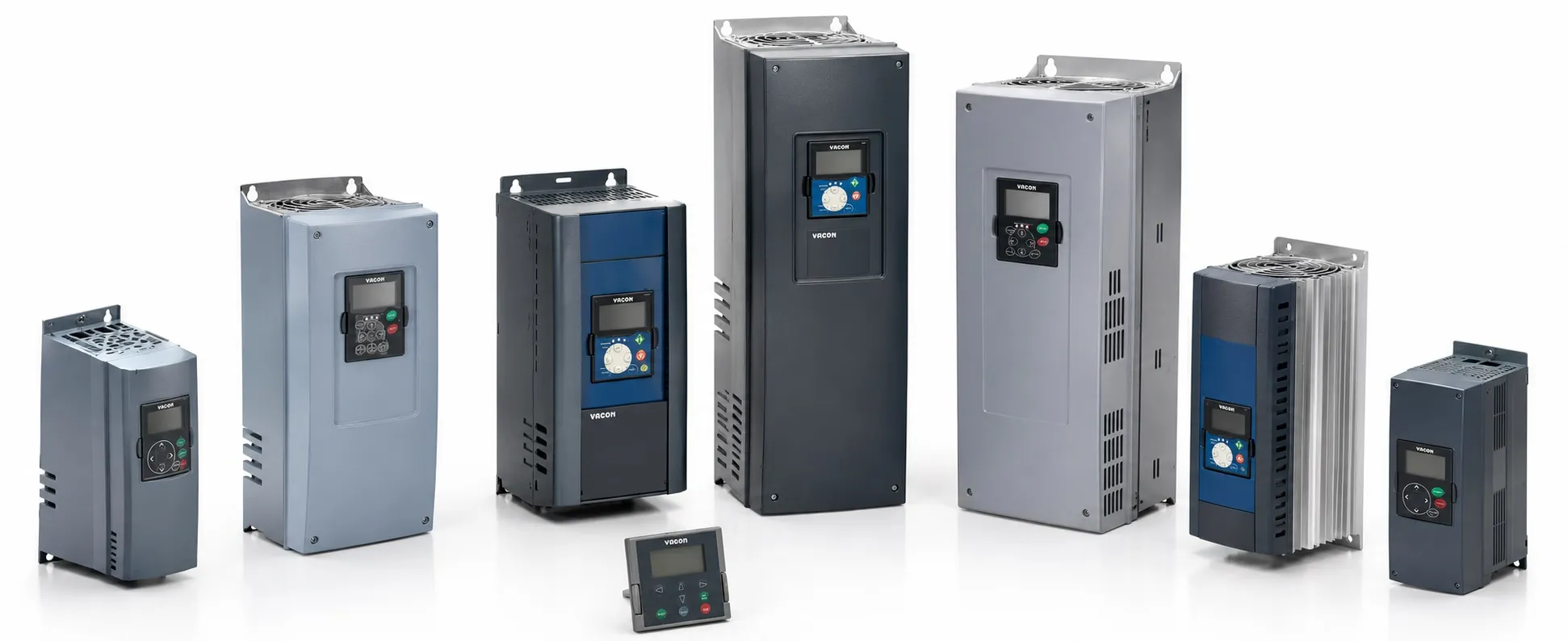
About VACON
VACON is a brand with Finnish roots, known for AC drives that control the speed and operating behavior of electric motors. These products are also called variable frequency drives, frequency converters or AC inverters. Today, the brand belongs to the Danfoss Drives portfolio. Its development has been shaped by software customization and adapting motor control to different industrial processes.
From Vaasa to international markets
Vacon was established in Vaasa, Finland, in November 1993 by 13 founders. The first VACON CX drives appeared in 1995, when offices also opened in Germany and Sweden. The VACON NX family arrived in 2000, and the company joined the Helsinki Stock Exchange that December. Further milestones included NXP Liquid Cooled in 2002 and VACON 100 HVAC in 2008.
Vacon became part of the Danfoss Group on 1 December 2014. Its merger with Danfoss Power Electronics was fully completed on 15 May 2015, bringing the operations together under Danfoss Drives. Danfoss originated in Nordborg, Denmark. The combination brought VACON's Finnish drive expertise and Danfoss's motor control experience into the same organization. VACON continues as a product brand within this structure.
The brand's engineering approach
Application software has been central to VACON's development alongside power electronics. Customizing drive functions for a process has been part of this approach since the CX generation in 1995. In suitable series, programmable logic within the drive can handle certain control tasks closely related to motor operation. This should not be assumed to provide the same functionality as an external PLC; its scope depends on the drive's software, inputs, outputs and application.
The type of electric motor and the required torque control influence drive selection. VACON's portfolio includes solutions for induction motors and permanent magnet motors. Supported motor types and control methods must be evaluated for each series.
Key product families
VACON 100 INDUSTRIAL: A series for applications including conveyors, compressors, pumps and production machinery. It supports induction, permanent magnet and synchronous reluctance motor control. Ethernet and RS485 interfaces, together with available options, facilitate integration into industrial communication systems. Input/output, communication and functional safety capabilities should be checked against the selected hardware configuration.
VACON 100 FLOW: Focuses on pump, fan and compressor applications. Multipump functions and built-in PID control help adjust motor speed as demand changes. Sensor feedback can be used for pressure control or flow control. Applications include water and wastewater facilities, distribution systems and ventilation processes.
VACON NXP: A platform for applications requiring dynamic motor control. Open- and closed-loop vector control, programmable functions and expansion boards in the NXP Air Cooled series support adaptation to cranes, winders and machinery. The family includes different air-cooled and liquid-cooled solutions.
VACON NXP Common DC Bus: Provides modules for sharing energy between drives through a common DC link. Appropriate active front-end systems can return braking energy to the supply network. In non-regenerative arrangements, other drives can reuse this energy; excess energy can be dissipated as heat through a suitable brake chopper and braking resistor.
VACON 3000: Represents the brand's medium-voltage drive solutions. Its modular Drive Kit approach allows system integrators to engineer cabinets and layouts for a particular installation. Target applications include marine, mining, oil and gas, chemical and cement industries. Voltage, power, cooling and front-end configuration are determined for the project.
Commissioning and software tools
VACON Live supports parameter configuration, monitoring and diagnostics for the VACON 100 and VACON 20 families. The included VACON Loader tool updates firmware on compatible drives. For the NXP family, NCDrive handles commissioning and monitoring, while NCLoad loads firmware and application software.
VACON Programming is used to develop process-specific control, monitoring and diagnostic logic for VACON 100 and NXP platforms; Danfoss states that training is required. Software and firmware must match the device family. The manufacturer's MyDrive Suite provides access to the relevant tools.
Applications and energy efficiency
VACON solutions serve applications ranging from pumps and fans to conveyors, lifting systems, marine installations and heavy industrial processes. Adjusting motor speed to demand can deliver energy savings, particularly in systems with variable flow requirements. Actual savings depend on the load profile, operating hours and existing control method; a single savings percentage cannot represent every application.
A water pumping installation in Kristinestad, Finland, provides a practical example. In the case study published by Danfoss, VACON 100 FLOW drives were used to manage multiple pumps and achieve steadier flow and pressure. Communication through Modbus RTU allowed the pump group to operate together according to demand.
Older series and product lifecycle
The brand's long history means that different generations remain installed in the field. Danfoss identifies VACON CX and VACON 10 as being in the Inactive lifecycle phase: production has ended, and the manufacturer states that spare parts and service options are no longer available for these products. The status of one series should not be applied to the entire VACON range. Danfoss also presents its newer iC7-Automation platform on NXP product pages.
A replacement assessment requires more than matching a kW rating. Supply voltage, motor current, load characteristics, braking, communication, option boards and application software all matter. Basic drive parameters and VACON manuals provide useful starting points for this assessment.
Sources: Vacon Annual Report 2013, Danfoss's 2014 announcement, the Kristinestad study with the 2015 merger note and the VACON CX lifecycle page. Brand information and lifecycle statements were checked on 7 October 2026.