
Types UPS
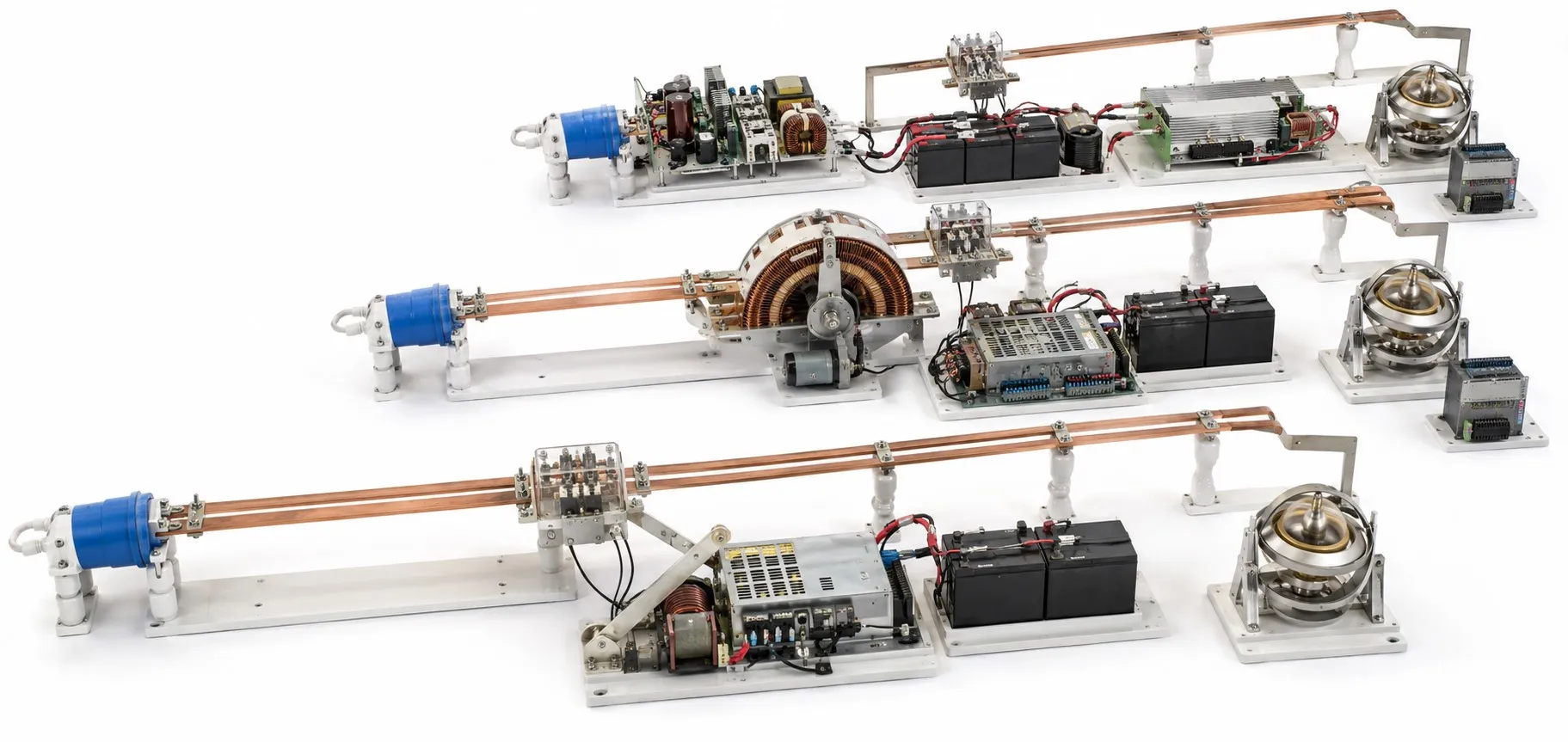
One of the key decisions when choosing an uninterruptible power supply (UPS) is its topology: the path power takes from the utility supply to the connected equipment. Three common approaches in electronic AC UPS systems are standby / offline, line-interactive and online / double-conversion. These names describe how the equipment works, rather than simply its price level. Models with the same topology can differ in capacity, waveform, runtime and performance.
1. Standby / offline UPS: switches to backup power during an outage
With utility power available: The supply normally powers the load. The UPS monitors input conditions, keeps its battery ready and provides filtering or surge suppression according to the model. In a standby design, the inverter is not normally the main source of load power.
During an outage: When the supply fails or input voltage moves outside the accepted limits, the load transfers to the battery and inverter power path. This transfer takes a brief interval. The connected equipment's power supply must tolerate that gap; check the specified transfer time.
When might it be suitable? It can provide short-term backup for compatible modems, routers and basic office equipment where utility conditions are generally acceptable. A relatively simple design and lower cost are its main benefits. Frequent voltage deviations may require more transfers to battery power.
2. Line-interactive UPS: corrects certain voltage deviations using AVR
With utility power available: The supply powers the load, while automatic voltage regulation (AVR) corrects certain low- or high-voltage conditions without using the battery. This function is related to voltage regulation, but a UPS also stores backup energy. That is an important difference between a voltage regulator and a UPS.
During an outage: The battery-powered inverter takes over the load. Transfer time in a line-interactive UPS is not zero. Battery operation may also be necessary when input voltage exceeds the AVR correction range.
When might it be suitable? It can support compatible computers, small servers and network systems in offices experiencing voltage sags or rises. It offers a balance between voltage regulation and efficiency. AVR alone does not resolve every noise disturbance or frequency problem.
3. Online / double-conversion UPS: continuously powers the load through its inverter
With utility power available: In normal double-conversion mode, incoming AC is converted to DC by a rectifier. Power passes through the DC bus to the inverter, which converts it back to AC for the load. The inverter therefore generates the output voltage. Double conversion describes the AC → DC → AC power path.
During an outage: The battery system supplies energy on the DC side. Because the inverter already powers the load, there is no transfer interruption when utility power gives way to battery power. Here, zero transfer time refers to the transition from normal double-conversion operation to battery operation.
When might it be suitable? It is an option for loads sensitive to brief supply gaps, environments with poor power quality and applications requiring tighter output control. Also consider purchase cost, conversion losses and cooling requirements. Understanding UPS systems versus inverters helps clarify the inverter's role within the system.
Does an online UPS continuously discharge its battery?
No. With an acceptable utility supply, the rectifier normally provides energy to the DC side, while charging controls keep the battery ready. A continuously operating inverter does not mean a continuously discharging battery. The battery serves as a backup energy source when utility power is insufficient.
Why check bypass and eco modes separately?
Bypass supplies the load through a power path outside the inverter under suitable conditions. Static bypass may be used during overloads or certain faults, while maintenance bypass provides a separate supply route for servicing. Protection and battery-backup behaviour depend on the arrangement in use.
Some online models have an eco mode that prefers the bypass path under acceptable utility conditions to reduce losses. Eco operation does not use the same power path as normal double conversion. Selection and commissioning must therefore consider the active operating mode, as well as the online designation.
Topology alone does not establish the output waveform
Particularly among standby and line-interactive models, battery-mode output may be a pure sine wave or a stepped approximation to a sine wave. The line-interactive label does not automatically guarantee pure sine-wave output. Check manufacturer compatibility information for sensitive loads and active-PFC power supplies. Transfer time and waveform are separate selection criteria.
Topology, power capacity and runtime are separate specifications
The difference between VA and watts matters for all three types. The load must remain within both the VA and watt ratings; larger systems use the same assessment in kW and kVA. Motor loads and similar equipment also require checks of starting current.
Runtime depends on usable battery-pack energy, actual load and operating conditions. The capacity of the battery charging system also affects how quickly backup capability can recover after an outage. An online UPS does not automatically provide longer runtime. Select duration from the model's runtime curve at the actual load.
The 24 V DC UPS option for industrial control panels
If the PLC, HMI panels and other control equipment use a suitable DC supply, a DC UPS is another option. Backup can be applied on the output side of a 24 V DC power supply; models combining the power supply and UPS functions are also available. DC UPS describes a different aspect of the system from the three AC-output topologies.
Check load current, backup duration, the acceptable DC voltage range and the supported energy-storage module. Keeping control equipment powered does not mean that motors or the entire machine remain energised.
What do rack, tower, modular and three-phase mean?
Rack and tower mainly describe physical installation. Modular describes how the system is assembled or expanded, while single-phase and three-phase describe input and output supply arrangements. These terms do not replace the standby, line-interactive and online distinction. A UPS can, for example, be both rack-mounted and online double-conversion.
The IEC 62040 standards family concerns UPS systems; IEC 62040-3 addresses performance and test requirements for AC UPS systems within its scope. Consider documented output performance alongside the topology name when selecting equipment.
How should the application guide selection?
Home and basic office loads: Establish utility conditions, equipment compatibility and required shutdown time first. Compare standby and line-interactive options against those needs.
Servers and networks: Check waveform requirements, transfer tolerance and the shutdown plan. Include Ethernet switches and other necessary network devices in the backup calculation.
Critical control and monitoring: Depending on load sensitivity, online or suitable DC UPS solutions may be appropriate. Assess the SCADA computer and communications infrastructure together. Supported UPS accessories can help with alarm reporting and controlled shutdown.
When comparing UPS models, assess efficiency, maintenance, battery replacement and total cost. The disadvantages of UPS operation also matter. Correct earthing and grounding and, where necessary, coordinated surge protective devices remain necessary; no topology eliminates every electrical risk.