
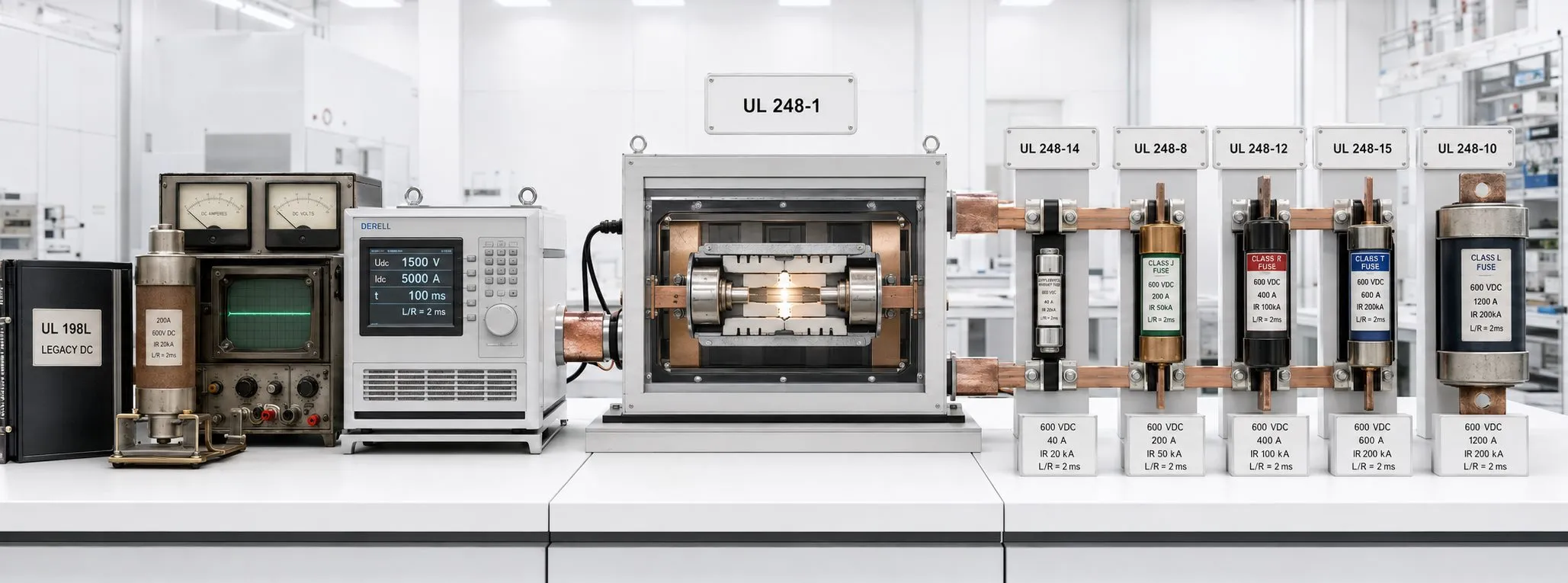
UL 198L: Understanding a Legacy DC Fuse Reference
Finding UL 198L in an old equipment manual raises a practical question: what information is needed to select a suitable fuse today? The designation refers to DC Fuses for Industrial Use, a historical standard associated with the evaluation of industrial fuses for direct-current service.
The reference helps explain an older product's documentation. It does not establish that a replacement fuse is suitable simply because it has the same ampere rating or fits the existing holder.
The Standard's Historical Status
OSHA includes UL 198L in its Standards No Longer Recognized list, linked to its January 6, 2003 notice. It should therefore be treated as a legacy reference when preparing a new specification. The status of a particular installed product requires its own documentation review; the old standard number alone does not settle that question.
For present-day selection, review the applicable fuse standards, including UL 248-1 and the relevant class-specific or application-specific part of UL 248. Confirm the exact product's ratings and certification rather than treating the change in standard number as a replacement cross-reference.
Why an AC Rating Does Not Establish DC Suitability
A fuse must do more than melt its element. It must also extinguish the resulting arc and withstand the voltage across the opened circuit. Alternating current provides periodic current zeros that assist interruption; steady direct current does not provide the same natural opportunity.
That makes the published DC voltage rating and DC interrupting rating essential when selecting fuses for DC circuits. A 600 V AC marking does not authorize use at 600 V DC. The manufacturer's DC application conditions must cover the actual circuit.
The Often-Missed Parameter: Circuit Time Constant
For a simplified series resistance-inductance circuit, the time constant is τ = L / R. With inductance in henries and resistance in ohms, the result is in seconds. It describes how quickly current changes in that circuit.
Worked example: A circuit with 2 mH of inductance and 0.2 Ω of resistance has a time constant of 0.002 / 0.2 = 0.01 seconds, or 10 ms. This is a circuit parameter. It is neither the fuse's opening time nor a universal acceptable limit for DC fuses.
Time constant can affect DC interruption performance. A circuit may meet the apparent voltage and fault-current limits yet fall outside the manufacturer's validated L/R conditions. Use the relevant DC data alongside the fuse's time-current characteristic; do not substitute the calculated time constant for a clearing-time value.
Build a Replacement Specification from the Circuit
| Item | What to establish |
|---|---|
| Original identification | Manufacturer, complete part number and documented replacement recommendation. |
| Operating voltage | Maximum DC operating voltage, including relevant charging conditions. |
| Available fault current | Required DC interrupting capability at the applicable voltage and test conditions. |
| Load and protection duty | Continuous current, startup demand, opening characteristic and any required I²t limits. |
| Application conditions | Fault-loop L/R, ambient temperature and equipment-specific requirements. |
| Installation and approvals | Fuse class, dimensions, connections, holder compatibility and applicable certification records. |
Keep the ampere rating separate from the interrupting rating. The first addresses current carrying under specified conditions; the second addresses fault interruption. Both matter in electrical fuse selection, and neither proves physical or functional interchangeability.
DC Drives Need Location-Specific Protection
In a DC drive, an incoming supply fuse, a DC output fuse and a fuse protecting a semiconductor branch can face different duties. Identify the fuse's position on the equipment schematic before comparing products. Follow the drive manufacturer's protection requirements for that location.
For semiconductor fuses, total clearing I²t can be a key coordination parameter. Published AC I²t data should not be transferred directly to a DC application without checking its validity. The protective duties of different fuse types cannot be reduced to the label “fast acting.”
Two Designations That Should Not Be Confused
UL 198L and Class L are different designations. UL 198L identifies a historical DC fuse standard. Class L identifies a fuse class addressed by UL 248-10. The shared letter does not make the two interchangeable terms.
A fuse's DC interrupting rating also does not establish the complete panel's short-circuit current rating, or SCCR. For UL 508A industrial control panels, component ratings and permitted protective-device combinations must be assessed together.