
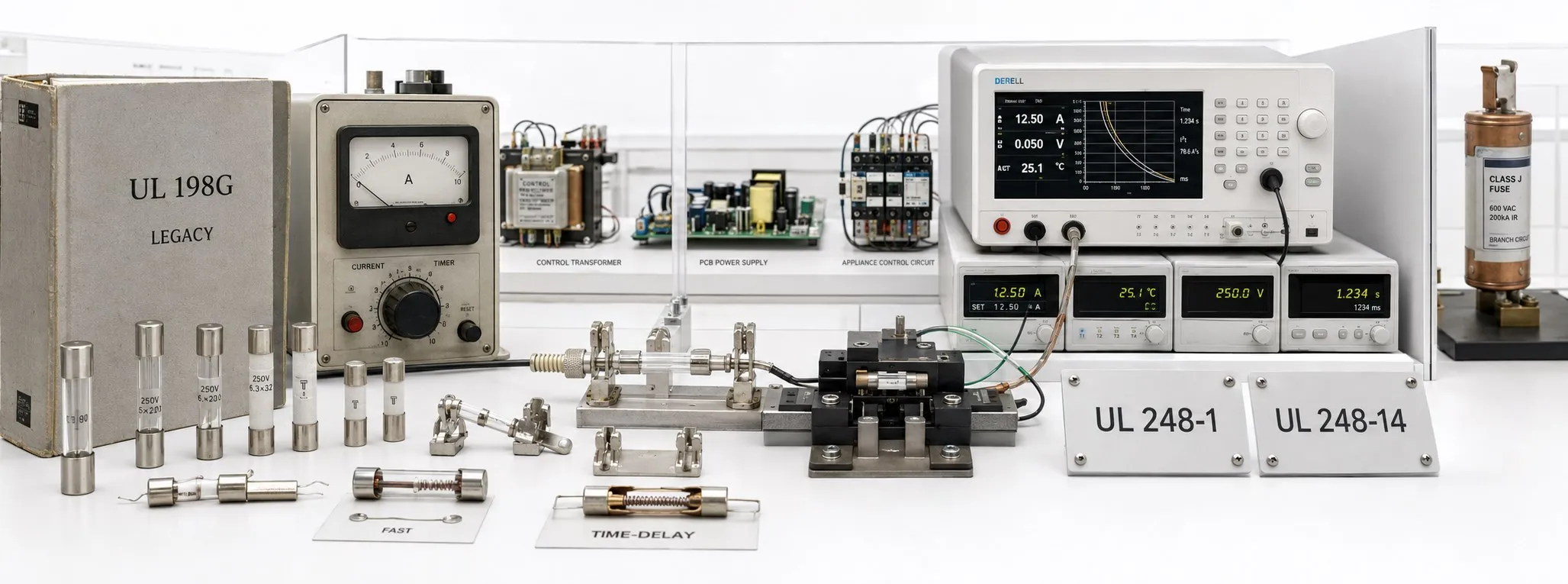
UL 198G: Legacy Supplemental Fuses and Replacement Decisions
An older equipment manual may specify a fuse evaluated to UL 198G. That designation refers to a historical standard for supplementary overcurrent protection. It describes a protective duty within equipment, rather than a general category of residential or commercial building fuses.
The useful question for maintenance is: what protection was this fuse intended to provide, and which current product preserves that function? Matching the old part's dimensions and ampere rating is only the beginning.
Where UL 198G Fits Today
OSHA lists UL 198G among its Standards No Longer Recognized, with a reference to the January 6, 2003 notice. Treat it as a legacy designation when writing a new specification. Its appearance in an old manual does not, by itself, determine the acceptability of the installed equipment.
Within today's fuse standards, the relevant supplemental-fuse requirements are found in UL 248-14, used together with UL 248-1. Part 14 covers supplemental fuses rated 60 A or less for applications that do not involve branch-circuit or equivalent protection. DC ratings are optional.
Understand the Fuse's Position in the Protection System
Equipment can require protection at more than one level. The supply circuit may already have its required overcurrent protection, while a smaller circuit inside the equipment needs a separate protective device. A supplemental fuse can serve that internal duty when its ratings and application conditions are suitable.
Consider a control cabinet containing a power supply, a PLC and several sensors. A fuse inside the power supply and the protective device feeding the cabinet may have different responsibilities. Their functions must be established from the equipment documentation; being located inside a device does not automatically classify a fuse as supplemental.
The individual parts of UL 248 distinguish between different fuse duties and classes. A supplemental fuse cannot replace required branch-circuit protection. This distinction matters more than the superficial similarities between different fuse types.
A Replacement Must Match More Than the Holder
Two cartridge fuses can fit the same clips and carry the same current marking while having different interruption capabilities or opening characteristics. Glass or ceramic construction alone does not establish a complete electrical specification.
| Check | Required information |
|---|---|
| Protective duty | The circuit or component being protected and the equipment manufacturer's requirements. |
| Current rating | Normal load, operating temperature and applicable derating conditions. |
| Voltage rating | A suitable rating for the actual AC or DC circuit. |
| Interrupting rating | Adequate fault-interruption capability at the applicable voltage and conditions. |
| Opening characteristic | Time-current behavior that accommodates legitimate inrush and provides the intended protection. |
| Installation and certification | Dimensions, terminals, holder compatibility and documented conditions of use. |
The ampere rating is not an instantaneous trip threshold. Opening time depends on the magnitude of the overcurrent and the product's characteristic. A time-delay fuse and a fast-acting fuse should therefore not be exchanged without evaluating the circuit.
For DC operation, obtain explicit DC ratings. An AC marking is not evidence of DC suitability. Base the final fuse selection on the exact manufacturer's part number and data sheet.
Do Not Confuse UL 198G with Class G
UL 198G is a historical standard number; Class G is a fuse class covered by UL 248-5. The letter G does not create a relationship that permits one product to replace another.
A further distinction concerns UL 1077 supplementary protectors. These devices are evaluated for use within electrical equipment under their own requirements. UL 1077 and UL 248-14 are separate standards; the shared word “supplementary” does not establish interchangeability.
Older documentation may also mention UL 198L, which concerns industrial DC fuses. Always read the complete designation before deciding which requirements apply.
What the Certification Mark Tells You
UL Listed and UL Recognized Component represent different certification scopes. Recognized components can have conditions of acceptability that must be satisfied within the finished equipment. A certification mark does not authorize a fuse for every protective duty.
When sourcing industrial fuses, match the complete model designation to the current technical documentation and certification record. For an obsolete part associated with UL 198G, a documented manufacturer replacement is a useful starting point, followed by verification of the actual application.