
About Telemecanique
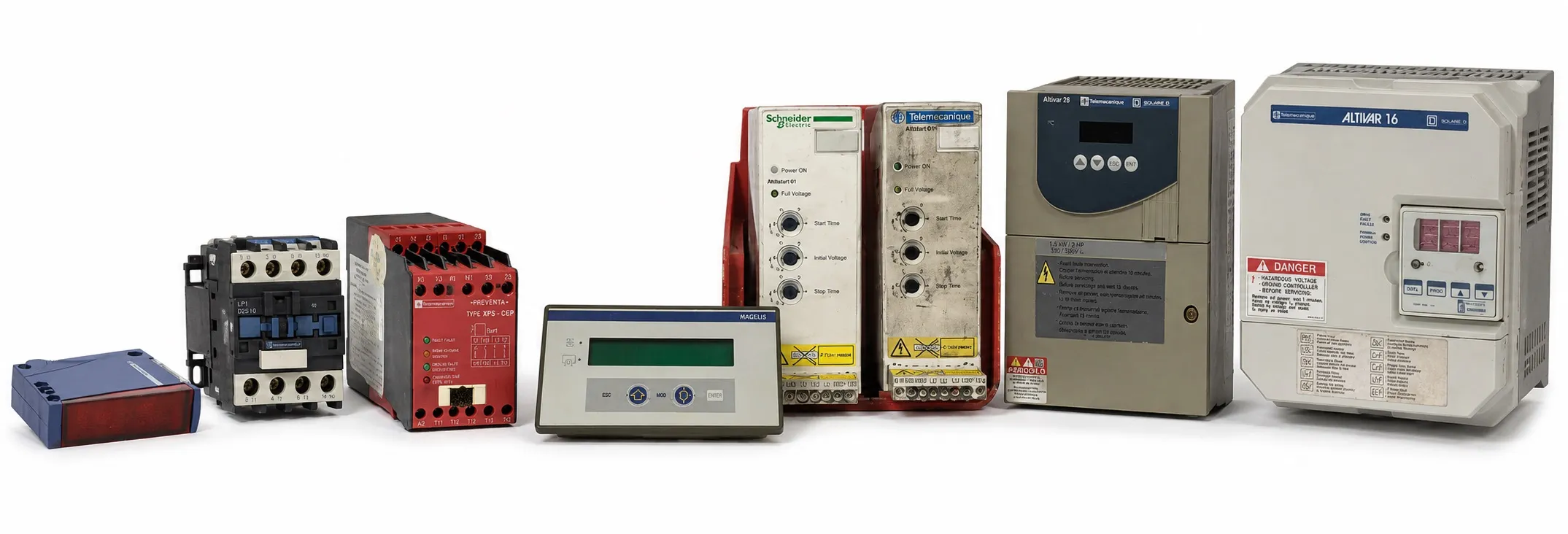
Understanding a century of industrial control and automation
Telemecanique is one of the established names through which we can trace the development of industrial electrical control, from electromechanical switching to electronic automation. A contactor starting a motor, a limit switch detecting position, a PLC managing a production sequence and a drive regulating motor speed represent different parts of that history. Understanding the brand requires attention to the product family, manufacturing period and complete device reference.
There is an important corporate distinction: much of the historical Telemecanique automation portfolio moved to the Schneider Electric brand, while Telemecanique Sensors joined YAGEO Group in 2023 as a separate business. An old Telemecanique contactor, a TSX PLC and a current Telemecanique Sensors product should therefore not automatically be assigned the same ownership or support channel.
Origins and development from 1924 to the present
1924 and 1928: Schneider Electric’s regional history states that Michel Le Goullec acquired Manufacture d’Appareillage Electrique in Nanterre, France, in 1924. The company took the name Télémécanique Electrique in 1928. Its early contactor work established an identity centred on electrically operated control and motor switching.
The 1930s to the 1960s: The corporate history records an employee benefits policy introduced in 1931 and a manufacturing agreement with Merlin Gerin in 1954. Canalis prefabricated busbar trunking and WB2-M pushbuttons entered the portfolio in the 1950s. Subsidiaries established across Europe, Canada and the United States during the 1960s marked important steps in international expansion.
The 1970s and 1980s: VAR 200 variable speed drives appeared in 1972, followed by the D contactor series in 1973. The 1980s brought first-generation Altivar frequency inverter drives and TSX60/80 PLCs, with the Integral 32/63 contactor-circuit breaker introduced in 1983. These developments added electronic speed control and programmable logic to an established electromechanical switching portfolio.
1988–2009: Schneider acquired Telemecanique in 1988. Later product milestones included Harmony control and signalling products in 2000, QuickFit connection technology in 2001 and TeSys U in 2004. In 2009, Telemecanique products, services and solutions migrated into Schneider Electric’s Automation and Control offering. This portfolio transition explains why both brand names remain visible in installed equipment.
A distinct sensing timeline: Telemecanique Sensors’ own history records limit and pressure switches in 1925, an inductive proximity switch in 1965, a photoelectric sensor in 1972 and the Inductel RFID system in 1985. These are milestones in the brand’s development, rather than a basis for describing every product as an industry-wide first.
2023 and the current structure: Schneider Electric announced completion of the sale of its Telemecanique Sensors industrial sensing business to YAGEO on 31 October 2023. YAGEO’s investor documents also record the acquisition. The current Telemecanique Sensors website describes it as a brand licensed by YAGEO Group. The transaction did not transfer every PLC, drive and contactor historically sold under the Telemecanique name to YAGEO.
What shaped the brand’s industrial identity?
Telemecanique’s identity is best understood through its presence across several layers of a machine’s control chain. The operator’s pushbutton, the contactor switching the motor, the overload relay monitoring the load and the switch detecting machine position can all belong to the same project. PLCs and drives added programming, communications and electronic motor control to that chain.
For a machine builder, the practical value lies in considering function, connections and maintenance together when selecting components. For a maintenance team, recognisable device references and documentation help explain the installed system. A broad product history does not make every generation compatible: the family and the generation must both be identified.
Contactors, overload relays and motor control
Contactors are among the most recognisable parts of the Telemecanique legacy. Schneider’s current portfolio includes separate families such as TeSys D/Deca, compact TeSys K and TeSys F for higher-current applications. After the LC1 prefix, the remaining reference identifies important family, frame, pole and coil details. Similar appearance does not establish equivalence.
For example, the LC1D126B7 data sheet specifies, under its stated conditions, an operational current of 25 A in AC-1 and 12 A in AC-3, with a 24 V AC coil. Calling it a “25 amp contactor” is therefore insufficient for a motor application. Utilisation category, operational voltage, switching duty, auxiliary contact arrangement and AC or DC coil supply must be checked together.
Thermal overload relays also belong to distinct families: LRD is associated with TeSys D, while LR2K is associated with TeSys K. The adjustment range must suit the motor nameplate current, and mounting compatibility and protection coordination also matter. Overload protection and short-circuit protection perform different tasks; an overload relay alone does not provide every protection required by the motor circuit.
Harmony operator controls and the scope of QuickFit
Older XB2 devices and later Harmony XB4/XB5 pushbuttons and control devices provide the physical interface between an operator and a machine. The operating head, fixing collar, contact block and lighting module may be separate components. Mounting diameter, momentary or maintained operation, NO/NC contacts and lamp supply are key selection details.
Schneider’s XB2/ZB2 to XB4/ZB4 guidance makes a useful distinction: a complete XB4 assembly can replace many older XB2 assemblies, but ZB4 components are not interchangeable with ZB2 components. Replacing an individual damaged head must therefore be assessed separately from replacing the complete assembly.
QuickFit, introduced in 2001, is a system that simplifies the assembly and connection of compatible motor starter components. Its purpose is to streamline connections between the relevant devices. The term does not mean that an entire panel operates without wiring or uses radio communications. Power and control connections outside the system still require their own appropriate design.
Altivar drives and Altistart soft starters
Historical ATV-reference Altivar devices are considered in the context of variable frequency drives controlling motor speed and operating behaviour. Fans, pumps and conveyors can require different control characteristics. Replacement selection involves more than matching kW: supply voltage and phase configuration, motor current, overload capability, braking requirements and communications must also be examined.
The principal role of ATS-reference Altistart devices is soft starting, with stopping control depending on the model. A soft starter is not a direct replacement for a frequency drive where continuous speed regulation is required. Current commercial portfolio names can also overlap: Schneider lists Altistart 01 under the Altivar umbrella. The reliable distinction rests on device function and the complete reference, as well as the family name.
When an older drive is replaced by a different generation, digital input logic, analogue reference scaling, relay outputs and network commands must be mapped again. Existing parameters and wiring should first be documented, then the settings required by the motor and process verified. Matching the brand and motor power does not establish that every parameter can be transferred unchanged.
TSX, Twido, Modicon and the programming ecosystem
Understanding historical Telemecanique TSX PLCs also involves recognising the Modicon name and Schneider’s different controller platforms. For example, Modicon Premium and a compact Twido do not share a single hardware and software platform. CPU reference, rack arrangement, I/O modules, communication cards and project version are the starting information for maintenance.
Software must be matched to the device. TwidoSuite/TwidoSoft serves Twido, while EcoStruxure Machine Expert Basic serves M221. Control Expert was previously Unity Pro, and Machine Expert was previously SoMachine; these are different environments. Zelio Logic smart relays occupy a separate position, with Zelio Soft used for the SR2/SR3 family.
Schneider identifies Twido as discontinued and M221 as a possible migration option, with additional hardware potentially needed for the actual configuration. Similarly, the availability of a PL7 to Control Expert conversion tool does not guarantee complete migration of every older TSX project. Program conversion, I/O mapping, communications and machine function testing must be planned together.
Access to an older system depends on more than the correct Schneider PLC programming cable. The electrical interface, driver software, operating system and authorised access details also matter. A running program retrieved from a controller may not contain the complete documented source project. Source files, hardware configuration, libraries and existing backups should therefore be preserved.
Telemecanique Sensors: detection and machine feedback
In the current sensing portfolio, the XS inductive family provides non-contact detection of metal targets. The XT capacitive family addresses different targets, including non-metallic materials and liquids in suitable applications. Older documentation may use the OsiSense XS/XT names. Sensing distance, target material, flush or non-flush mounting and environmental conditions affect actual performance.
Two sensors in the same M18 housing can have different outputs: one may be NPN and the other PNP. The NPN versus PNP distinction must be considered alongside the PLC input circuit. NO/NC operation, two- or three-wire connections and connector pin assignments must also be checked. A sensor that fits mechanically may still be an unsuitable electrical replacement.
XCK and XCM limit switches use mechanical contact with the target. Compact, classic, miniature and industrial formats address different requirements. Actuator type, operating direction, contact behaviour, cable entry and mounting dimensions must be examined together. Official conversion tables help compare older and newer references, while suitability in the actual installation still needs verification.
Machine safety requires a separate assessment
Products such as XUSL safety light curtains serve a safety function distinct from ordinary production sensing. Resolution, protective height, response time and connection to the control system must be considered through the machine risk assessment. Models within a family should not automatically be assigned the same safety classification or options.
A similar distinction applies to Safe Torque Off, or STO, in drives. An ordinary stop command and a safety function are different things. STO alone does not provide electrical isolation or remove every machine hazard. When replacing an older device, the operation of the existing safety chain must be verified separately.
Identifying legacy equipment, selecting spares and planning migration
Identification: Obtain clear photographs of the side nameplate and terminal arrangement as well as the front of the device. Record the complete reference and suffixes, supply and coil voltages, serial number and any hardware or firmware version. Descriptions such as “Telemecanique 18.5 kW” or “LC1 contactor” do not provide enough information to identify the correct replacement.
Functional comparison: Compare load category and coil for a contactor, motor current and control interface for a drive, program and I/O architecture for a PLC, and output type and installation conditions for a sensor. Installing a same-size contactor with a 24 V AC coil in a 24 V DC control circuit illustrates why matching the voltage number alone is insufficient.
Condition: Used, repaired, refurbished and unused old-stock products require different assessments. Appearance alone cannot establish operating history, contact wear, drive behaviour under load or the usefulness of a PLC backup. Test coverage should be explained in terms of the intended application; displaying a start-up screen is not a complete functional test.
Migration planning: A like-for-like spare may help restore operation during a short maintenance window. A longer-term plan must consider documentation, spare parts, software and support access together. An old brand label does not automatically mean a product is unsupported, while a new label does not prove compatibility with an existing system. Lifecycle status must be checked for the specific product reference.
How should the brand be assessed?
Telemecanique’s strength lies in an industrial engineering legacy spanning motor control, sensing and programmable automation. Making good use of that legacy means assessing documentation, actual operating conditions and maintenance options together, rather than treating the brand name alone as a guarantee of quality or compatibility.
For a team designing a new installation, current architecture and lifecycle considerations take priority. For a team maintaining an existing machine, accurate identification, dependable spares and a documented migration plan become central. Viewed this way, Telemecanique offers more than a historic logo: it provides a technical record of how industrial control has evolved across generations.
Editor’s note: “Same brand, same size, same amperage” does not establish a suitable replacement. Older Telemecanique equipment requires complete reference and functional matching. The support channel also depends on the product: a contactor or PLC may require Schneider documentation, while a current sensor may be supported by Telemecanique Sensors. The 2023 sensing business sale makes this distinction important.
Related Telemecanique technical documentation
Telemecanique drive manuals, Telemecanique drive fault codes, Telemecanique soft starter manuals, Altivar 31 manuals and Altivar 61 manuals provide relevant starting points for identifying the correct legacy series.
Other related automation categories
Explore other system components through sensors, PLCs and accessories, HMIs and operator panels, fuses and limit switches.
Product pages: Telemecanique products and Schneider Electric products.
Sources
Schneider Electric: origins and corporate history; Schneider Electric: product milestones.
Schneider Electric: brand transition and QuickFit; Telemecanique Sensors: company profile and sensing history.
Schneider Electric: disposal completion announcement, 31 October 2023; YAGEO: November 2024 investor presentation, Telemecanique Sensors transaction.
Schneider Electric: TeSys contactors, protection relays and QuickFit; Schneider Electric: LC1D126B7 product data sheet.
Schneider Electric: XB2/ZB2 versus XB4/ZB4 replacement guidance; Schneider Electric: Twido and possible M221 migration.
Schneider Electric: automation software families; Schneider Electric: PL7 to Control Expert conversion manual.
Schneider Electric: Altistart 01 product scope; Telemecanique Sensors: XS inductive and XT capacitive sensors.
Telemecanique Sensors: XCK and XCM limit switches; Telemecanique Sensors: XUSL safety light curtains.