
What is the conservation of angular momentum?
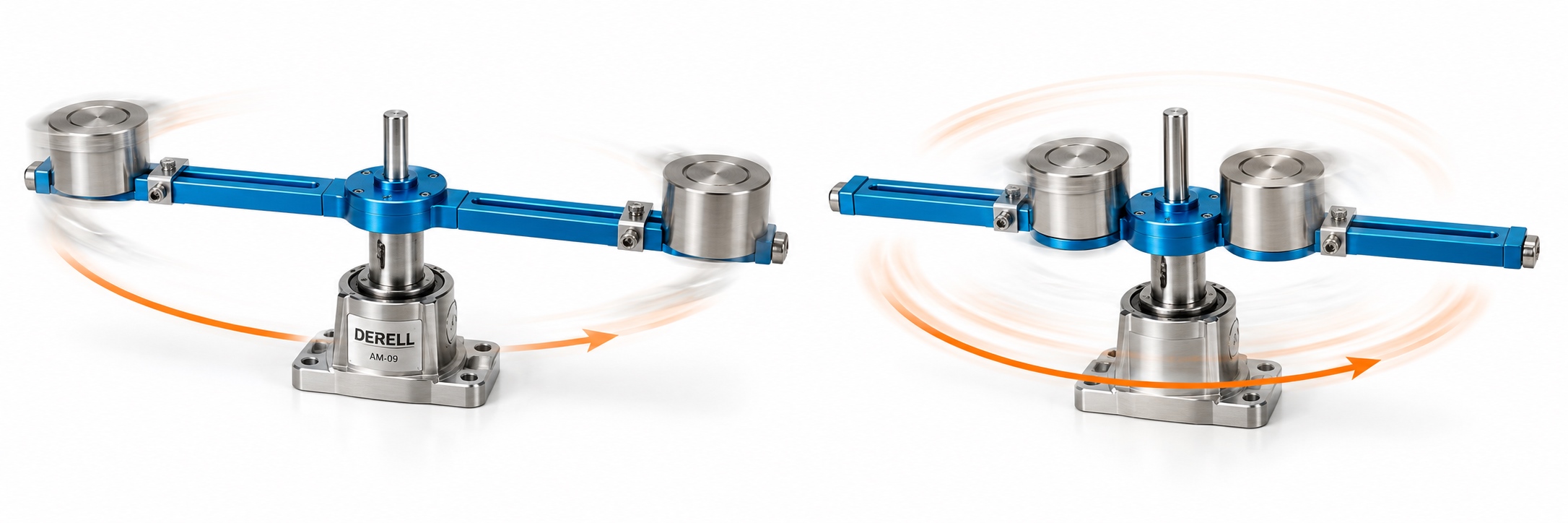
What is conservation of angular momentum?
Conservation of angular momentum means that a system’s total angular momentum remains constant when the net external torque about the chosen reference point is zero. Individual external forces do not all have to vanish; what matters is the sum of their torques. A system can spin faster while retaining exactly the same angular momentum.
This principle explains why a skater speeds up when pulling their arms inward, how coupled flywheels reach a shared speed, and how orbital motion behaves under an ideal central force. Start with what is momentum? and compare the quantities in linear versus angular momentum.
How is angular momentum defined?
A point particle’s angular momentum about O is L⃗O = r⃗ × p⃗. The position vector r⃗ runs from O to the particle; p⃗ is its linear momentum. The × symbol denotes a vector cross product. For several particles, total angular momentum is the vector sum of their individual values, all calculated about the same point.
For a rigid body rotating about a fixed z axis, the component along that axis is Lz = Izω. Here Iz is the moment of inertia about that axis, and ω is angular velocity. Their units are kg·m²/s, kg·m² and rad/s, respectively. When using L = Iω, specify the rotation axis and use the inertia about that same axis.
Moment of inertia depends on more than mass. For point masses, I = Σmiri², where ri is each mass’s perpendicular distance from the axis. Moving mass farther from the axis increases rotational inertia. If speed n is given in RPM, convert it to rad/s using ω = 2πn / 60.
The conservation condition: net external torque
About a fixed point O in an inertial reference frame, dL⃗O,total/dt = τ⃗O,external,net. Therefore, τ⃗O,external,net = 0 ⇒ L⃗O,total = constant. If only the external torque component along one axis is zero, the angular momentum component along that axis is conserved; the entire vector need not remain constant.
Torque describes a force’s turning effect about the chosen point: τ⃗ = r⃗ × F⃗. Its unit is the newton metre, N·m. Linear momentum conservation depends on net external force; angular momentum conservation depends on net external torque about the same reference.
The system boundary matters too. Frictional torques between two flywheels are internal interactions when both wheels belong to the system. Each wheel’s angular momentum can change while their total remains constant. Bearing friction or a motor torque applied from outside is an external influence on the chosen system. Before analysing momentum transfer, decide which components are included.
Why does moving mass inward increase spin speed?
For a system rotating about the same fixed axis with negligible external torque, the initial and final states satisfy Iinitialωinitial = Ifinalωfinal. Hence ωfinal = (Iinitial/Ifinal)ωinitial. This explains everyday examples such as a skater pulling their arms inward.
Consider two point masses of 2 kg each, positioned on opposite sides of the axis. Their distance from it changes from 0.50 m to 0.25 m. Neglect the inertia of the supports and mechanism; an internal mechanism pulls both masses inward together. With an initial angular velocity of 2 rad/s, Iinitial = 1 kg·m², Ifinal = 0.25 kg·m² and ωfinal = 8 rad/s. In both states, Lz = 2 kg·m²/s.
The animation compares two separate states of the same system; it does not show the inward movement between them. Stop resets the drawing to its starting view; Start begins the motion again.
Does conserved angular momentum mean constant energy?
Total energy is conserved; rotational kinetic energy alone need not remain constant. When radial motion has stopped in the initial and final states, Erotation = ½Iω² = Lz²/(2I) applies. In the example above, rotational energy rises from 2 J to 8 J. In the ideal setup, the required 6 J comes from work done by the mechanism pulling the masses inward. A skater supplies this energy through muscular work.
Keeping angular momentum constant does not make speeding up energy-free. For the distinction between these quantities, see the relationship between momentum and energy.
What happens when two flywheels are coupled?
The first flywheel has an inertia of 0.20 kg·m² and rotates at 30 rad/s. A second flywheel on the same axis is initially stationary and has an inertia of 0.10 kg·m². If external torque is negligible and friction brings them to a shared speed, ωshared = (I₁ω₁ + I₂ω₂)/(I₁ + I₂) = 20 rad/s. Total angular momentum is 6 kg·m²/s both before and after coupling.
Rotational kinetic energy falls from 90 J to 60 J. The remaining 30 J becomes internal energy, particularly heat. This resembles the energy conversion in inelastic collisions. If the wheels initially rotate in opposite directions, their velocities must carry opposite signs; choose a positive rotation direction first.
Planets, gyroscopes and quantum physics
Planetary motion: In the ideal two-body approximation, the central gravitational force produces no torque about the force centre. In an elliptical orbit, a planet speeds up as it approaches the centre and slows as it moves away, sweeping out equal areas in equal times. Gravity and initial conditions determine the orbit; conservation of angular momentum constrains the motion.
Gyroscopes and tops: A freely rotating symmetric rotor keeps the direction of its angular momentum when external torque is negligible. For a tilted top, gravity can exert torque about the support point, changing the axis direction through precession. Low friction does not automatically mean that every external torque is zero.
Quantum physics: Angular momentum magnitude and measurement outcomes along a chosen axis are associated with specific quantum values. The total can include both orbital angular momentum and spin. Electron spin should not be pictured as the classical rotation of a tiny ball; its conservation uses the quantum description.
Automation applications: load inertia and stopping
A servo motor or a motor powered by a variable frequency drive applies shaft torque when accelerating a load. If the load alone is the chosen system, its angular momentum changes. For constant inertia, τnet = Iα, where α is angular acceleration. Stopping the same load in less time requires greater net braking torque, so the ramp time must be considered together with load inertia.
An encoder can provide speed and position feedback; a PLC can manage the motion sequence. During stopping, suitable hardware can convert rotational energy to heat through dynamic braking, or return it as regenerative energy in a suitable system. Braking changes angular momentum towards zero while also managing where the energy goes.