
How are AWG and mm² converted?
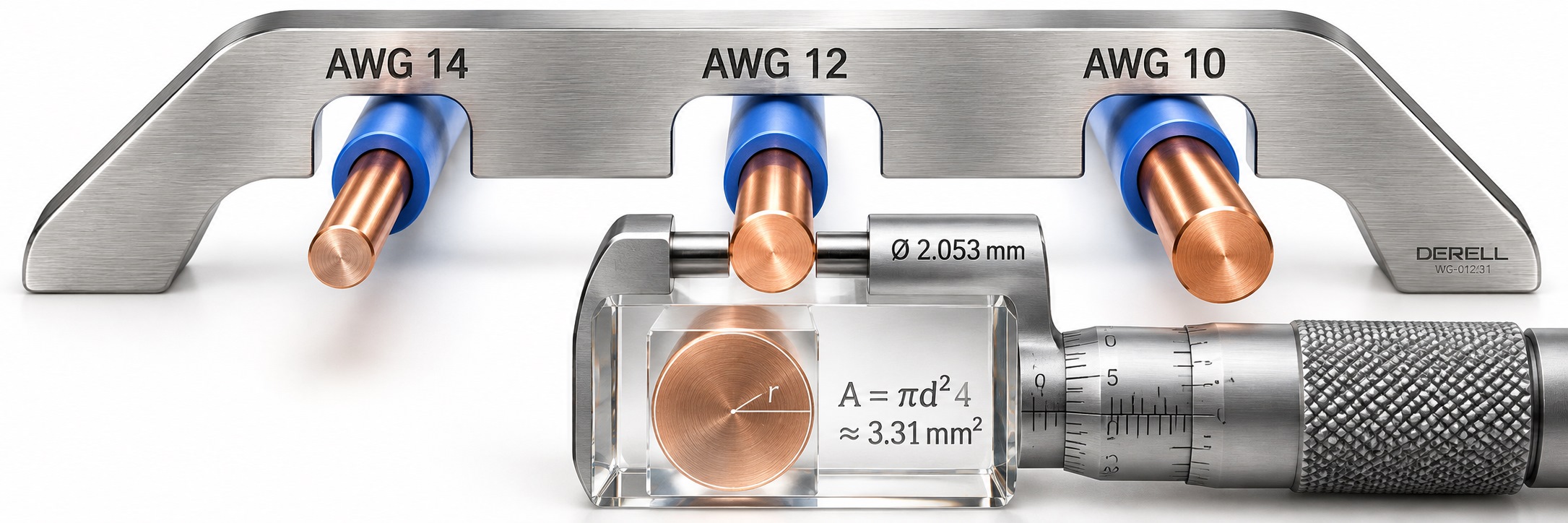
How do you convert AWG to mm²?
AWG expresses conductor size as a gauge number; mm² expresses its cross-sectional size as a metric area. To convert, look up the area corresponding to the AWG number. For example, 18 AWG is approximately 0.823 mm², 14 AWG approximately 2.08 mm², and 12 AWG approximately 3.31 mm² in theoretical equivalent area.
However, converting a size is different from choosing a replacement cable. Find the numerical equivalent first. If a cable will be replaced, also assess current-carrying capacity, voltage drop, insulation and termination compatibility. Simply choosing the nearest metric size is not a sufficient selection method.
Why does a higher AWG number mean a thinner conductor?
AWG stands for American Wire Gauge. In this system, larger numbers mean thinner conductors: 12 AWG is thicker than 14 AWG, and 14 AWG is thicker than 18 AWG. Gauge and area are not related linearly; dividing the gauge number by two does not give its area.
A useful approximate rule is that reducing the AWG number by three roughly doubles the area. For example, 20 AWG is about 0.518 mm² and 17 AWG about 1.038 mm². Use this rule for a quick comparison and the chart or formula for an accurate value.
AWG to mm² conversion chart
The values below describe the geometric equivalent of an ideal solid, round conductor. The diameter column refers to bare metal, not the outside diameter of an insulated cable. Actual strand construction and the area stated by a manufacturer may differ.
| AWG | Theoretical equivalent area (mm²) | Equivalent solid-wire diameter (mm) |
|---|---|---|
| 30 | 0.05093 | 0.2546 |
| 28 | 0.08098 | 0.3211 |
| 26 | 0.1288 | 0.4049 |
| 24 | 0.2047 | 0.5106 |
| 22 | 0.3255 | 0.6438 |
| 20 | 0.5176 | 0.8118 |
| 18 | 0.823 | 1.024 |
| 17 | 1.038 | 1.15 |
| 16 | 1.309 | 1.291 |
| 15 | 1.65 | 1.45 |
| 14 | 2.081 | 1.628 |
| 13 | 2.624 | 1.828 |
| 12 | 3.309 | 2.053 |
| 11 | 4.172 | 2.305 |
| 10 | 5.261 | 2.588 |
| 9 | 6.634 | 2.906 |
| 8 | 8.366 | 3.264 |
| 7 | 10.55 | 3.665 |
| 6 | 13.3 | 4.115 |
| 5 | 16.77 | 4.621 |
| 4 | 21.15 | 5.189 |
| 3 | 26.67 | 5.827 |
| 2 | 33.63 | 6.544 |
| 1 | 42.41 | 7.348 |
| 1/0 | 53.48 | 8.251 |
| 2/0 | 67.43 | 9.266 |
| 3/0 | 85.03 | 10.4 |
| 4/0 | 107.2 | 11.68 |
1/0, 2/0, 3/0 and 4/0 are also written as 0, 00, 000 and 0000 AWG. In this range, more zeroes mean a larger conductor: 4/0 AWG is thicker than 1/0 AWG. The notation 2/0 is not a mathematical division.
Can 2.5 mm² cable replace 12 AWG?
They are not equivalent in area. The theoretical area of 12 AWG is approximately 3.31 mm²; 2.5 mm² is about 24% smaller. Two nearby values in a chart do not establish that cables can carry the same load under the same conditions.
For an ideal comparison using the same material, length and temperature, R = ρ × L / A. Reducing area from 3.31 mm² to 2.5 mm² increases resistance by approximately 32%. At the same current, voltage drop and the heat loss calculated from I²R also increase. Check the manufacturer's resistance specification for the actual cable.
4 mm² is larger than the theoretical area of 12 AWG, but this does not automatically approve a substitution. The terminal's accepted size and conductor class, ferrule or lug, insulation temperature/voltage rating, and equipment instructions must be compatible. For the full selection process, see how electrical cable cross-section is selected.
How do you convert mm² back to AWG?
For a numerical comparison, find the closest area in the chart. If a design requires that the existing geometric area must not be reduced, look for an AWG candidate with equal or greater area. Because AWG runs in the opposite direction, this may require a smaller gauge number.
| Metric size | AWG candidate with no smaller area | AWG equivalent area |
|---|---|---|
| 0.5 mm² | 20 AWG | 0.5176 mm² |
| 0.75 mm² | 18 AWG | 0.823 mm² |
| 1 mm² | 17 AWG | 1.038 mm² |
| 1.5 mm² | 15 AWG | 1.65 mm² |
| 2.5 mm² | 13 AWG | 2.624 mm² |
| 4 mm² | 11 AWG | 4.172 mm² |
| 6 mm² | 9 AWG | 6.634 mm² |
| 10 mm² | 7 AWG | 10.55 mm² |
For example, 2.5 mm² is not exactly 14 AWG. At approximately 2.08 mm², 14 AWG is smaller; 13 AWG, at about 2.624 mm², is the first whole-number candidate that meets the geometric area requirement. If the chosen product range does not offer 13 AWG, 12 AWG may be assessed, subject to electrical and mechanical compatibility.
This second chart compares areas only; it is not an ampacity chart or a cable substitution approval between standards. Under IEC 60228, metric sizes are nominal conductor classifications with requirements for construction and resistance. An area calculated from the AWG formula and a nominal IEC cable label therefore do not establish identical products.
AWG conversion formula
To calculate a value outside the chart, first find the theoretical bare-conductor diameter. Let n be the AWG number, d the diameter in millimetres, and A the area in mm²:
d = 0.127 × 92((36 − n) / 39)
A = π × d² / 4
12 AWG example: With n = 12, d is approximately 2.0525 mm. Calculating π × 2.0525² / 4 gives about 3.309 mm², written as 3.31 mm² to two decimal places. Rounding intermediate calculations too early can cause small differences.
To calculate a theoretical AWG number from area, use n ≈ 36 − 19.5 × log(A / 0.0126677) / log(92). Enter A in mm² and use the same logarithm base in both terms. The result may be fractional; the nearest gauge and the candidate that does not reduce area need not be the same.
In the formula, use n = 0 for 1/0, n = −1 for 2/0, n = −2 for 3/0, and n = −3 for 4/0. Do not enter “2/0” as division on a calculator.
Why must diameter, core count and strand count be kept separate?
A 2 mm diameter is not a 2 mm² area. A bare, round metal conductor with a diameter of 2 mm has a geometric area of π × 2² / 4 = 3.14 mm². A 2 mm measurement taken over insulation cannot establish its metal area.
A stranded conductor includes gaps between strands. For equal-diameter strands, the total geometric metal area can be estimated from A = strand count × π × strand diameter² / 4. For example, seven strands of 0.20 mm give about 0.220 mm² of metal. This measurement alone does not verify nominal AWG classification, standards compliance or current-carrying capacity.
Core count and strand count are different: a single-core cable may have either a solid or a stranded conductor. See the difference between solid and stranded conductors. For stranded products, read nominal AWG, strand count/diameter and electrical specifications together in the manufacturer's data sheet.
Does AWG alone tell you how many amps a cable can carry?
No. An AWG–mm² chart describes conductor size. Allowable current depends on copper or aluminium construction, insulation temperature rating, installation method, ambient temperature, cable grouping and the number of loaded cores. Adding an unconditional “maximum amps” column to a conversion chart would therefore be misleading. See current-carrying capacity by cable cross-section.
The geometric AWG conversion is independent of material, but copper and aluminium of the same area do not have identical electrical behaviour. Resistance, termination requirements and allowable current may differ. The difference between copper and aluminium cables is therefore part of a replacement decision.
A long cable may meet thermal requirements while still producing excessive voltage drop. This is especially important in 12 V and 24 V circuits. Check voltage drop in a long cable and use the method explained in how voltage drop is calculated.
Common questions
Is 16 AWG the same as 1.5 mm²? No. Its theoretical area is approximately 1.309 mm². These are nearby sizes, not exact equals; product suitability must be assessed separately.
How many mm² is 14 AWG? Its theoretical equivalent is approximately 2.08 mm². “14 AWG = 2.5 mm²” is not an exact conversion.
How many mm² is 12 AWG? Approximately 3.31 mm² in theoretical area. 2.5 mm² is below that value and 4 mm² above it; this comparison alone does not authorise a substitution.
Are AWG and SWG the same? No. They are different wire gauge systems. A wire marked SWG must not be converted using an AWG chart.
Does the AWG of a stranded cable describe one tiny strand? The cable's nominal AWG describes the whole conductor's size; the gauge of an individual strand may be specified separately. The manufacturer's data sheet distinguishes the two.
Technical references
The chart and worked examples are calculated from the AWG geometric relationship and rounded for display. Manufacturer construction tables and IEC conductor classifications serve different purposes.
NBS/NIST — Copper Wire Tables, Handbook 100 | Alpha Wire — AWG/Metric Conductor Table | IEC 60228:2023 | LAPP — Current rating and dimensioning of cables and wires