
Servo motor prices
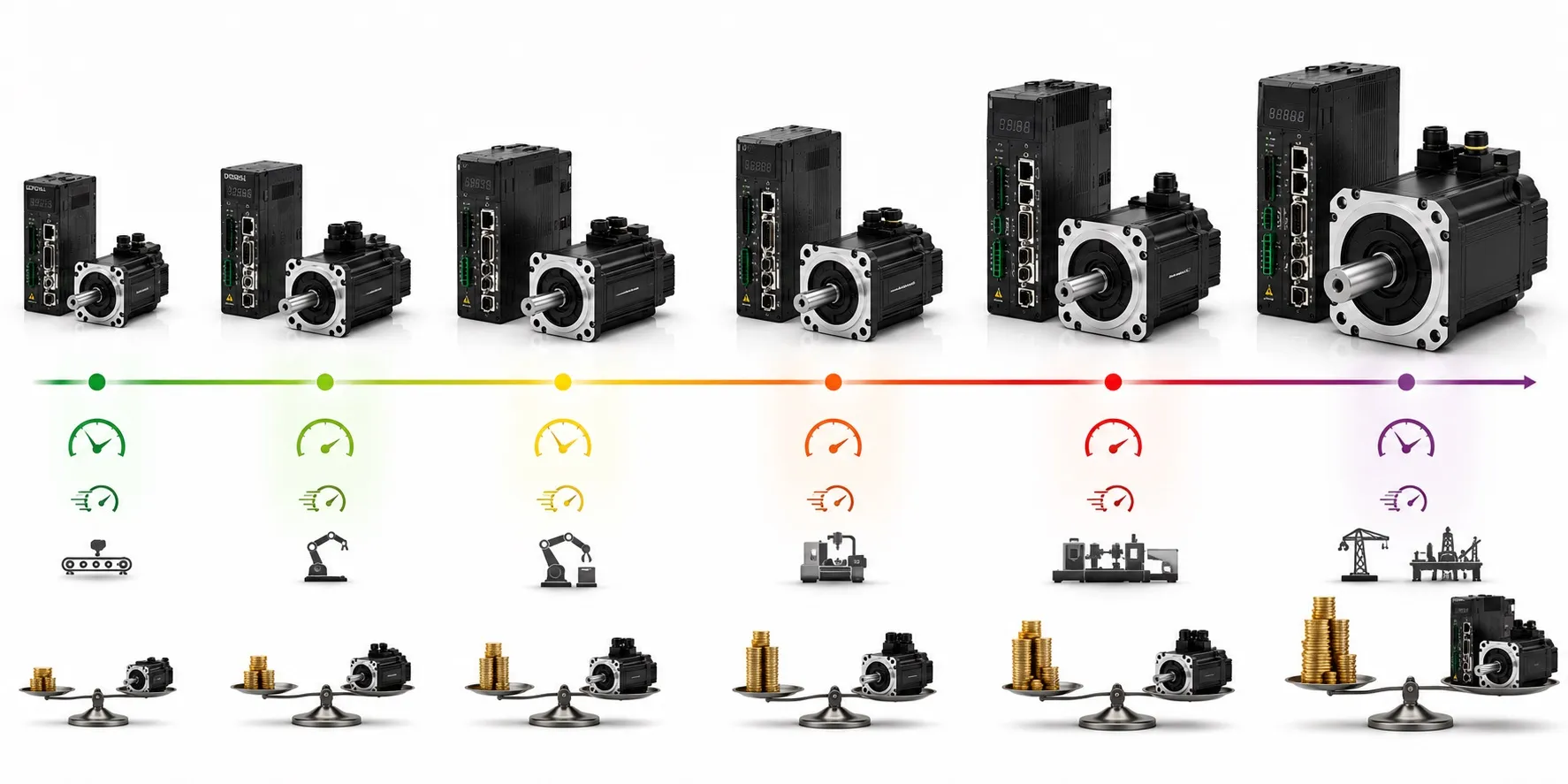
A useful price comparison starts with matching specifications
Servo motor prices depend on power, rated speed, torque, feedback, holding brake and product series. For products from 0.4 kW to 10 kW, comparing the power rating alone is insufficient. First establish whether the quotation covers the motor only, the motor and drive, or a package that also includes cables. A realistic budget for servo systems considers both the machine requirements and the scope of supply.
Motor prices and complete package prices cover different items
A motor price does not automatically include a compatible drive, power cable, feedback cable or brake connections. When reviewing servo motor and drive prices, identify each item separately. An apparently inexpensive quotation may charge extra for cables, connectors or the required communication option. Compare servo motor and drive pricing using the same product series, scope of supply and commercial terms.
Specifications that affect prices across the 0.4–10 kW range
Rated power and speed: Availability of ratings such as 0.4, 0.75, 1, 1.5, 2, 3, 5, 7.5 or 10 kW depends on the manufacturer's series. Motors with the same power rating can have different rated speeds and frame sizes. The relationship between power and torque is expressed as T = 9550 × P / n, where P is in kW, n in rpm and T in N·m. For example, 1 kW of mechanical power corresponds to approximately 3.18 N·m at 3000 rpm or 6.37 N·m at 1500 rpm. This calculation alone does not establish that a particular motor can operate at both points.
Continuous torque, peak torque and inertia: Choosing an oversized motor without a load and transmission calculation can add unnecessary motor and drive cost. An undersized motor may be inadequate during acceleration or sustained operation. For torque control applications, assess operating speed, duty cycle and the catalog torque-speed limits together. Peak torque is not a continuously available torque rating.
Comparing motors with and without a holding brake
When comparing servo motor packages with a brake and packages without a brake, keep the motor series, rated speed and feedback option consistent. Brake hardware adds cost, but no fixed USD premium or percentage applies across every manufacturer. Assess holding torque, brake supply, release and engagement times, and connection hardware separately. Also check the braked version's mass and inertia in its specifications.
Editor's note: The motor's holding brake primarily holds the shaft and load at standstill. It is not intended for repeated deceleration during normal operation. Vertical axes require appropriate brake selection and operating sequences; having a motor brake does not establish that every machine safety requirement has been met.
Feedback and drive compatibility directly affect the budget
Choosing an absolute encoder or incremental feedback can affect drive compatibility, position retention and accessory requirements. Encoder resolution alone does not determine the machine's positioning accuracy. When replacing an existing motor, check the complete part number, feedback protocol, mounting flange, shaft diameter and connector arrangement. Another motor with the same kW rating cannot simply be assumed compatible with the installed drive.
Pulse/direction, analog commands and control options such as EtherCAT are primarily assessed at the drive and controller level. The PLC needs the appropriate motion outputs or network support. Communication modules, software, commissioning and continuous-flex cable requirements can introduce costs that are not visible on the motor nameplate.
Information needed for a current quotation
For comparable quotations, specify the motor and drive part numbers, power and speed, brake option, feedback type, supply voltage and cable length. For a new axis, also provide the load, travel distance, target speed and duty cycle. Compare tax treatment, currency, quotation validity, stock availability and lead time on consistent terms. Broad USD ranges without an identified current model and scope of supply are an unreliable basis for a purchasing budget.
Total axis cost includes the motor, drive, cables, required mechanical transmission, brake supply and commissioning. For second-hand products, also assess operating condition, available test information, feedback and brake condition, and the availability of a matching drive. Compare the total cost of a compatible solution that meets the application requirements when making the purchasing decision.
Related topics
Understanding how servo systems work, speed, torque and position control, position control fundamentals, the home reference position and position loop gain helps determine whether the purchased system suits the application.
A complete axis budget also involves PLCs and HMIs, encoders, power supplies, the purpose of a braking resistor and servo gearboxes. The general principles discussed in the braking resistor article must be assessed alongside the selected servo drive's own regenerative resistor requirements.