
Servo Motor and Drive Prices
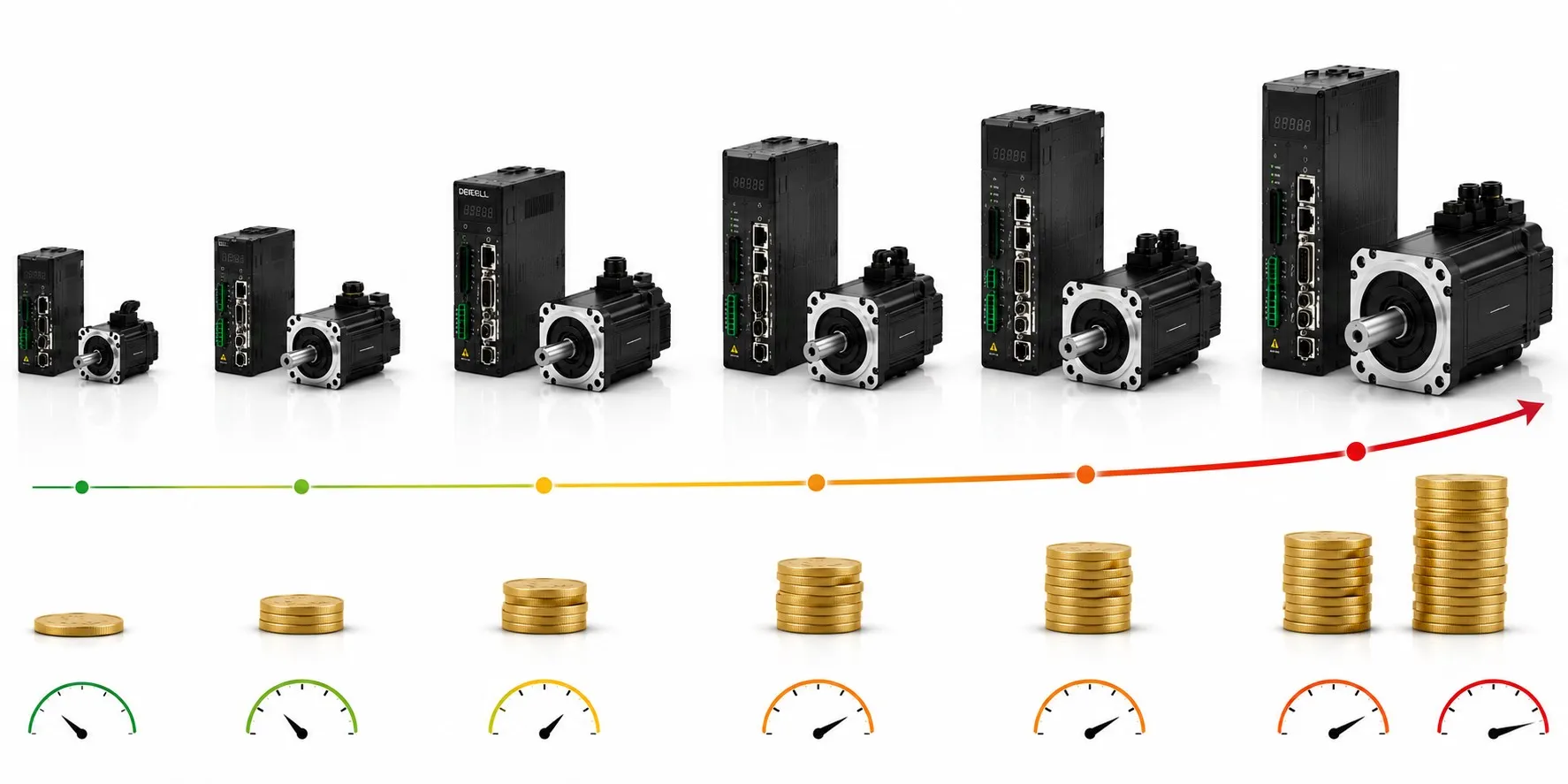
Compare complete kits with matching specifications
Servo motor and drive kit prices depend on power, brand and series, as well as the brake option, encoder type, control interface and included accessories. When comparing servo systems from 0.4 kW to 10 kW, first identify a kit that meets the application requirements. A useful servo price comparison requires more than matching power ratings and headline prices.
What does the kit price include?
The basic pairing is a servo motor and a compatible servo drive. Power cables, encoder cables, brake wiring, connectors and control connections may be supplied separately. Cable length, suitability for continuous flexing and preassembled connectors affect the total cost. Check separately whether a gearbox, coupling, controller, braking resistor and commissioning services are included.
Comparing prices from 0.4 kW to 10 kW
Among 0.4 kW servo kits and 0.75 kW servo kits, products with the same power rating can differ in brake configuration, flange size, rated speed and encoder. Even on a small axis, cycle time and acceleration requirements can change the appropriate model. The lowest-priced kit is not economical if it cannot deliver the required motion.
For 1 kW, 1.5 kW, 2 kW and 3 kW servo kits, compare rated torque, peak torque, motor speed, rotor inertia and drive current together. Two motors with identical power ratings may have different low-speed load capabilities and acceleration characteristics.
For servo kits rated at 5 kW and above, including the 10 kW class, assess supply voltage and phase requirements, cabinet cooling, cable sizing and braking energy in greater detail. Do not assume that price rises by a fixed multiplier with power: series features and auxiliary equipment also affect the budget.
Technical options that affect the price
The motor brake in braked servo kits is primarily a holding device for the de-energized state. Brake torque, supply and engagement/release times must suit the application; a standard holding brake should not be treated as a routine dynamic stopping brake or a personnel safety brake. Compare unbraked servo kits against the axis's requirement for secure load holding.
The feedback system also belongs in the price comparison. Distinguish incremental and absolute encoders, single-turn and multi-turn position information, and the interface supported by the drive. Higher encoder resolution alone does not guarantee greater machine accuracy. Backlash, compliance and loading conditions also affect the result.
Pulse/direction, analog commands and industrial network options must match the controller. Communication or safety options within the same series may require different drive part numbers. Confirm motor-drive compatibility, software support and the required parameter configuration and commissioning before purchasing.
Separate the product price from the completed axis cost
A comparable quotation should identify the motor part number, drive part number, accessories, cable lengths and scope of services. Include any required braking resistor and other energy-management equipment for rapidly decelerating axes or descending loads. Resistor selection must respect the drive's permitted ratings.
Compare VAT treatment, currency, exchange-rate terms, shipping, lead time, quotation validity and warranty coverage on the same basis. For imported products, an advertised price can differ from the total delivered cost. Consider spare-parts availability, technical support and potential machine downtime alongside the initial purchase price.
Buying only a motor or only a drive
Do not confuse the servo motor price with the price of a complete kit. When retaining an existing drive and replacing only the motor, matching power and flange dimensions is insufficient: verify feedback protocol, motor electrical data, connectors and the manufacturer's supported pairing. Replacing an older drive with a newer model also requires checking the controller interface and existing program.
Information needed for a current quotation
Provide the existing motor and drive nameplates, or specify the required power, rated speed, load, travel distance and cycle time. State the available mains supply, brake requirement, control interface, encoder preference, cable lengths and quantity. This allows a quotation to cover the required kit and accessories. Assess the current price and lead time together with the selected part numbers and quotation date.
Related servo topics
Selecting the right servo motor and drive, load and transmission calculations and speed and torque control help define the technical requirements behind the budget.
Positioning precision and accuracy and servo motor maintenance and repair cover performance and operating considerations that belong alongside the initial purchase price.
Other categories that complete the selection
Consider the PLC and EtherCAT communication on the control side, and encoders on the measurement side, as parts of the complete application.
Power supplies for brake or auxiliary control circuits and an appropriate IP protection rating can also affect accessory and installation costs.
Technical references
Kollmorgen: selecting a servo motor for the application
Beckhoff: motor holding-brake function and limitations
HEIDENHAIN: encoder resolution versus accuracy
These references support technical selection and comparison; they are not OtomasyonAVM selling prices or quotations.