
What factors should be considered when selecting a pump?
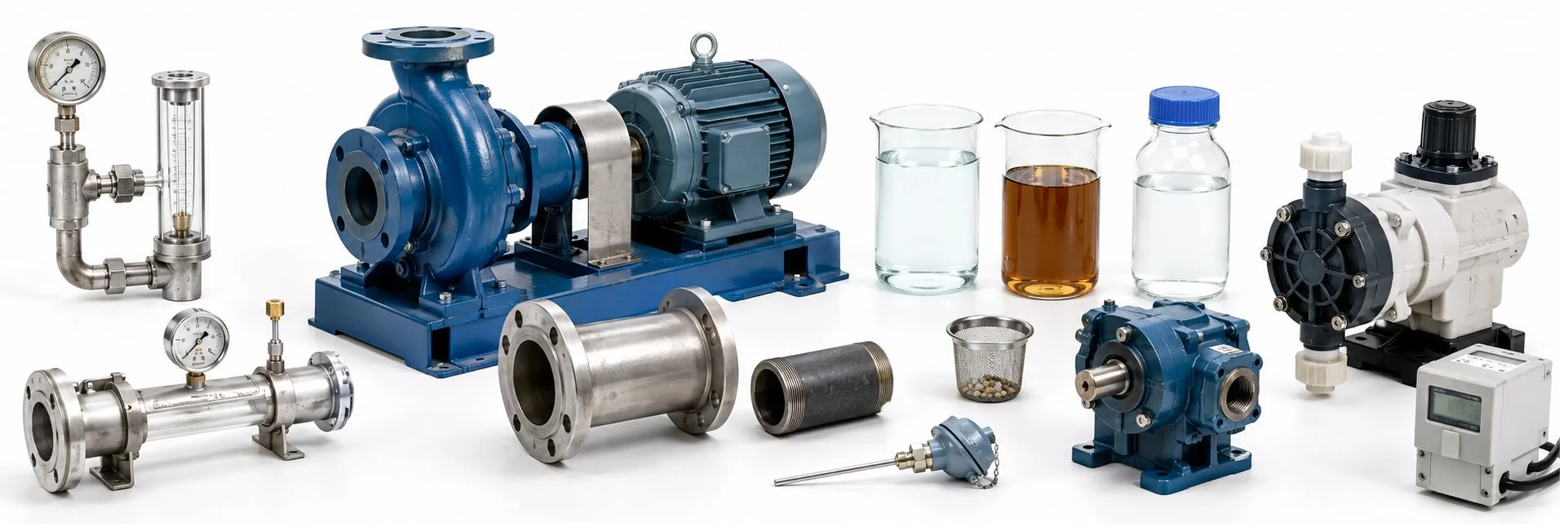
Specify the duty before choosing the pump
A good selection delivers the required flow at the required head, with the intended liquid, across the expected operating range. Brand, pipe connection size and motor kilowatts are not enough to define that duty. Start with what the pump must do, then describe the liquid and the system. The curve, efficiency-point and suction checks below focus on centrifugal pumps.
Write down demand and system resistance
Establish normal, minimum and peak flow requirements. An existing flow meter can provide better evidence than a rough estimate. A short demand peak may not justify one oversized pump that spends most of its life far below that duty. Record how often each operating condition occurs, not just its maximum value.
Total head includes elevation, friction in pipes and equipment, the difference in inlet and outlet pressure, and velocity-head differences where relevant. Filters, valves and heat exchangers matter. Building height is not directly the circulator head in a filled, closed loop. Circulation mainly requires overcoming flow resistance; static filling pressure is a separate consideration.
Read the curve for the proposed configuration
Maximum flow and maximum head usually describe different operating points. The required flow and head must occur together on the pump curve. The actual operating point is set by the intersection of the pump and system curves. For efficient selection, aim to keep frequent duties near the best efficiency point (BEP) and within the manufacturer's permitted range. Use curves for the proposed speed, frequency and impeller diameter, and check the full duty envelope.
A worked example of the required head
Consider water supplied from a tank open to atmosphere to an outlet 10 metres above its surface. The required flow is 6 m³/h. Total suction and discharge losses at that flow are 8 metres, and the outlet must retain 1 bar gauge pressure.
| Input | Example value | Selection consequence |
|---|---|---|
| Required flow | 6 m³/h = 100 L/min | Read the pump's head at this flow. |
| Elevation difference | 10 m | Add to the static head. |
| Suction and discharge losses | 8 m | Use total losses at the specified flow. |
| Required outlet pressure | 1 bar ≈ 10.2 m of water | Add because the source tank is at atmospheric pressure. |
Neglecting velocity-head differences gives H ≈ 10 + 8 + 10.2 = 28.2 m. The preliminary duty is therefore 6 m³/h at 28.2 m. That calculation does not establish suction suitability, materials or motor size. Changing tank levels and other operating conditions must also be evaluated.
Check the liquid before accepting water-test data
Temperature, density, viscosity, chemistry and solids affect design and performance. This helps explain the differences between water pumps and oil pumps. Do not assume a clean-water curve applies unchanged to a viscous or denser liquid; obtain the manufacturer's assessment. Select the pump design, solids passage, casing and sealing components for the service. Centrifugal describes the pumping principle, while submersible describes the installation arrangement: one pump can be both.
Make sure the suction supply is adequate
NPSHa describes the suction head available from the system; NPSHr is the pump's requirement. Available head must exceed the requirement by the margin appropriate to the application. There is no single margin suitable for every pump. Assess the lowest liquid level, temperature, altitude and suction losses. A strong discharge curve cannot compensate for inadequate suction conditions. Insufficient margin can lead to cavitation and damage.
Match the motor and controls to the duty
The motor rating must cover pump shaft-power requirements throughout the allowed operating range. Check voltage, phases, frequency, duty duration and start frequency. With a variable frequency drive, verify permitted speeds and motor cooling. PID control or a float level switch may suit different duties. Choose pump control for the process; fitting a drive alone does not ensure correct sizing or energy savings.
Also assess installation space, ambient conditions, connections, pipe loads and maintenance access. Noise, vibration and overheating depend on operating conditions as well as the equipment. Critical duties may need a standby pump and a plan for replacement-part lead times.
Ask for evidence with the quotation
Provide liquid details, flow and head requirements, temperatures, suction levels and pipework data, followed by the electrical supply, operating hours, controls and installation arrangement. Request a performance curve with the proposed duties marked, plus efficiency, shaft power, NPSHr and material/seal specifications. State uncertainties explicitly so the supplier can assess them.
Continue exploring
Pump questions and answers · Calculating pump power · Water and oil pump differences · Reducing energy use
Technical references
KSB — Pump characteristic curves
KSB — Liquid properties and pump selection
KSB — NPSH and suction conditions