
OL Fault codes
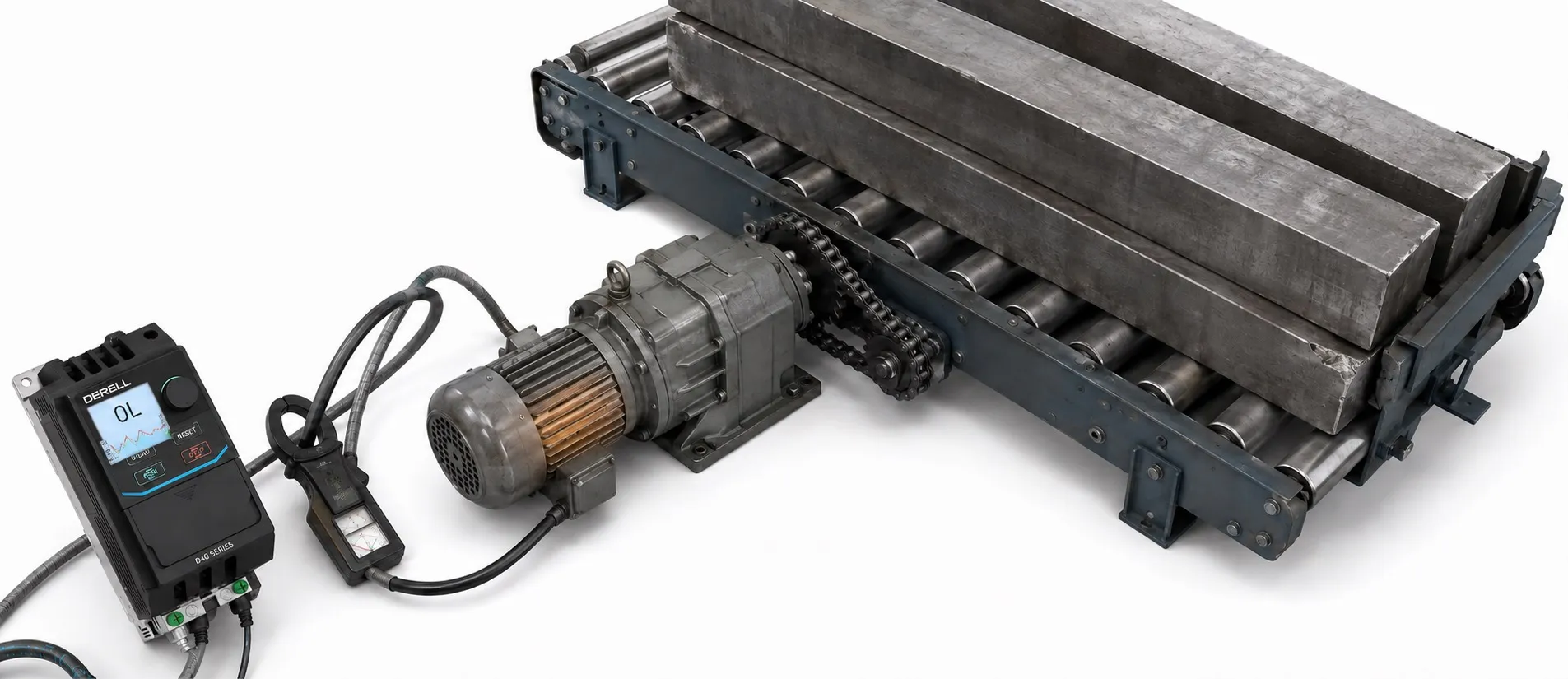
What Does an OL / Overload Fault Mean on a VFD?
OL – Overload generally means that the motor or the VFD has exceeded its permitted load or thermal capability for a sufficient period of time.
The easiest way to understand OL is to compare it with Overcurrent:
If OC is the current's sudden scream, OL is the thermal footprint that current leaves over time.
A motor may operate above rated current briefly without producing an overload trip.
If the same overload continues long enough, however, heat accumulates in the motor or in the drive power stage and overload protection can operate.
So the useful question is not only:
“How high is the current?”
but:
“How high is the current, and how long has it been there?”
For the complete fault family, see the OtomasyonAVM VFD Fault Codes guide.
Why doesn't OL trip immediately?
Motors and drives are normally designed to tolerate temporary overload.
Acceleration, temporary process load and other operating events can require current above the continuous rating.
Electronic motor overload protection therefore commonly uses an inverse-time thermal model.
The principle is simple:
The larger the overload, the shorter the permitted operating time.
This allows temporary legitimate overload while still protecting the motor from sustained thermal stress.
Motor Overload vs Drive Overload
Motor Overload protects the motor's thermal capacity.
The VFD may estimate motor thermal loading from output current, operating time, configured motor rated current and, depending on the drive, motor speed or cooling characteristics.
For the dedicated topic, see Motor Overload Protection.
Drive Overload protects the VFD's own rectifier, inverter power stage and thermal capability.
A perfectly healthy motor can still produce Drive Overload if the VFD itself is undersized or continuously operated beyond its duty rating.
Why is the motor rated-current parameter so important?
The electronic thermal model does not magically know the size of the connected motor.
The motor nameplate current has to be configured correctly.
If a 5 A motor is configured as an 8 A motor, the electronic model can underestimate motor thermal loading.
If an 8 A motor is configured as a 5 A motor, nuisance overload trips can occur.
The motor-rated-current setting is therefore a protection parameter, not merely a commissioning detail.
Can low-speed operation cause motor overload?
Yes.
Many general-purpose induction motors use a shaft-mounted cooling fan.
At 50 Hz the fan provides relatively strong airflow.
If the same motor produces high torque for a long time at 10 Hz, the shaft fan also rotates much more slowly and motor cooling can be dramatically reduced.
Some VFD motor thermal models compensate for this reduced low-speed cooling.
Why can repeated starts and reversals produce OL?
Every acceleration cycle requires additional torque and current.
If the machine repeatedly starts, stops and reverses before the motor has time to cool, thermal load can accumulate from cycle to cycle.
This makes the actual machine duty cycle important when sizing both the motor and the VFD.
OC, Stall and OL can all come from the same jam
A mechanically jammed machine does not always produce the same fault first.
If current rises extremely quickly, the drive may trip on OC / Overcurrent.
If the motor remains at low speed while trying unsuccessfully to move the heavy load, the system may enter a Motor Stall condition.
If elevated current continues for long enough, the motor or drive thermal model may finally produce OL.
A useful distinction is:
OC = fast high-current protection.
STALL = motor cannot sustain the required motion.
OL = thermal capacity is being consumed over time.
Is OL the same as OH?
No.
OH / Heatsink Overtemperature usually refers to a measured heatsink or power-module temperature.
Drive overload is based on the manufacturer's allowed overload/thermal capability.
The two conditions can interact, but they are not the same protection function.
What do OL1, OL2 and OL3 mean?
There is no universal OL1 / OL2 / OL3 dictionary.
The exact manufacturer and drive family must be checked.
For example, on many Yaskawa drives:
oL1 = Motor Overload
oL2 = Drive Overload
oL3 = Overtorque Detection 1
On many current INVT drives:
OL1 = Motor Overload
OL2 = VFD / Inverter Overload
and OL3 may not appear in that basic fault family at all.
This means that an OL3 code should never automatically be interpreted as “third-stage overload.”
The correct search method is:
manufacturer + exact drive model + OL3
Motor Overload vs Overtorque
These are different concepts.
Motor overload is primarily a thermal protection function.
Overtorque detection monitors whether motor current or estimated torque exceeds a configured threshold for a defined period.
This is why Yaskawa's oL3 example is important: a code beginning with “oL” does not necessarily mean electronic motor thermal overload.
What if one VFD runs several motors?
This is an important special case.
The VFD sees the total output current, but it may not know the individual thermal condition of each motor connected in parallel.
One motor can therefore be overloaded while the combined current still appears acceptable.
Depending on the manufacturer and machine design, each motor may require its own thermal overload protection or temperature sensing.
Can ambient temperature and altitude affect overload?
Yes, but carefully distinguish cause and fault code.
High ambient temperature and high altitude can reduce the available cooling margin and may require drive derating.
This does not mean that “high altitude automatically creates OL”.
It means the permitted continuous current or overload capability may be lower than under standard conditions.
A practical OL troubleshooting sequence
1. Confirm whether the code means Motor Overload, Drive Overload or another function.
2. Compare motor nameplate current with the VFD motor-rated-current parameter.
3. Read actual motor current from the drive monitor or suitable measurement equipment.
4. Record how long the machine runs before OL occurs.
5. Inspect the mechanical load. Bearings, gearbox, belt, conveyor, pump and process conditions.
6. If OL occurs mainly at low speed, investigate motor cooling.
7. If the machine cycles frequently, examine the duty cycle.
8. For Drive Overload, verify VFD size and Normal Duty / Heavy Duty rating.
9. Check enclosure temperature and any altitude derating requirements.
10. Do not increase overload settings simply to silence the fault.
Why does OL return immediately after reset?
If the actual machine load has not changed, resetting the drive does not remove the overload.
Thermal stress also does not disappear instantly when current becomes zero.
Some protection systems retain thermal memory until sufficient cooling has occurred.
The exact reset behaviour depends on the drive family.
Editor's field note
When I see OL, I look at amps first — but immediately ask how long.
A 5 A motor drawing 6 A for two seconds is not the same machine as a 5 A motor drawing 6 A for forty minutes.
Then I ask one more question:
“At what frequency is the motor operating?”
A self-cooled motor carrying the same current at 10 Hz and 50 Hz does not necessarily have the same thermal margin.
And finally:
Is the motor overloaded, or is the drive overloaded?
Replacing parts before answering that question is not troubleshooting — it is guessing.
VFD OL / Overload FAQ
What does OL mean on a VFD?
It generally indicates that a permitted motor or drive load/thermal capability has been exceeded for a sufficient period.
Are OL and OC the same?
No. OC is normally a fast high-current protection event; OL represents accumulated overload or thermal stress.
Does OL1 always mean Motor Overload?
No. It is common on Yaskawa and INVT families, but fault codes are manufacturer-specific.
Does OL2 always mean Drive Overload?
No. It is common, but the exact drive manual must be checked.
Does OL3 mean third-stage overload?
No. On many Yaskawa drives oL3 means Overtorque Detection 1.
Can low-speed operation cause OL?
Yes. Self-cooled motors can have much less cooling airflow at low shaft speed.
Can repeated starts cause OL?
Yes. Thermal energy can accumulate when the motor does not have enough cooling time between cycles.
Are OH and OL the same fault?
No. OH generally refers to measured heatsink temperature; OL is a load/thermal-overload protection function.
Will a larger VFD fix Motor Overload?
Not if the motor itself is overloaded. A larger drive does not increase motor thermal capacity.
Can I simply increase the overload setting?
Only when the existing setting is genuinely incorrect. Increasing protection limits does not remove a physical overload.
Related VFD fault topics
VFD Fault Codes · OC / Overcurrent · OH / Heatsink Overtemperature · Motor Stall