
Motor Stall fault
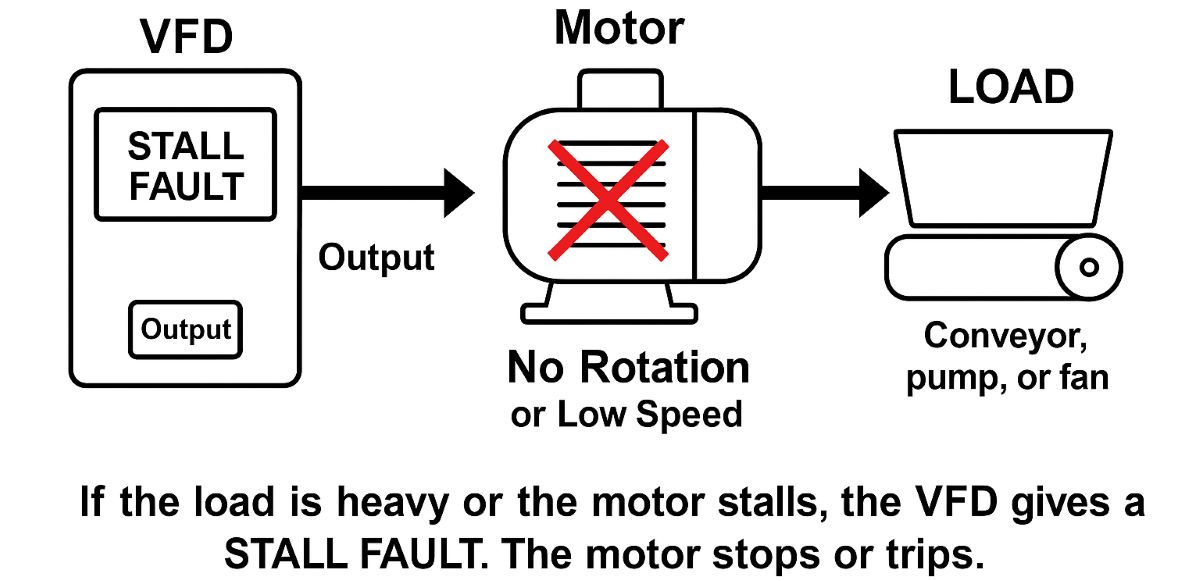
Motor Stall Fault – Visual Animation
the motor stalls, current spikes, and protection trips instantly.
A "Motor Stall Fault" in a Variable Frequency Drive (VFD) typically indicates that the motor has failed to start or is unable to maintain the required speed for operation. In simpler terms, the motor is "stalling" or not able to keep up with the commanded speed or load. This fault can be triggered for various reasons:
Common Causes of Motor Stall Faults:
Overload Conditions: Too much mechanical load on the motor can cause it to stall.
Mechanical Binding: Physical obstructions that prevent the motor shaft from turning freely.
Electrical Issues: Problems like phase imbalance or low supply voltage can result in a stall condition.
Incorrect Settings: Incorrect parameters set in the VFD, such as acceleration/deceleration times, can cause the motor to stall.
Poor Motor Condition: Worn-out components in the motor like bearings can also lead to stall conditions.
Troubleshooting Steps:
Check for Mechanical Obstructions: Make sure there are no physical impediments to the motor shaft's free rotation.
Verify Electrical Connections: Check if the electrical wiring is correct and that the motor is receiving adequate voltage.
Review VFD Settings: Verify that all the parameters are set correctly for the motor's specifications.
Examine the Motor: Check the motor's condition to see if any components need replacement.
Run Tests: Operate the motor at lower speeds or loads to see if the problem persists.
If the stall fault condition continues despite these checks, it may be advisable to consult with a professional for a thorough diagnosis and repair.
Note: Always follow safety procedures and consult the VFD and motor manuals when troubleshooting.
One critical point to remember: Most of the time, a stall fault is actually a *protection mechanism* triggered by the VFD to prevent serious damage to both the motor and the mechanical system. Just resetting the fault and moving on might solve it temporarily, but if you don't identify the true cause, you risk far more expensive failures down the road.
Some technicians immediately blame the motor size, assuming "the motor is too small" and try to swap it out. In reality, the real culprit is often *incorrect parameter settings*, poor installation, or neglected maintenance. Before upsizing the motor, always check the system design, wiring quality, and mechanical resistance thoroughly.
Practical tip: If the stall fault happens only at high load, especially during startup, try increasing the acceleration ramp time in the VFD, or check the current limit parameters. Fast acceleration can cause the drive to demand more current than the motor or power supply can safely provide, which quickly leads to a stall or protection trip.
Finally, for persistent stall faults, don't forget to use a thermal camera to inspect bearing and winding temperatures, run insulation resistance tests, and always stick to a regular maintenance schedule. That way, you avoid unnecessary motor replacements and keep your entire system reliable for the long run.
Your shopping cart is empty!