
What are the differences between CNC machines and 3D printing?
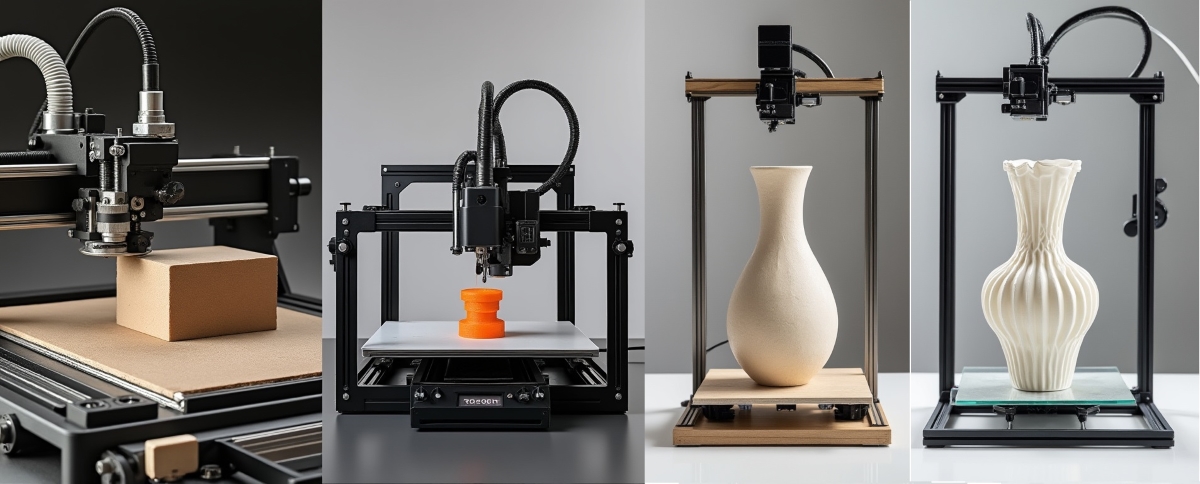
Remove material or build the part layer by layer?
Hello everyone. CNC milling and turning shape a part by removing material, whereas 3D printing generally builds it by joining material layer by layer. Tool access is a central consideration in machining; build orientation and layer formation matter in additive manufacturing. Understanding how CNC works and the different 3D printing technologies helps identify which process can meet the component’s requirements.
A useful comparison goes beyond machine speed or raw material price. Assess equivalent geometry, function, material requirements, tolerances and production quantity. Checking a component’s appearance and proving that it can operate under load are different objectives.
Editor’s note: CNC describes computer-controlled machine motion, rather than being another name for subtractive manufacturing. This page compares CNC milling and turning with additive manufacturing. Some industrial systems combine material deposition and milling in one machine, so the technologies are not mutually exclusive.
Production process: stock material versus printing feedstock
CNC machining can start from a block, bar, plate or preformed component. Cutting operations create the required surfaces. The materials that CNC equipment can machine depend on the machine and tooling. Not every part needs to be carved from a large solid block: a casting or forging may need machining only on its critical features.
3D printing includes distinct processes. FFF/FDM extrudes thermoplastic material; SLA cures liquid photopolymer with light; SLS processes polymer powder; metal powder bed fusion is a different industrial process. Whether the printing material is filament, resin or powder affects part properties and the processing chain. An ABS-like resin should not be treated as the same material as ABS thermoplastic.
Geometry: cutter access and cleanable internal features
In machining, tool diameter, tool length and access to the part constrain the design. A rotating end mill, for example, leaves a radius rather than a perfectly sharp internal pocket corner. Complex geometries may require additional setups, special tools or more machine axes.
3D printing can offer greater freedom for lattices, lightweight structures and certain internal channels. This does not mean that every imaginable cavity is straightforward to manufacture. It must be possible to remove supports, drain resin or clear residual powder. Particularly in enclosed or narrow channels, manufacturability includes cleaning after the build.
Dimensional accuracy: layer height is not a tolerance
CNC milling and turning can suit critical holes, bearing seats and mating surfaces. However, achievable machining accuracy depends on the machine, tools, workholding, temperature and inspection conditions. A single tolerance should not be assumed for every CNC machine and component.
In 3D printing, layer height and resolution influence feature reproduction; they do not establish equivalent dimensional accuracy throughout the part. Shrinkage, warping and orientation can change the result. If a bearing must fit correctly, produce and measure the relevant feature rather than relying on a resolution figure.
Surfaces and finishing: leaving the machine is not the end
Machined parts can retain tool marks or require deburring; some surfaces need grinding, polishing or coating. Printed parts may have layer steps, support marks or a powdery surface, depending on the process. Improving a printed surface can also alter dimensions, so finishing belongs in the production plan.
SLA parts require washing and, depending on the material, post-curing. Powder-based processes require depowdering; metal printing may need support removal and other finishing operations. Time and cost must be counted until the part reaches its acceptable final condition.
Strength: a shared material name does not guarantee identical behaviour
Particularly in filament printing, layer orientation, bonding between layers and infill affect performance under load. Increasing printed part strength involves more than raising the infill percentage. The relationship between build orientation and service loads must be assessed.
Metal prints and all polymer prints should not be assigned to a single strength category. Machined stock properties also depend on alloy and manufacturing history. Where mechanical performance in service matters, examine the test conditions behind datasheet values and use appropriate mechanical testing where necessary.
Speed: compare more than cutting or printing time
Programming, workholding, tool setup and repositioning contribute to machining lead time. Model preparation, slicing, build arrangement, cooling and finishing contribute to printing lead time. A simple machined part may be completed quickly, while printing may favour a prototype that is difficult to fixture. To optimise the production process, compare the time from preparation to an inspected component.
Cost and quantity: there is no universal crossover point
CNC cost includes stock, preparation, tooling, cycle time and inspection. 3D printing time and cost must include feedstock, machine utilisation, supports, labour, finishing and failed builds. There is no rule that a single part is always cheaper to print, or a large batch always cheaper to machine.
3D printing can support series production; build packing and finishing capacity matter. In CNC series production, spreading setup effort across repeated parts and using automation can provide advantages. Base the decision on quotations meeting the same acceptance criteria and a realistic production plan.
Waste and environment: fewer chips are not the complete measure
Assessing the environmental impact of CNC machining includes material removal, chip recovery, energy and cutting fluids. The sustainability of 3D printing also depends on supports, failed builds, conditions for powder reuse, washing waste and energy consumption. Compare processes per accepted, usable component; visible material waste alone gives an incomplete picture.
Combining processes: print the geometry and machine critical features
A suitable metal part can be additively manufactured before its mounting surfaces and precision holes are machined. Some hybrid machines combine deposition and milling in the same system. Machining allowances, datum features and workholding must be designed in advance. Combining processes does not remove the need for quality control; specify which requirement each stage will fulfil.
A workshop example: decide what the first part needs to prove
If a sensor bracket is needed only to check mounting space and cable routing, a suitable printed model may speed up prototyping. If the bracket will operate around heat, oil or vibration, material and strength need separate assessment. CNC machining may suit an accurate sliding component made from specified stock. A part needing both complex internal geometry and precision mounting surfaces may justify additive manufacturing followed by machining. Function and acceptance requirements should drive process selection before appearance.
Related manufacturing topics
CNC control systems, CNC questions, 3D printer questions, prototyping, production quality control.
Sources
NIST: additive manufacturing and measurement research
Sandvik Coromant: workpiece materials and machinability
UltiMaker: orientation, layer bonding and design constraints
Formlabs: washing, curing and post-processing
EOS: metal depowdering and downstream processing