
What is IEC 61008? RCCBs and residual current protection
Dear colleagues,
IEC 61008 is the product standard series for household and similar-use RCCBs. An RCCB is a residual current operated circuit breaker without integral overcurrent protection. Understanding the differences between an MCB, an RCD and an RCBO helps identify what protection a device actually provides.
IEC 61008-1:2024 is the fourth edition of the general rules. Its scope covers RCCBs rated at no more than 440 V AC and 125 A, at 50 Hz, 60 Hz or 50/60 Hz. These are the standard’s scope limits; they do not mean every device can operate at all those limits. Use the ratings declared for the actual product.
How does IEC 61008 differ from IEC 61009?
IEC 61008: RCCB — residual current protection. An RCCB has no integral protection that detects overload or short circuit. It requires coordination with a suitable fuse or circuit breaker. IEC 61009: RCBO — residual current and overcurrent protection combined. For miniature circuit breakers providing overcurrent protection in household and similar installations, IEC 60898 is another relevant standard family. Treating these functions as interchangeable can leave a circuit incorrectly protected.
How does an RCCB detect leakage?
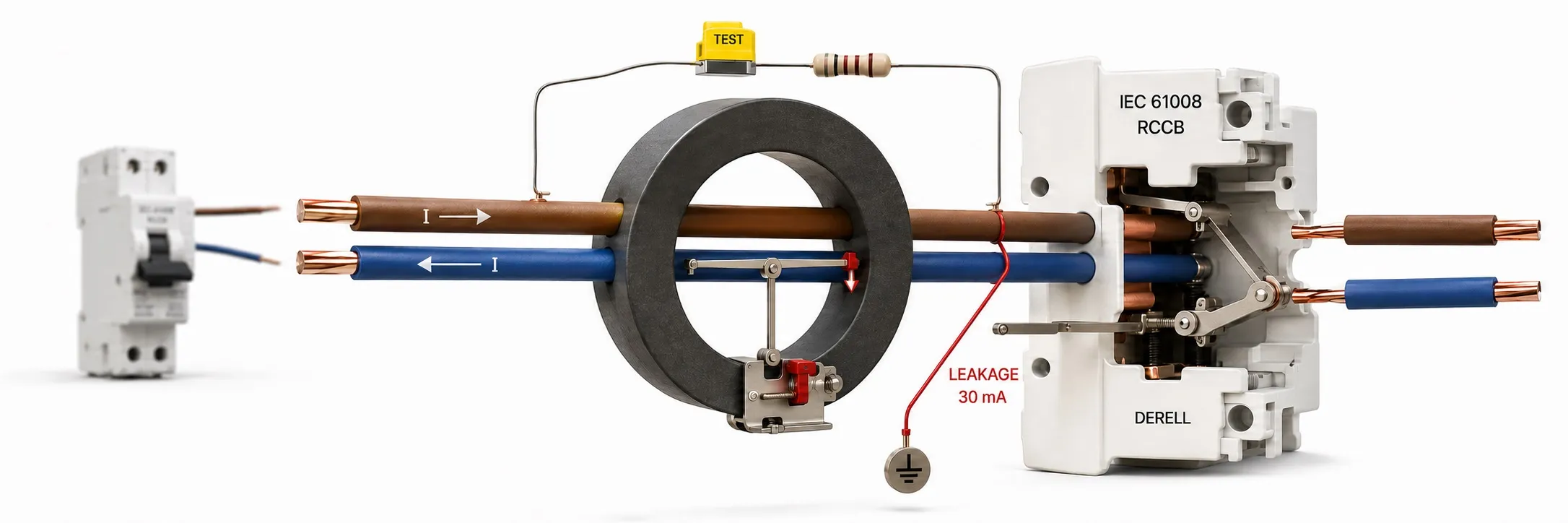
In a single-phase circuit, the phase and neutral pass through a common sensing ring. During normal operation, their currents balance. If insulation failure allows some current to return through another path, a residual current, IΔ, appears. In a three-phase circuit, the device monitors the vector sum of the phase currents and the neutral current, where present.
An RCCB does not operate by directly measuring current in the PE conductor. Protective earth does not pass through the sensing ring and must not be switched. Earthing and residual current protection perform different duties; neither replaces the other. The RCCB opens its contacts when the applicable residual current and time conditions are met.
Animation: normal operation → insulation fault → trip
Select Start / Replay to run the demonstration. The red dashed line represents an example leakage path from phase to PE. When the RCCB trips, the load supply and the illustrated leakage current are interrupted. Stop / Reset returns the demonstration to its initial state.
The sequence is slowed down for teaching; its timing is not an actual trip time or a test result. Tripping does not repair the insulation fault. In a real installation, the fault must be corrected before restoring power. The supply side may remain live, and PE remains connected throughout the sequence.
How should you read the device markings?
In — rated current: A marking such as 40 A describes the device’s rated current-carrying capability under specified conditions. This ampere rating does not mean an RCCB provides overload protection above 40 A. IΔn — rated residual operating current: A marking such as 30 mA relates to residual current protection. 40 A and 30 mA describe different properties.
Un and frequency: The rated voltage, frequency, pole arrangement and wiring diagram must suit the circuit. Conditional short-circuit ratings must also be assessed with the upstream protective device specified by the manufacturer. A kA marking on an RCCB does not automatically make it an RCBO with overcurrent protection.
30 mA and 300 mA serve different purposes
Correctly selected RCDs rated at 30 mA or less provide additional protection against electric shock. A 300 mA device may be used in a suitable installation arrangement to protect against fire risks caused by insulation leakage. The difference between 30 mA and 300 mA is not simply a choice between “more sensitive” and “more powerful”. A 300 mA device does not replace 30 mA additional protection for people.
What changes between types AC, A, F and B?
RCD types AC, A, F and B differ in the residual current waveforms they can detect. Check the equipment manufacturer’s instructions for electronic loads, variable frequency drives and other converter circuits. IEC 62423 addresses additional product requirements for types F and B. An RCD’s “type B” is a different classification from an MCB’s B trip curve.
Which characteristics does the standard assess?
Product tests assess residual current operating behaviour, insulation, contact and terminal construction, and mechanical and electrical endurance. An IEC 61008 marking alone does not indicate waterproof construction or unlimited environmental resistance. Check the ambient temperature limits, enclosure conditions and the product’s declared ingress protection separately.
IEC publishes a product standard; a standard number on the label is not, by itself, independent certification. Review the manufacturer’s conformity documentation, relevant test or certification records where required, and applicable national requirements. Protective-device standards and EN 61008 should be read in that context. A product standard alone does not verify the design or installation of the complete electrical system.
The test button and maintenance
The T or TEST button creates an artificial current imbalance inside the device to check its tripping function. Follow the manufacturer’s instructions and applicable maintenance requirements for the test interval; one interval should not be assumed for every product and environment. Account for connected equipment beforehand because the test may disconnect its supply.
The test button does not measure earth resistance or PE continuity. Appropriate measurements are needed to verify the installation. If the test button fails to trip the device, a competent person must assess the supply, wiring and device condition. A failed button test alone does not establish the exact cause.
All active conductors of the protected circuit, including neutral, must pass through the correct device. Do not mix the downstream neutrals of different protective devices, and provide separate short-circuit protection. Assess protective-device selection and upstream/downstream selectivity using the manufacturer’s data. Maintenance requires suitable isolation, prevention of re-energisation and verification of absence of voltage.
Why does an RCCB keep tripping?
Residual current trips may be associated with insulation faults, wiring errors or the combined leakage currents of several loads. Trips at night or during rain also need investigation in context. Bypassing the protective device or arbitrarily changing its sensitivity is not a solution. Some electric shock scenarios may not produce a detectable residual current; having an RCCB does not remove the need for safe working practices.
This article provides general technical information. Follow the applicable standards, manufacturer’s documentation and assessment by a competent person for an actual installation. You may share this article with attribution to Otomasyon AVM.