
IEC 61427
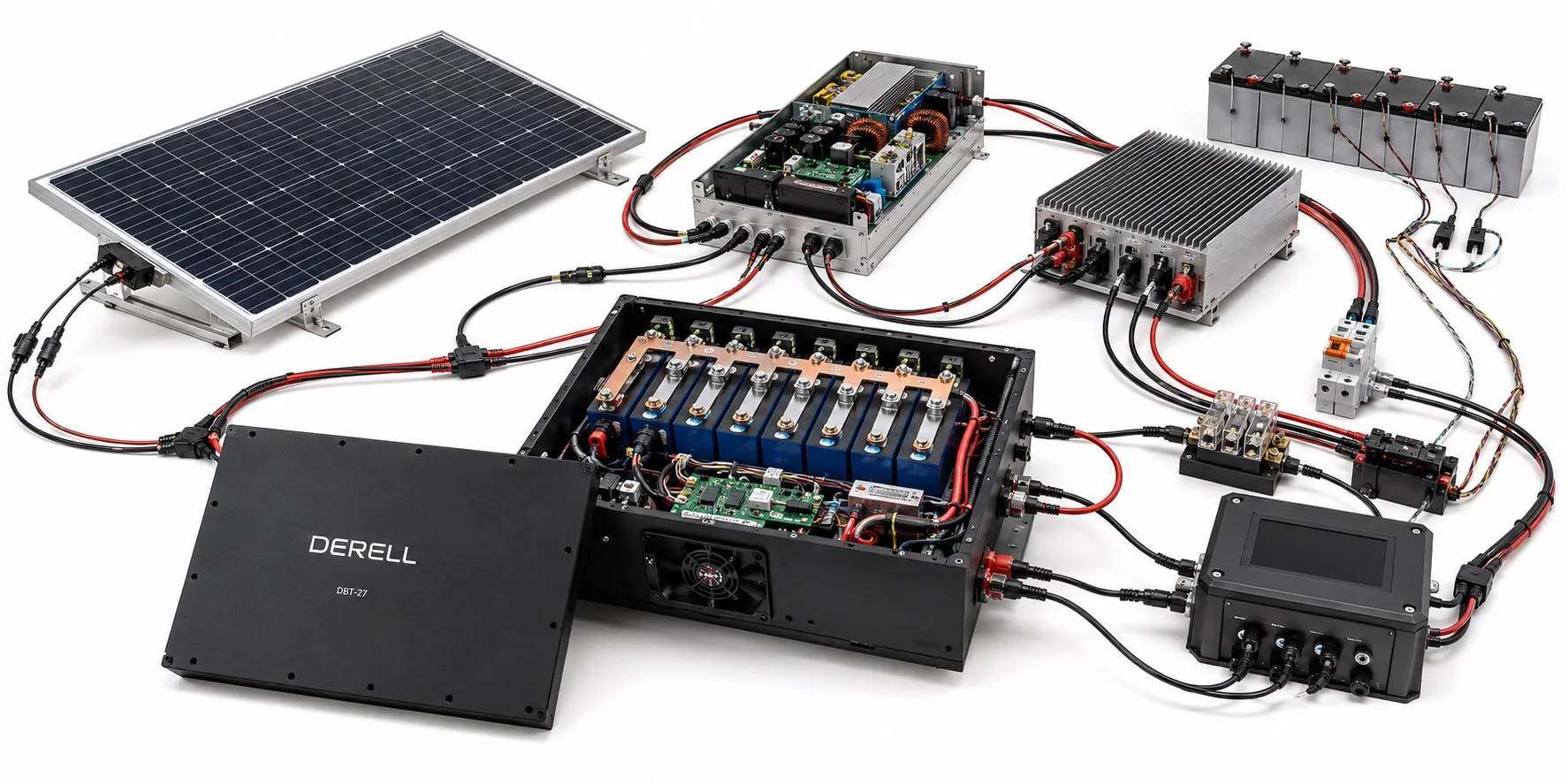
Choose a storage battery for its duty, not just its Ah rating
IEC 61427 is a series of requirements and performance test methods for rechargeable cells and batteries used in renewable energy storage. A battery bank can face very different duties in an isolated photovoltaic system and a grid-connected installation. The useful specification describes when energy is stored, how much power is demanded and how the battery is cycled, as well as its nameplate capacity.
Part 1 addresses off-grid photovoltaic operation
IEC 61427-1:2013 applies to cells and batteries in off-grid photovoltaic applications. Output from a solar panel does not necessarily coincide with demand. Using solar energy at night requires stored energy, while weather-dependent production can leave a battery facing several days of limited replenishment.
Its cycling endurance assessment includes stages of shallow cycling at low state of charge and high state of charge. SOC describes how charged a battery is; depth of discharge describes how much of its capacity has been used. A result obtained solely by repeatedly charging fully and discharging fully does not describe this duty on its own.
Part 2 separates the jobs performed by grid-connected storage
IEC 61427-2:2015+A1:2024 addresses battery endurance and electrical performance in on-grid electrical energy storage. These renewable energy storage applications exchange energy through power conversion equipment. The related converters and grid interface equipment are outside this part's scope.
Endurance duties include frequency regulation, load following, peak-power shaving and photovoltaic energy time shifting. A battery used to move daytime generation to a later demand period faces a different profile from one repeatedly absorbing and delivering short bursts of power. For solar battery storage, establish which service profile was tested before comparing cycle-life claims.
The framework is not restricted to lead-acid chemistry
The series applies across secondary battery types, rather than prescribing a single chemistry. Lithium-ion and nickel-cadmium products still have their own operating limits. Chemistry-neutral tests do not imply a universal charging setup for every battery type. Our battery standards guide helps put those scopes in context.
Turn the nameplate rating into a useful energy estimate
Worked example: a nominal 48 V, 100 Ah battery has an approximate nameplate energy of 4,800 Wh, or 4.8 kWh. For illustration, assume 80% usable energy and 90% conversion efficiency. The resulting energy delivered to the load is about 3.46 kWh, enough for roughly 6.9 hours at a constant 500 W.
Those percentages are assumptions for the calculation, not settings mandated for every battery by the standard. Actual delivery depends on voltage behaviour, temperature, ageing, auxiliary consumption and the manufacturer's limits. Review inverter requirements alongside system efficiency. Keep kWh and kW separate: adequate stored energy does not establish that the battery can supply the required instantaneous power.
Check the charging controls and the boundaries of the report
An MPPT function does not replace chemistry-specific battery charging limits. The charging equipment and any battery management system need compatible voltage, current and temperature settings. Include the connection and protection arrangement when selecting battery accessories.
Ask the supplier for the exact model, standard part and edition, test profile and remaining capacity after testing. For an efficiency claim, establish the measurement boundary: does it include the inverter and auxiliary devices, or only the battery? A battery performance report does not automatically complete the safety and grid-connection assessment of an entire installation.
Editor's note
A statement of IEC 61427 conformity is not a prediction of years of service at your site. Start with daily energy demand and the period the installation must tolerate without adequate generation, then compare that duty with the report. More panel capacity and a larger battery system address different constraints: generation and storage headroom.
Related reading
Choosing a solar storage battery · Understanding MPPT · Solar accessories · IEC 62548 · IEC 62446 · UL 1741 · Battery standards
Sources: IEC 61427-1:2013 · IEC 61427-2:2015+A1:2024 · IEC 61427-1 — Preview · IEC 61427-2 — Preview