
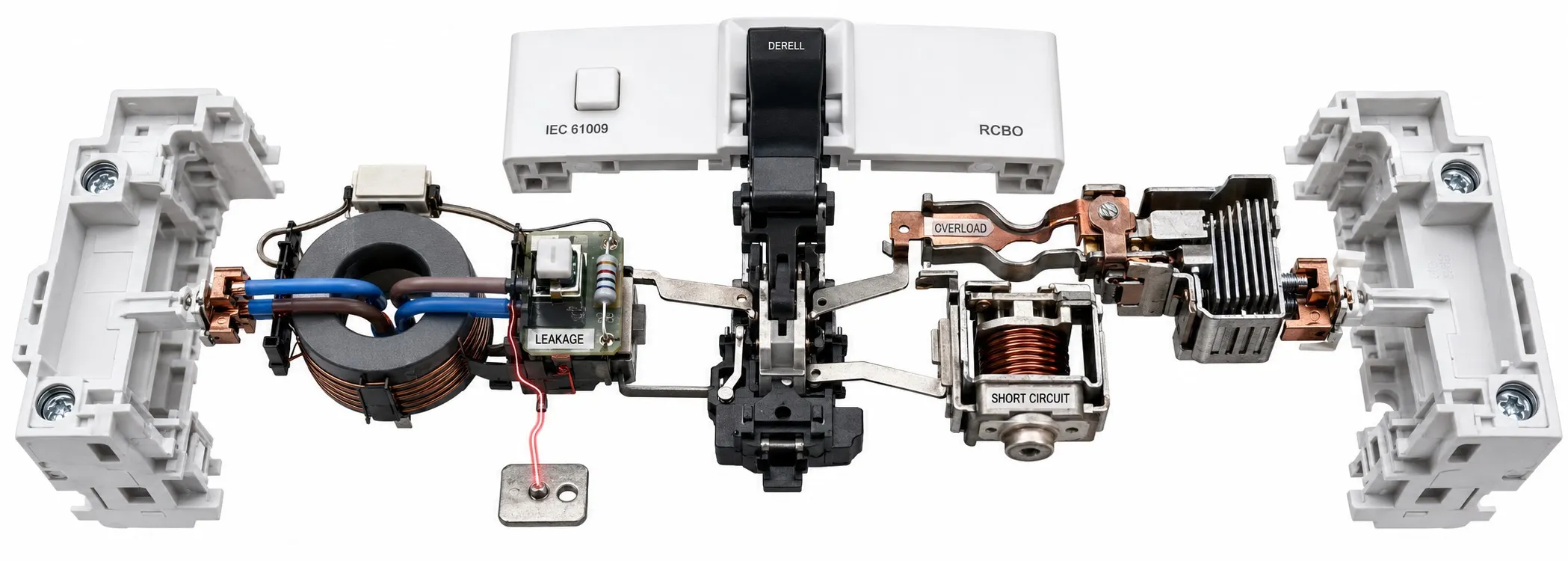
IEC 61009: What an RCBO Protects—and How to Read Its Ratings
B16. 30 mA. Type A. 6 kA. These markings can all appear on the same RCBO, yet each answers a different question. How much load current is the device rated for? How does its overcurrent release respond? Which residual-current waveforms can it detect? What short-circuit duty can it handle? Reading those details separately is the first step towards choosing the right protection.
IEC 61009 covers residual current operated circuit-breakers with integral overcurrent protection, commonly called RCBOs. They combine residual-current protection with overload and short-circuit protection. If you are comparing MCBs, RCCBs and RCBOs, that combination is the defining feature.
Four Ratings, Four Separate Decisions
Consider an RCBO marked B16, 30 mA, Type A, 6000. The following interpretation assumes that 6000 identifies its rated short-circuit capacity under the stated standard and operating voltage.
| Marking | What it tells you | What it does not tell you |
|---|---|---|
| 16 A | Rated current, In. | It is not a leakage threshold or a promise of instantaneous tripping at 16 A. |
| B curve | The overcurrent tripping characteristic. | It does not identify a Type B residual-current device. |
| 30 mA | Rated residual operating current, IΔn. | It is unrelated to the circuit’s permissible load current. |
| Type A | Detection of sinusoidal AC and pulsating DC residual currents. | It does not cover every possible DC residual-current waveform. |
| 6000 / 6 kA | Rated short-circuit capacity, Icn, under the specified conditions. | It is not a continuous current rating. |
Selecting a 16 A or 32 A protective device requires a check of the cable, installation conditions and connected load. Choosing between B, C and D trip curves also requires adequate fault disconnection—not simply a curve that tolerates the starting current.
What the Standard Actually Covers
IEC 61009-1:2024 sets the general requirements and tests for household and similar RCBOs. Its scope extends to 440 V AC, 125 A and rated short-circuit capacities up to 25 kA, at 50 Hz, 60 Hz or 50/60 Hz. These are the boundaries of the document’s scope, not ratings that every compliant product possesses.
Two neighbouring standards explain the product’s place in a distribution board. IEC 61008 addresses RCCBs without integral overcurrent protection. IEC 60898-1 covers circuit-breakers for overcurrent protection in household and similar AC installations. An RCCB’s current rating does not turn it into an overload protective device.
IEC 61009 is a product standard. Installation design, conductor sizing, earthing arrangements and coordination still require the applicable installation rules and manufacturer’s instructions. For projects referencing EN 61009, check the exact regional edition rather than assuming that every publication changes on the same date.
Why Residual Current Is Different from Load Current
In a single-phase circuit, the residual-current function compares current leaving through line with current returning through neutral. If some current returns by another route, the monitored conductors no longer balance. The RCBO responds to that imbalance when its operating conditions are met. It does not need to measure current in the protective earth conductor to perform this comparison.
The overcurrent function has a different task: responding to overload and short circuit. A dangerous leakage current can be far below the current needed to operate the overload release. Conversely, a line-to-neutral short circuit can produce a large current without a residual imbalance. The two functions address different fault conditions.
This distinction also explains 30 mA versus 300 mA ratings. A suitably selected device rated at 30 mA or less can provide additional protection against electric shock. A 300 mA device does not provide the same additional protection.
Electronic Loads Make the RCD Type Important
Residual current is not always a clean sine wave. Rectifiers and electronic power converters can produce other waveforms, which is why Type AC, A, F and B are separate classifications. Type AC detects sinusoidal AC residual current; Type A also covers pulsating DC. Type F adds specified mixed-frequency conditions, while Type B additionally covers smooth DC residual current.
IEC 62423 provides additional requirements for Type F and Type B devices. Where a circuit supplies a variable frequency drive, use the equipment manufacturer’s guidance to establish the required protection. Selecting a device solely because it says “30 mA” leaves the waveform question unanswered.
When the RCBO Trips, the Handle Is Only a Clue
One handle can open because of several different protective functions. When investigating residual-current tripping, damaged insulation and accumulated leakage are possible causes. If the trip occurs when an appliance starts, inrush and short-circuit faults may also need investigation. Use the product’s trip indication, where provided, alongside suitable measurements.
Cross-connected neutrals and an unintended downstream neutral-to-earth connection can disturb the current balance. A competent electrician may use a leakage-current clamp meter as part of the investigation. Fitting a higher-rated device is not a diagnosis: increasing the current rating can leave the circuit inadequately protected.
The Test Button Has a Specific Job
Pressing T or TEST exercises the residual-current function through the device’s internal test circuit. It does not measure earth-electrode resistance, prove the entire installation safe or verify every aspect of the overcurrent release. Follow the manufacturer’s test interval. If the test button fails to trip the device, have the supply, connections and RCBO checked rather than assuming protection remains effective.
An RCD tester provides a different form of verification, using controlled test conditions and measured results. IEC 61557-6 addresses equipment for checking the effectiveness of installed RCD protection.
Protection Has Limits—and Documentation Matters
An RCBO does not make contact with live conductors safe. Current passing through a person from line to neutral may produce no sufficient residual imbalance, while remaining far below the overload trip level. Likewise, the fact that an RCD can detect an imbalance without earthing does not remove the need for protective earthing where required.
Its standard protective functions also do not make an RCBO a surge protective device or an arc fault detection device. Those functions need separate consideration.
Finally, CE marking is not an independent test certificate. Check the manufacturer’s declaration of conformity, the stated product standard and any third-party certification offered for the exact model. A useful specification identifies the current rating, trip curve, residual-current type, sensitivity, short-circuit capacity and pole arrangement—not just “an IEC 61009 breaker”.