
How has Ethernet evolved and what are the future trends?
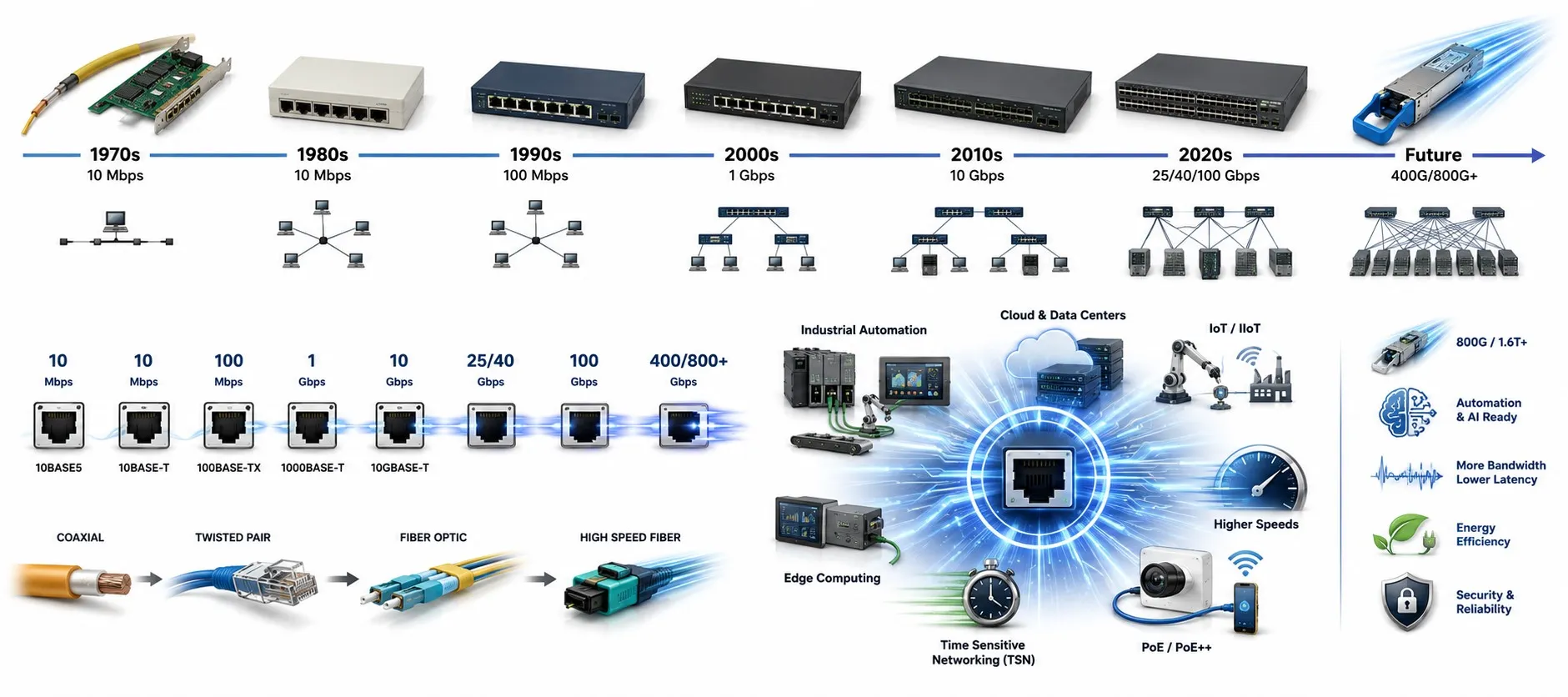
Ethernet’s evolution is not simply a story of moving from 10 Mb/s to hundreds of gigabits per second. Ethernet has retained a common MAC/frame foundation while continuously branching across physical media, speed, power delivery, timing and application requirements. Today the same Ethernet family includes office LANs, data centres, in-vehicle networks, industrial backbones and Single Pair Ethernet technologies designed to reach much closer to field devices.
That is why the question “How fast will future Ethernet be?” has no single answer. In data centres the direction is toward 800 Gb/s and 1.6 Tb/s-class links, while in a factory the more important advance may be 10 or 100 Mb/s Single Pair Ethernet with long reach and reduced cabling. One side of Ethernet is pushing raw bandwidth; another is optimizing reach, cabling, power and timing.
Ethernet’s evolution is not simply a race for higher speed. The same standards family has branched to solve very different problems: higher bandwidth, longer reach, fewer copper pairs, power delivery and more deterministic timing.
| Period | Key step | What changed? |
|---|---|---|
| 1970s | Experimental Ethernet | The experimental Xerox PARC system operated around 2.94 Mb/s and was not the same physical system as later 10BASE-T. |
| 1980s | IEEE 802.3 / 10 Mb/s | Standardization created the common Ethernet MAC/PHY family and established standardized 10 Mb/s Ethernet. |
| 1995–1999 | 100 Mb/s and 1 Gb/s | 802.3u Fast Ethernet, 802.3z Gigabit Ethernet and 802.3ab 1000BASE-T moved Ethernet into faster desktop and backbone use. |
| 2002–2010 | 10G → 40G/100G | 10 Gigabit Ethernet moved into data-centre/backbone roles, followed by standardized 40 and 100 Gb/s Ethernet in 802.3ba. |
| 2016–2019 | 2.5/5G, 25/50/200/400G, SPE | Ethernet became a family of application-specific rates rather than a simple staircase, while Single Pair Ethernet moved toward automotive and field connectivity. |
| 2024–2026 | 800G + long-reach SPE | 802.3df standardized 800 Gb/s Ethernet, while 802.3dg-2026 completed 100 Mb/s long-reach Single Pair Ethernet. |
How did Ethernet speeds evolve?
The IEEE 802.3 archive shows the major speed milestones clearly: 100 Mb/s with 802.3u, Gigabit Ethernet with 802.3z, 10 Gb/s with 802.3ae, 40/100 Gb/s with 802.3ba, 200/400 Gb/s with 802.3bs, and 400/800 Gb/s with 802.3df-2024. The same archive also shows 2.5G/5GBASE-T, 25G, 50G and many copper/fiber PHYs created for different use cases. [1]
So Ethernet should not be treated as one straight sequence of “10 → 100 → 1000 → 10G → 100G.” Modern Ethernet speeds have to be considered with the physical medium, reach and target application. A 1000BASE-T plant link and an 800G data-centre optical link solve very different problems.
800 Gb/s is no longer just a future target
A key 2026 correction is that 800 Gb/s Ethernet is already standardized. The IEEE P802.3df Task Force completed its work when IEEE Std 802.3df-2024 was approved by the IEEE-SA Standards Board on 16 February 2024. The amendment added published 400 and 800 Gb/s Ethernet physical-layer specifications. [2]
Older articles that place “400G/800G” entirely in the future are therefore dated. Deployment volume is a separate question: standardized does not mean already common in every network.
What is the status of 1.6 Tb/s Ethernet?
Here the opposite caution is needed: 1.6 Tb/s should not yet be described as a published IEEE Ethernet standard. IEEE P802.3dj is the active project covering 200, 400, 800 Gb/s and 1.6 Tb/s Ethernet. In September 2026 the Task Force was still resolving Standards Association ballot comments; the September 2026 session material shows active Draft 3.2 comment resolution. [3] [4]
The accurate wording is therefore: 1.6 Tb/s is the next Ethernet class in active standardization in 2026. The Ethernet Alliance 2026 Roadmap similarly presents 100G–800G interconnects as current growth areas while describing 1.6T Ethernet as emerging. [5]
Is future Ethernet only about higher speed?
No. One of the most interesting industrial developments moves in the opposite direction: lower-speed Ethernet that can reach farther, use less copper and extend closer to field devices. That is the role of Single Pair Ethernet.
Why does Single Pair Ethernet matter in industry?
Single Pair Ethernet (SPE) carries Ethernet over one balanced pair instead of the multiple pairs used by technologies such as 100BASE-TX or 1000BASE-T. IEEE 802.3cg-2019 introduced 10 Mb/s SPE physical layers including 10BASE-T1L and 10BASE-T1S, opening a different path for building and industrial automation. Ethernet Alliance material summarizes 10BASE-T1L point-to-point reach up to 1000 m and shorter T1S/multidrop use cases. [6]
That direction advanced again in 2026. The IEEE P802.3dg Task Force announced approval for publication of IEEE Std 802.3dg-2026, 100 Mb/s Long-Reach Single Pair Ethernet, at the June 2026 IEEE SA Standards Board meeting. [7] This shows that SPE is not remaining only a 10 Mb/s field-link technology.
Its industrial value is not simply “100 Mb/s is fast.” The larger opportunity is to carry the Ethernet technology family closer to field devices with less copper, fewer protocol-conversion gateways and a more direct path from OT data to higher systems. Legacy 4–20 mA or fieldbus wiring cannot simply be converted to Ethernet by changing the connector; PHY, cabling, power and device support still have to match.
TSN: making Ethernet more predictable, not merely faster
Time-Sensitive Networking (TSN) represents a different direction in Ethernet evolution: deterministic services with bounded latency, low packet-delay variation and low packet loss. The IEEE 802.1 TSN Task Group explicitly defines its charter around deterministic connectivity over IEEE 802 networks. [8]
TSN is not one protocol. It is a family of IEEE 802.1 mechanisms covering timing, scheduled traffic, frame preemption and related bridge behaviour. Current base standards include IEEE 802.1Q-2022 and IEEE 802.1AS-2025 for timing and synchronization. [8]
For industrial automation, this does not mean ordinary Ethernet suddenly becomes a deterministic motion-control network by itself. TSN provides tools for controlled coexistence of time-critical and non-critical traffic on standard bridged networks. Compare that carefully with EtherCAT real-time performance: EtherCAT’s process-data model and TSN bridge scheduling are different technologies.
Will all industrial Ethernet protocols converge into one?
There is no technical basis for claiming that every industrial protocol will collapse into a single application protocol. EtherNet/IP, PROFINET and EtherCAT all use Ethernet technology but retain different real-time models, device profiles, configuration approaches and data-processing methods.
A more realistic direction is that a common Ethernet physical/Layer-2 foundation extends further down into OT while multiple upper-layer ecosystems continue to coexist. See protocols that operate over Ethernet and industrial communication for the broader map.
PoE and the data-plus-power trend
Another major branch of Ethernet evolution is carrying power over the communications cabling. Conventional Power over Ethernet (PoE) reduces separate power wiring for cameras, access points and selected industrial devices. Single Pair Ethernet ecosystems also consider power and data together over one-pair infrastructure.
The future value is not simply “more watts.” In a machine or plant, installation cost, cable density, thermal rise, power budget and reliability matter together. It would be misleading to assume that every field device will become a one-cable PoE node.
How are AI and hyperscale systems changing Ethernet?
The Ethernet Alliance 2026 Roadmap highlights AI and hyperscale systems as strong drivers of higher Ethernet rates, with 100G–800G interconnect growth and emerging 1.6T Ethernet. It also emphasizes new optical approaches and better bandwidth per watt. [5]
Do not apply data-centre requirements directly to factory control. A PLC–HMI link does not need 800 Gb/s. Hundreds of gigabits per second can make sense between AI servers moving huge model and tensor data. Ethernet’s strength is that a common frame family can scale across very different PHYs and rate classes.
Is energy-efficient Ethernet a new future idea?
No. IEEE 802.3az Energy-Efficient Ethernet was already published in 2010. The IEEE 802.3 archive lists it as completed work. [1] The newer trend goes beyond that foundation: at very high data-centre rates, energy per bit, optical efficiency, cooling and power management become increasingly important. The 2026 Ethernet Roadmap explicitly frames future scaling in terms of more bandwidth per watt and improved power management. [5]
Will “security” simply be added inside Ethernet?
The statement “future Ethernet will become more secure” is too vague by itself. Ethernet PHY/MAC is only one part of OT security. Real network protection spans 802.1X access control, MACsec, VLANs and segmentation, IP/TLS layers, and the security features of industrial application protocols. Security should therefore not be described as one future IEEE 802.3 feature.
The industrial trend is that as Ethernet reaches more field devices, the attack surface also extends downward. Plant design therefore needs both Ethernet network security and broader industrial cybersecurity controls.
Will fiber replace copper?
No. Fiber becomes increasingly important at very high rates and longer reaches, while copper remains valuable for short links, field installation and power delivery. Single Pair Ethernet is itself strong evidence that copper is evolving rather than disappearing. Ethernet cable types and maximum Ethernet cable length must always be evaluated for the specific PHY.
What is the status of the main trends in September 2026?
| Topic | September 2026 status | What that means |
|---|---|---|
| 800 Gb/s Ethernet | Published standard — IEEE 802.3df-2024 | It is no longer merely a future rate; adoption and deployment are separate questions. |
| 1.6 Tb/s Ethernet | Active IEEE P802.3dj project | Standardization is advanced, but it should not yet be labelled a completed IEEE standard in September 2026. |
| 100 Mb/s long-reach SPE | IEEE 802.3dg-2026 approved | Single-pair field Ethernet is gaining both bandwidth and reach options. |
| TSN | Multiple published IEEE 802.1 standards + ongoing work | Timing and deterministic-service tools continue to mature on bridged Ethernet networks. |
| AI / hyperscale Ethernet | Industry deployment and design trend | Drives high-rate optics and energy-per-bit pressure; it is not itself one IEEE standard name. |
| SPE for OT convergence | Standards + ecosystem trend | Aims to extend Ethernet more directly toward sensors and field devices. |
What does the future actually mean for a factory?
For a factory, the meaningful future is not “replace every port with 800G.” A more realistic direction is fewer protocol-conversion boundaries between control, data collection and upper systems, Ethernet-based connectivity extending closer to field devices, more controlled transport for time-critical traffic, and easier movement of device data into IIoT and edge computing layers.
That also makes disciplined design more important. A very fast link cannot fix the wrong VLAN, poor cabling, inadequate QoS or a bad protocol architecture. Ethernet’s future is a combination of the right PHY + the right timing model + manageability + security + an application-appropriate protocol, not bandwidth alone.
In one paragraph
Ethernet has evolved from an experimental multi-megabit shared network into a standards family that now includes published 800 Gb/s Ethernet. But its 2026 direction is broader than speed: 1.6 Tb/s standardization, Single Pair Ethernet reaching field devices, 100 Mb/s long-reach SPE, TSN for more deterministic transport, high-speed optics for AI data centres, and energy-per-bit optimization are progressing in parallel. 800G is a published standard; 1.6T is still an active IEEE P802.3dj project as of September 2026. A useful future-trends article must keep those two statuses separate.
Related Ethernet guides
What is Ethernet? • History of Ethernet • Ethernet speeds • Gigabit Ethernet • Ethernet protocol • Ethernet frame structure • MAC address • Ethernet cable types • Power over Ethernet • Ethernet network security • EtherCAT • EtherNet/IP • PROFINET • Industrial communication
Technical sources
- IEEE 802.3 Working Group Archive: official archive of completed work including 100M, 1G, 10G, 40/100G, 200/400G, 800G, Energy-Efficient Ethernet, SPE and related projects. IEEE 802.3 Archive ↩
- IEEE P802.3df Task Force: completion of the 400/800 Gb/s project with approval of IEEE Std 802.3df-2024 on 16 February 2024. IEEE 802.3df ↩
- IEEE P802.3dj: active 200, 400, 800 Gb/s and 1.6 Tb/s Ethernet Task Force. IEEE P802.3dj