
How are robots used in space exploration?
Robotics supports surface exploration, sample collection, equipment handling and scientific measurement in space. Rovers, landers and robotic arms can work where no people are present or assist astronauts. Their ability to operate in space comes from mission-specific design and validation, rather than an inherent ability of ordinary robots to withstand space conditions.
Surface exploration: Rovers and stationary landers
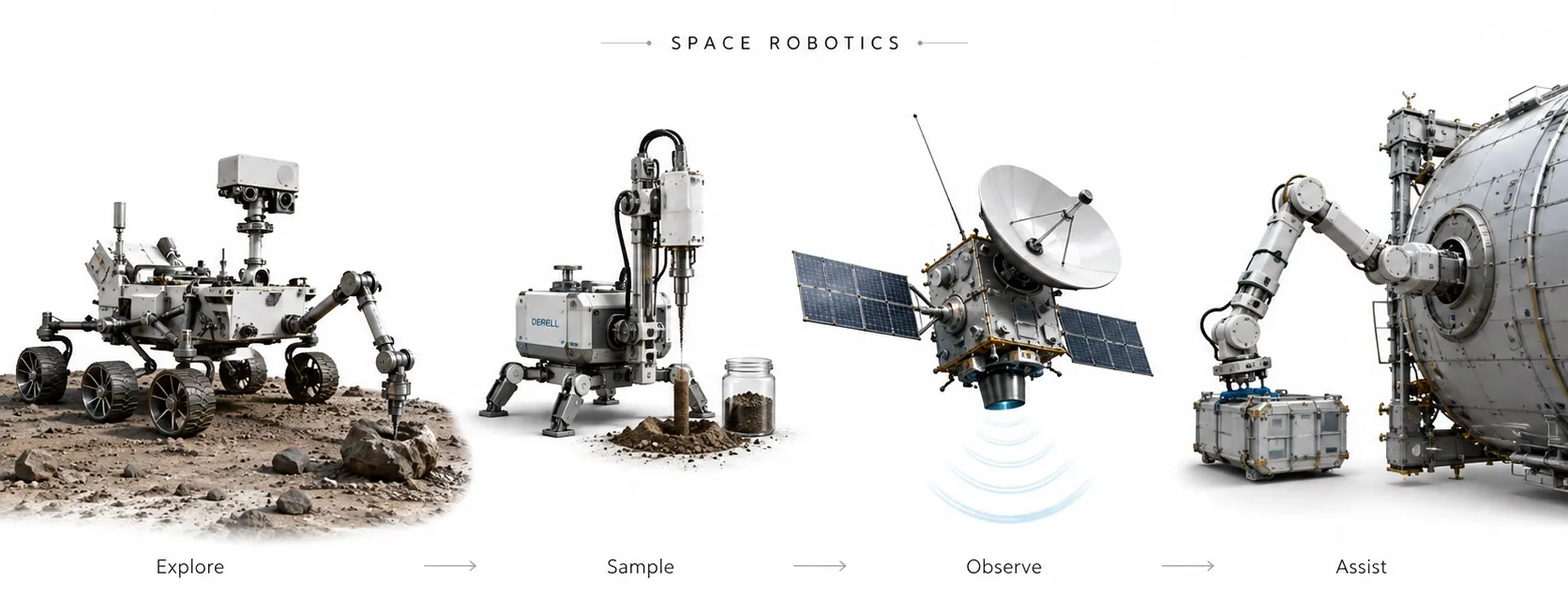
Rovers are mobile robots that travel between locations on a planetary surface. Stationary landers can investigate their surroundings from a fixed location. These different robot types do not perform identical tasks. On Mars, Perseverance provides a concrete example of a rover combining terrain imaging, rock investigation and sample collection.
The rover's sensors and actuators work together: cameras gather information about the surroundings, wheel mechanisms move the vehicle, and a robotic arm positions scientific instruments. Imaging a rock, approaching it safely and extracting a sample are separate tasks.
Sampling: Local investigation and Earth return are different
Perseverance's sampling system includes collecting rock material in tubes, inspecting it and sealing the containers. Internal mechanisms handle tubes alongside the external robotic arm. The robot's operating sequence is more than simply reaching out to pick something up: it must preserve the sample's integrity and associated records.
OSIRIS-REx illustrates a different achievement. Its capsule carrying material collected from asteroid Bennu returned to Earth on 24 September 2023. Collecting samples on Mars and delivering an asteroid sample to laboratories on Earth are different stages of exploration. Keeping that distinction clear helps explain what each mission has actually accomplished.
Working in orbit: Canadarm2 and Dextre
Canadarm2 is a robotic arm used on the International Space Station for equipment handling, maintenance and capturing and berthing suitable visiting cargo vehicles. Dextre was developed for more detailed maintenance work outside the station. The robot's mechanical structure and end effector are selected around the tasks it needs to perform.
These systems can be operated by astronauts or ground teams. Robot programming, movement sequences and operating procedures all matter. Remote operation is different from full autonomy. Space robots do not need a human-shaped body; an arm or specialised gripper may be sufficient for the task.
How do satellites, probes and space telescopes fit in?
Satellites and space telescopes use automatic control and remote operation. However, describing all of them in the same way as a surface rover or a grasping robotic arm obscures their differences. When considering the difference between a robot and a machine, it helps to examine the system's sensing, control and physical actions together.
A space telescope such as Hubble primarily points at targets and performs scientific observations. The Voyager missions have contributed to our understanding of the outer planets and interstellar space. Robotics and automation in space encompass more than wheeled vehicles and articulated arms.
Why does communication delay require local decisions?
A radio signal takes approximately 3–22 minutes one way to travel between Earth and Mars, depending on the planets' positions. Sending a command and receiving its result require two separate journeys; data transfer and processing add further time. A Mars rover therefore cannot respond to an Earth-based joystick as though it were being driven locally.
Perseverance's AutoNav system can evaluate terrain and plan routes around obstacles while travelling towards a predefined destination. As with autonomous vehicles, perception and route assessment are important, although the environment and operating constraints differ. Making navigation decisions along the way does not mean the rover has unlimited authority to choose its scientific objectives.
Do space robots always use artificial intelligence?
No. Autonomous operation can also be achieved through predefined rules and conventional control algorithms. Artificial intelligence may contribute to particular perception or decision-making tasks. Machine learning is a way of building models from suitable data. Image processing, autonomy and machine learning are not interchangeable terms.
How does the space environment change robot design?
Vacuum or low pressure, temperature changes, radiation, surface dust and launch vibration are assessed according to the mission. The surfaces of Mars and the Moon and the interior of a space station are different environments. These conditions affect the limits of robot technology and the choice of materials. Thermal-vacuum, vibration and shock testing are among the methods used to validate space hardware.
Space robots can share basic sensing and motion principles with industrial robots, but successful industrial operation does not, by itself, establish suitability for a space mission. From a robot safety perspective, fault detection, motion limits and defined behaviour during a communication outage are also part of the design.
How does a space robot's control loop work?
In a simplified example, the system takes a measurement, compares the actual state with the target, generates a motion command and measures the result again. This feedback control helps regulate quantities such as arm position or vehicle orientation. “Command sent” does not mean “task completed successfully”. Results are assessed through onboard measurements and telemetry transmitted to Earth.
The role of robots in human exploration
Robots can survey terrain before a crewed mission or support astronauts by moving equipment and working outside a habitat. One important direction in the future of robotics is complementary task sharing between people and robots. Long-duration operation, energy management and fault tolerance are engineering factors that determine how well that cooperation works.
Mission and technical references: NASA — Perseverance · CSA — Canadarm2 · CSA — Dextre · NASA — OSIRIS-REx · NASA — Mars communications.
You may share this article with attribution to OtomasyonAVM.