
What is the licensing and cost structure of EtherCAT?
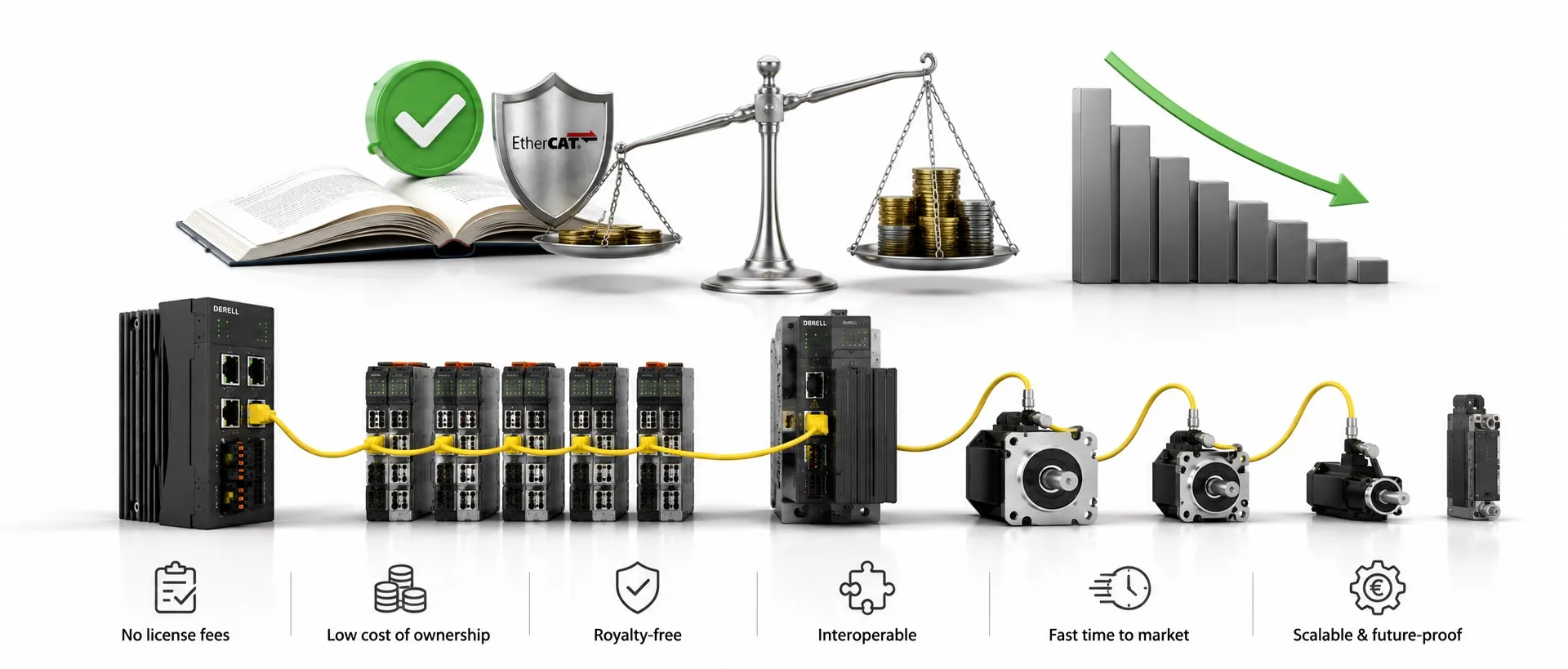
What is the licensing and cost structure of EtherCAT? The answer depends on what you are building. A machine builder buying established EtherCAT products, a company developing an EtherCAT MainDevice, and a vendor putting a new EtherCAT SubDevice on the market face very different obligations. EtherCAT is an open technology, but the technology itself is not open-source software. The MainDevice technology licence is free of charge; on the SubDevice side, the patent-licence cost is normally embedded in the EtherCAT SubDevice Controller (ESC) silicon.[1]
That distinction changes the cost discussion completely. For a user assembling a machine from standard PLCs, EtherCAT I/O and servo drives, there is no separate per-node EtherCAT royalty paid to ETG. For a device manufacturer, ETG membership and the Vendor ID are free, but engineering, ESC/IP hardware, firmware, ESI creation, the mandatory Conformance Test Tool subscription and product verification are real development costs.[2]
| Scenario | ETG membership | Vendor ID | Technology licence | Where money is actually spent |
|---|---|---|---|---|
| Machine builder / integrator | Not required | Not required | No direct EtherCAT royalty for using off-the-shelf devices | Controller, I/O, drives, engineering software, integration and commissioning |
| MainDevice developer | Membership itself is free | Depends on the product role/policy | MainDevice technology licence is royalty-free | Master stack, RTOS/runtime, engineering and support |
| SubDevice vendor | Required and free | Required and free | ESC-chip patent licence is normally embedded in chip price | Hardware, stack integration, ESI, CTT subscription and verification |
| FPGA/IP-Core implementation | Required if shipping a SubDevice; free | Own vendor identity required | One-time or quantity-based IP-Core licences can apply | FPGA, IP-Core, development and validation |
Start with the role: using EtherCAT is not the same as implementing EtherCAT
ETG explicitly separates end users from device vendors. If a machine builder integrates ready-made EtherCAT products, ETG membership is not mandatory and no Vendor ID is needed. A company manufacturing an EtherCAT device, on the other hand, must become an ETG member and obtain a valid EtherCAT Vendor ID before placing that device on the market. Both membership and Vendor ID assignment are free of charge.[2]
This role-based view is more useful than saying “EtherCAT is free.” The protocol may not generate a recurring royalty for the machine builder, but the project can still carry substantial hardware and engineering cost. The exact balance depends on the technical requirements, cycle time, axis count, diagnostics and safety architecture.
ETG membership is free; there is no paid membership ladder in the current ETG model
The EtherCAT Technology Group states that membership is free of charge. Members gain access to specifications, implementation guidance, developer resources, support material and working groups. Device vendors need membership because it is tied to Vendor ID and development resources, while normal users may join voluntarily.[1]
This matters when budgeting a product: an annual ETG membership fee should not be inserted into a cost model unless ETG changes its policy in the future. The current cost drivers sit elsewhere.
The Vendor ID is also free — but it carries responsibility
A valid EtherCAT Vendor ID uniquely identifies the manufacturer of an EtherCAT device. ETG currently assigns it free of charge. A machine builder integrating purchased devices does not need one, whereas a company shipping its own EtherCAT device does.[3]
The identity cannot simply be borrowed from the maker of a communication module. If your company turns a third-party EtherCAT interface into your own finished product, the finished device is expected to carry your vendor identity. That affects the ESI, product code and device-integration process, not just paperwork.[3]
MainDevice licensing: free EtherCAT licence, potentially non-free software stack
ETG states that the licence to implement an EtherCAT MainDevice is free of charge and remains royalty-free under the licence agreement. That legal licence should not be confused with the price of the software used to build the controller. Commercial master stacks, real-time operating systems, PLC runtimes, engineering tools and vendor support contracts may have their own commercial terms.[1]
This is why two machines using the same EtherCAT technology can have very different software budgets. One may use a commercial controller package with support and certified integrations; another may use a library-based implementation and carry more of the integration burden internally. See the separate guide to EtherCAT programming tools.
Open technology does not mean licence-free source code
ETG's own FAQ states that EtherCAT technology itself is not Open Source. Open-source EtherCAT software does exist, but its source-code licence is a separate legal layer. The current SOEM repository, for example, identifies its MainDevice library as dual-licensed under GPLv3 and a commercial licence. A developer therefore has to check both EtherCAT technology terms and the actual software licence being used.[4]
That is a stronger engineering statement than “open source means no licence cost.” A GPL-compatible project may be able to use one route; a closed commercial product may require another. The result depends on the software chosen, not on EtherCAT's fieldbus status alone.
Where the SubDevice licence goes: into the ESC model
For chip-based SubDevices, EtherCAT follows a model in which the patent-licence cost is built into the EtherCAT SubDevice Controller (ESC) component. The ESC supplier holds the relevant hardware licence, so the device vendor, integrator and end user do not pay a separate EtherCAT patent royalty for every finished product.[1]
The controller chip is still only one line in the bill of materials. An EtherCAT SubDevice may also require a host MCU, PHY/magnetics, connectors, EEPROM/SII, isolation, local I/O hardware, firmware, ESI XML, documentation, EMC work and production testing. These elements connect directly to the MainDevice/SubDevice communication model.
FPGA designs move part of the cost into the IP licence
An FPGA implementation can use an EtherCAT IP-Core instead of a stand-alone ESC ASIC. ETG describes both licences that allow unlimited SubDevice production after one licence payment and quantity-based licence models, depending on the IP-Core offering. That makes the economic optimum sensitive to production volume and the amount of application logic already intended for the FPGA.[1]
For a low-volume specialist controller, paying for flexible FPGA integration can make sense. For a high-volume compact I/O module, a dedicated ESC or integrated communication SoC may give a lower unit cost. There is no universal “cheapest EtherCAT hardware” answer without the actual product architecture.
Conformance Test Tool: a recurring development cost for device vendors
EtherCAT device vendors are required to maintain a valid subscription to the official Conformance Test Tool (CTT). CTT is used in-house to check protocol conformance and the ESI file before a product is released. ETG describes the tool as subscription-licensed so that tests and support can be maintained over time.[5]
This is one of the most important distinctions in an accurate cost model: free membership and a free Vendor ID do not mean free product conformance work. Engineering hours, regression testing, tool subscription and issue correction remain part of product development.
Official test-center certification is optional, but the certificate is not
ETG does not require every device to be sent to an official EtherCAT Test Center. In-house CTT testing is the minimum vendor requirement. However, an official Conformance Certificate is only issued after successful testing at an accredited EtherCAT Test Center, and a customer may require that certificate. ETG does not publish one universal test-center price; the vendor has to obtain a quotation from the selected test center.[6]
This makes certification a commercial decision as well as a technical one. A mass-market drive or I/O family may justify formal certification early. A prototype used internally may follow a different route. Either way, conformance of the communication device and compliance of the complete machine are separate questions; see EtherCAT and industry standards.
For machine builders, total cost of ownership matters more than protocol royalty
A useful EtherCAT project budget can be written as:
TCO ≈ MainDevice/controller + I/O + drives + sensors/encoders + cabling + engineering/runtime software + integration hours + commissioning + safety validation + spares + maintenance.
In a high-axis-count motion system, combining distributed I/O, servo control and high-resolution encoder feedback on one deterministic network can reduce engineering hardware elsewhere in the machine. In a small, slow application with a handful of I/O points, the same architecture may be economically excessive. Cost has to be tied to the actual application, not to the protocol name.
| Cost item | Machine builder / user | EtherCAT device vendor |
|---|---|---|
| ETG membership | Optional; free | Required; free |
| Vendor ID | Not required | Required; free |
| ESC / IP | Included in purchased device cost | BOM or FPGA/IP-Core cost |
| CTT | Not required | Valid subscription required |
| Official test center | Not applicable | Optional unless market/customer demands certificate |
| Engineering | Configuration, PDO/DC setup, diagnostics and commissioning | Hardware, firmware, ESI, testing and documentation |
Safety over EtherCAT has a free technology licence, but safety engineering is not free
ETG states that the Safety over EtherCAT (FSoE) implementation licence is free of charge, and a machine builder using off-the-shelf FSoE devices does not need a separate FSoE licence. The project still has to achieve and validate its required safety integrity or performance level. That is engineering, verification and documentation work, not a protocol royalty.[1]
Functional safety should also remain separate from industrial cybersecurity. A safety-capable EtherCAT architecture does not replace access control, segmentation or security governance.
How to compare EtherCAT economically
Do not compare EtherCAT with PROFINET, EtherNet/IP, SERCOS or another industrial communication system by asking only which one has a licence fee. Compare the complete machine: controller/runtime price, I/O and drive cost, topology hardware, engineering time, diagnostics, commissioning effort, staff knowledge, safety validation and spares. The technical comparison belongs on the separate page covering EtherCAT versus other Industrial Ethernet protocols.
The economic conclusion can therefore reverse with the application. EtherCAT may reduce total system cost in a tightly synchronized machine even when some individual components cost more, while a basic application may gain little from the same performance. The decision should be tied to EtherCAT's actual advantages and its constraints, not to a generic “low-cost” label.
Related EtherCAT guides
• Primary advantages of EtherCAT
• EtherCAT technical specifications
• Programming languages and tools
• EtherCAT versions and extensions
References
[1] EtherCAT Technology Group, FAQ – Membership, Open Technology, Licences, IP-Cores and FSoE: https://www.ethercat.org/en/faq.html
[2] EtherCAT Technology Group, EtherCAT Device Vendor: https://www.ethercat.org/en/conformance_for_vendors.htm
[3] EtherCAT Technology Group, EtherCAT Vendor ID: https://www.ethercat.org/en/vendor_id.html
[4] OpenEtherCATsociety, SOEM – Simple Open EtherCAT Master, current repository and licence notice: https://github.com/OpenEtherCATsociety/SOEM
[5] EtherCAT Technology Group, EtherCAT Conformance Test Tool (CTT): https://www.ethercat.org/en/ctt.htm
[6] EtherCAT Technology Group, ETG.7010 EtherCAT Conformance Guide: EtherCAT Conformance Guide