
GB/T
Understanding Chinese charging interfaces and compatibility
GB/T is not a name reserved for electric vehicle charging. It is the general prefix for China’s recommended national standards. “GB” comes from Guobiao, meaning national standard, while “T” refers to Tuijian, meaning recommended. In electric vehicles and charging systems, GB/T usually refers to Chinese AC/DC charging interfaces and their associated charging standards. A technical assessment must identify the complete standard number and edition year.
Editor’s note: A “GB/T compatible” label alone does not establish that a vehicle will work with a charging station. The AC or DC interface, applicable edition, communication support and electrical limits must match. Also, not every part of a standard series is revised in the same year: the official catalogue check on 17 October 2026 still lists GB/T 20234.2-2015 as current.
Connection hardware, charging systems and communication
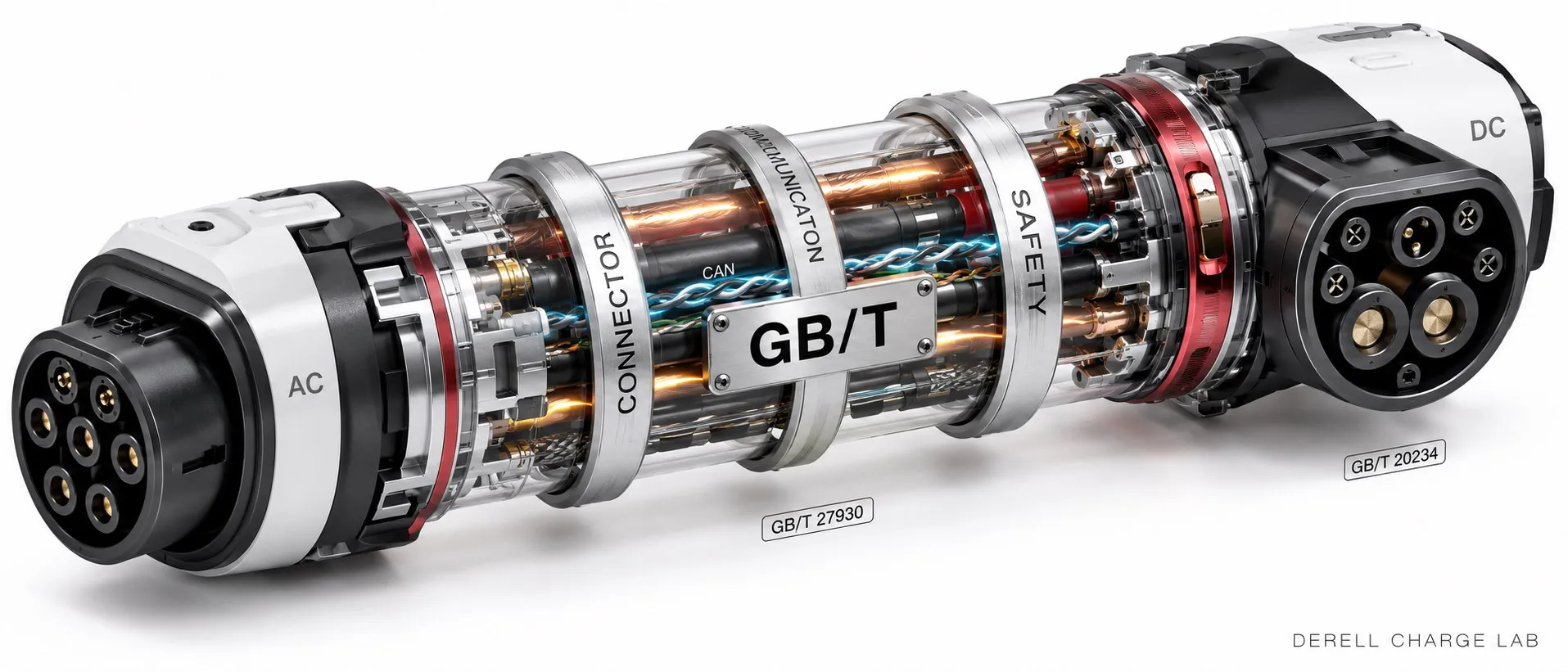
GB/T 20234.1-2023 covers general requirements for connection hardware used in conductive EV charging. GB/T 20234.2-2015 defines the AC charging coupler, while GB/T 20234.3-2023 defines the DC charging coupler. Treating the 20234 series as a single socket specification therefore misses essential distinctions.
GB/T 20234.4-2023 is a separate part for the high-power DC charging coupler and is associated with ChaoJi development. Describing the series as having only three parts is outdated. The conventional 20234.3 interface and the 20234.4 interface should not be assumed to be the same physical connection because their names are similar.
GB/T 18487.1-2023 addresses general requirements for conductive charging systems. GB/T 18487.5-2024 addresses DC charging systems using the GB/T 20234.3 interface. The construction of the coupler and the control and operating requirements of the charging system belong to different standardisation layers.
GB/T 27930-2023 covers digital communication between an off-board conductive charger and an electric vehicle. GB/T 27930.2-2024 additionally defines the communication protocol for GB/T 20234.3. Assess the interface, system type and protocol edition together; “supports 27930” alone is an incomplete technical description.
GB 44263-2024 concerns safety requirements for conductive EV charging systems and took effect on 1 August 2025. Its prefix is GB, rather than GB/T, and it is a mandatory standard to consider within its applicable Chinese conformity framework. A recommended-standard prefix does not remove other mandatory safety requirements applying to a product.
Why must AC and DC charging be assessed separately?
During AC charging, alternating current enters the vehicle, and the onboard charger (OBC) converts it to the direct current required by the battery. Although the GB/T AC interface may resemble an IEC Type 2 connection, it should not be treated as identical. Mechanical construction, contact arrangement and connection functions must be checked. For AC ratings such as 7.4 kW, 11 kW and 22 kW, the OBC’s phase support and current capacity also determine performance.
During DC charging, power conversion takes place in the station, which supplies controlled direct current within the limits accepted by the vehicle. Conventional GB/T implementations can have separate AC and DC vehicle inlets. Successful AC charging does not demonstrate compatibility of the DC interface and protocol.
What information do the vehicle and station exchange?
Common GB/T DC charging implementations use CAN-based communication. Vehicle-side control and the battery management system (BMS) help keep charging within permitted voltage and current limits. Station capabilities, vehicle requests, operating states and faults are exchanged through the applicable protocol. Sharing a CAN physical layer does not mean two devices understand the same messages.
AC charging control should not be assumed to use the same CAN communication as DC charging. Common basic AC implementations use control-pilot and PWM signals to manage connection status and available current. Battery chemistry, temperature and state of charge influence vehicle-side charging limits; the station cannot independently increase those limits.
Using adapters with Type 2, CCS or CHAdeMO
As with the distinction between Type 2 and CCS, GB/T compatibility involves both the physical connection and communication. A plug fitting an inlet does not establish suitable voltage range, current limits, locking or safety functions. An AC cable or adapter must support the connection arrangement accepted by the vehicle and station.
When adapting between different DC charging families, simply connecting power contacts is insufficient. If the protocols differ, suitable active communication conversion, charging-sequence management and preservation of safety functions are required. A blanket promise that every GB/T vehicle will work at every CCS or CHAdeMO station through an adapter is unjustified. Supported vehicles, stations and software versions must be identified.
The connector name does not determine charging power
On the DC side, the basic relationship is P = V × I. For example, 500 V × 200 A = 100 kW. This is a calculation example, not a GB/T rating. Actual power is constrained by the station’s operating range, cable and contact current capacity, vehicle demand, battery temperature and state of charge. A station’s maximum advertised power is not continuously available to every vehicle.
At high current, contact resistance produces significant I²R losses and heating. Temperature monitoring and cooling arrangements are used as appropriate to the application. Standardising a high-power interface does not give every cable the same voltage rating, current rating or cooling capability.
How are ChaoJi, GB/T and CHAdeMO related?
ChaoJi is a next-generation high-power charging approach developed through cooperation between the China Electricity Council and the CHAdeMO side. ChaoJi-1 is associated with GB/T communication, while ChaoJi-2 is associated with CHAdeMO communication. Harmonising the coupler approach does not automatically make all existing vehicles mutually compatible. Backward-compatible operation requires appropriate adapter design, control support and interoperability validation.
Safety and practical checks
Protective-conductor continuity, insulation monitoring, overcurrent protection, temperature supervision and safe disconnection must be assessed as parts of the complete charging system. In appropriate DC charging architectures, an insulation monitoring device supervises insulation between the power circuit and earth. This differs from residual-current protection on the AC side; providing one function does not automatically satisfy the other.
A Chinese vehicle brand does not necessarily indicate a GB/T inlet; equipment can vary by target market. Before planning home charging or choosing a wallbox, check the actual inlet, OBC capability, accepted DC voltage range and manufacturer approval. Practices such as charging through an extension lead also require a separate assessment of the installation and safety, beyond connector compatibility.
Instead of specifying only “GB/T”, identify the full standard number, edition, published amendments, interface type, electrical limits and supported protocol. Acceptance checks should verify normal charging and fault handling together, rather than only confirming that the connector fits. Further everyday questions are covered in the EV charging FAQ.
Related topics
Charging standards and interfaces: Compare IEC 61851, IEC 62196, SAE J1772, CHAdeMO and CCS connectors to distinguish charging-system requirements, connection hardware and communication.
Supporting electrical topics: DC fuses, earthing, residual-current protection, voltage drop and IP protection ratings address protection and installation requirements that must be considered alongside the charging interface standard.
Edition note: Standard numbers and catalogue status were checked against official records on 17 October 2026. The applicable full text, published amendments and product scope must also be considered for each project.
Technical sources and official records
SAMR / SAC — GB/T 20234.2-2015 — AC charging coupler
SAMR / SAC — GB/T 20234.4-2023 — High-power DC charging coupler
SAMR / SAC — GB/T 18487.5-2024 — DC charging systems for GB/T 20234.3
SAMR / SAC — GB/T 27930.2-2024 — Communication protocol for GB/T 20234.3
SAMR / SAC — GB 44263-2024 — Safety requirements for EV conductive charging systems
CHAdeMO Association — ChaoJi GB/T standards released
Phoenix Contact — Principles of e-mobility charging technology