
What communication protocols does the device support?
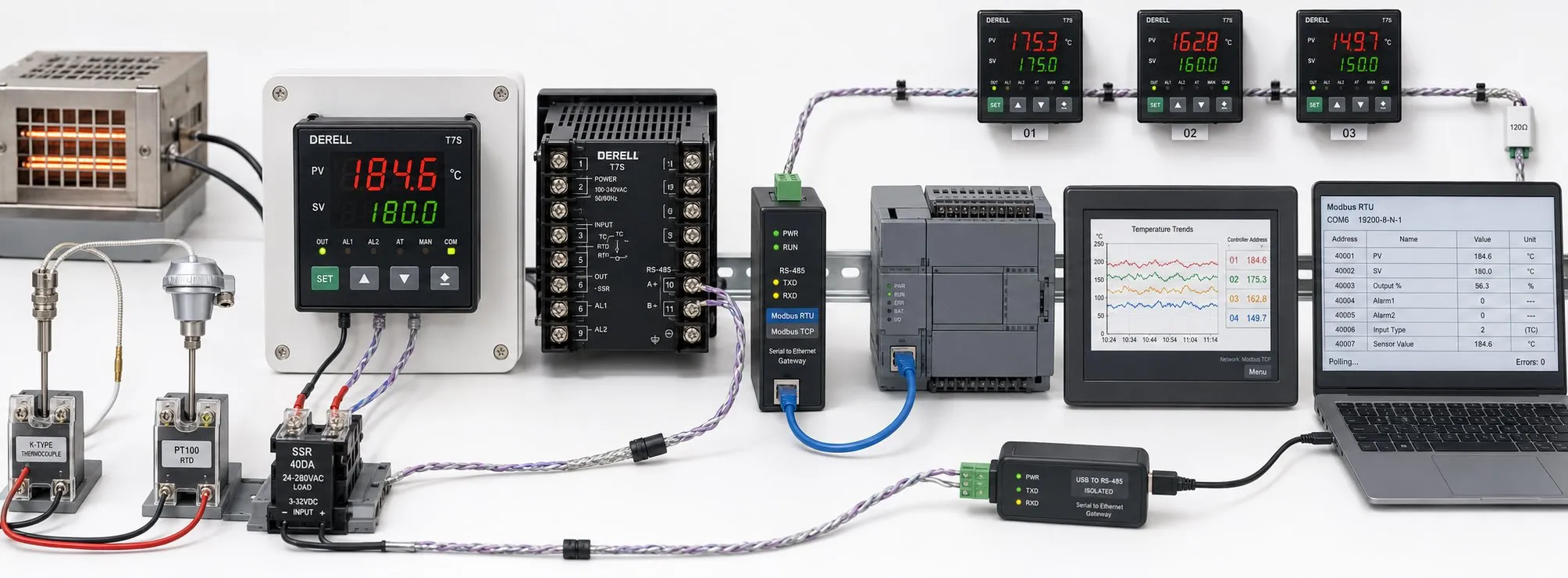
Protocol support is determined by the complete model code
Hello, the communications protocols supported by a temperature controller depend on its model, option card and firmware. One model in a series may have no communications, while another supports Modbus RTU over RS-485. For PLC, HMI or SCADA integration, check the complete order code and communications manual, as well as the series name.
An interface is different from a protocol
A communications port identifies the connection interface; a protocol defines the rules for exchanging data. An RS-485 interface does not necessarily use Modbus. Likewise, an Ethernet port does not establish support for Modbus TCP, EtherNet/IP and PROFINET.
Editor's note: Matching connectors and cables do not guarantee communication. The physical interface, protocol, device roles and data definitions must all be compatible. An ordinary cable adapter connected to RS-485 terminals does not translate protocols.
How do Modbus RTU, ASCII and TCP differ?
Modbus RTU is an option that temperature controllers may support over RS-485. Modbus ASCII uses a different serial framing format and requires separate support. Modbus TCP operates over TCP/IP. Support for one variant does not establish support for the others. Check that the requesting and responding device roles are compatible.
Industrial Ethernet and other field networks
EtherNet/IP is an industrial communications technology based on CIP; it is not synonymous with a generic Ethernet connection. PROFINET is a different industrial Ethernet protocol. Use the appropriate PLC driver, device configuration and, where required, the manufacturer's device description file.
PROFIBUS and PROFINET are different protocols. Verify which network and device role the controller supports. CANopen is based on CAN and uses an object dictionary and communications mechanisms such as PDOs and SDOs. CAN hardware alone does not establish CANopen support.
Where do BACnet and wireless connections fit?
BACnet is relevant to building automation and HVAC integration. BACnet/IP and BACnet MS/TP use different connection arrangements. Check supported objects, properties and write capabilities against the product's conformance and communications documentation.
Some products offer Wi-Fi, Bluetooth or Zigbee. However, the connection may be limited to phone-based setup, data viewing or a manufacturer's application. A wireless interface does not guarantee open, direct data exchange with a PLC. The purpose of a USB port must also be verified separately.
Which values can be read or written?
Where supported, the system can read measured temperature (PV), setpoint (SP/SV), output demand and alarm status. Setpoints or operating modes may be writable, but do not assume every parameter can be changed remotely. Obtain the address, data type, sign, unit, scaling and access rights from the model's data map.
For example, if a manufacturer defines a temperature value as an integer scaled in 0.1 °C units, 2534 represents 253.4 °C. Another device may interpret that number differently. Also check whether the Modbus driver displays addresses from zero or one, and verify word order for values occupying multiple registers.
Which settings must match during commissioning?
For serial communications, match the device address, baud rate, data bits, parity and stop bits. Verify terminal labels, wiring and termination against the manufacturers' diagrams. For Ethernet, check IP configuration and protocol-specific device settings. During installation, first read a known value, then test one permitted write operation to establish a clear commissioning sequence.
When is a gateway needed?
If the controller supports only Modbus RTU and the supervisory system uses another protocol, a suitable protocol gateway may be considered. Its data mapping must be defined separately. A basic interface converter and a protocol gateway perform different functions. This distinction matters for latency, diagnostics and maintenance in industrial communications design.
Communications speed and temperature control speed are different
The PLC's polling interval is different from the sensor's response time or the controller's PID control loop. Faster polling may simply read the same value repeatedly if the measurement has not updated. Choose the interval according to the device's update rate and network load.
Monitor timeouts and data validity so a stale value is not mistaken for a current measurement after a connection failure. Whether local PID continues, the last setpoint is retained or another action occurs depends on the model and configuration. Test this behaviour, particularly where setpoints are supplied remotely, and make the communications fault visible.
When selecting a controller, define the required values, read/write permissions, network type and behaviour after connection loss. “With communications” is not a sufficient technical specification by itself.
Temperature controllers | Temperature controller FAQ | Temperature controller prices