
Faq For Quantum
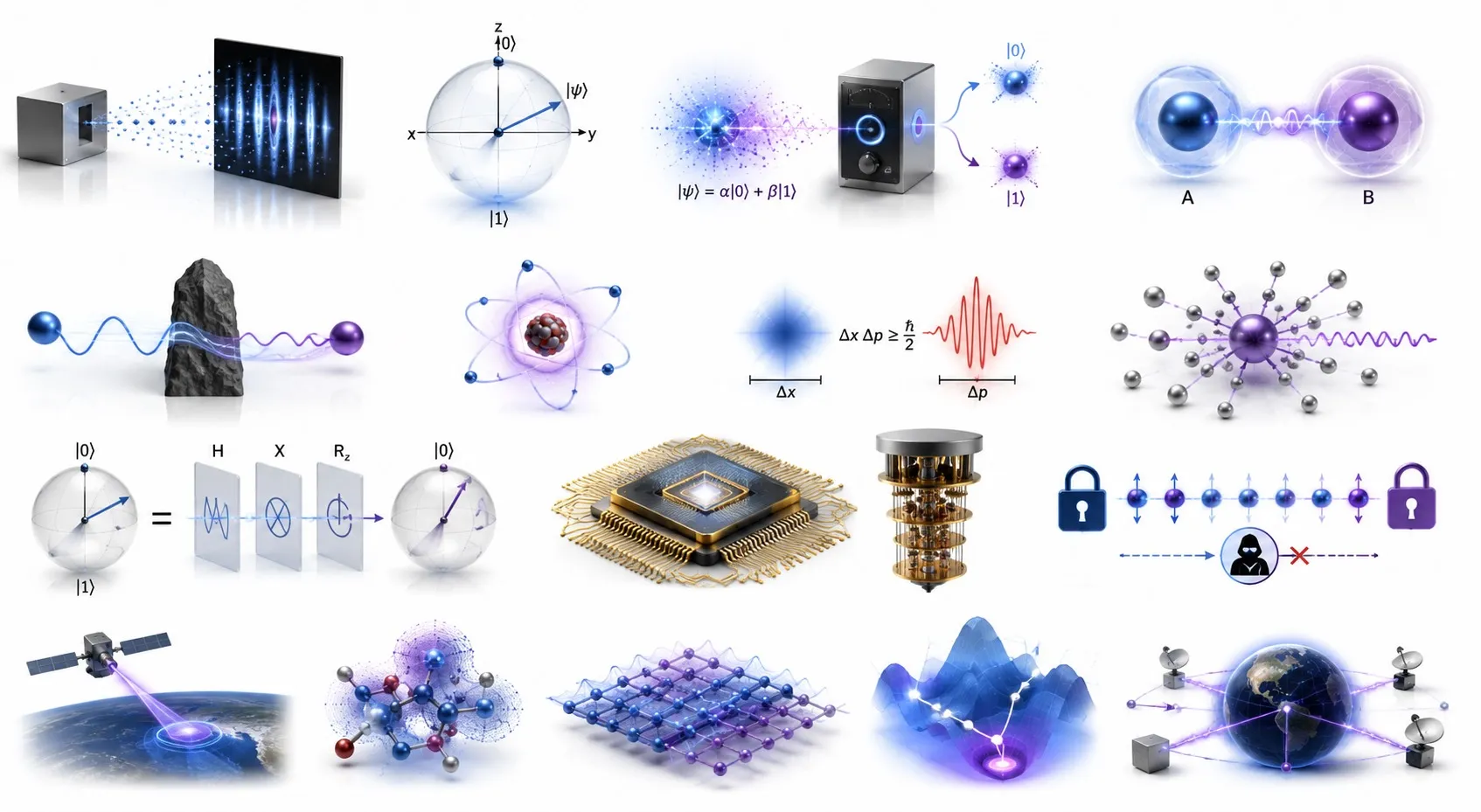
This is an illustrative montage of quantum topics, not a photograph of particles or a record of experimental measurements.
Quantum Physics FAQ: Concepts, Technology and Common Misconceptions
Quantum physics describes how matter and light behave, particularly at atomic scales. It lets us calculate the probabilities of measurement outcomes. It is not a claim that anything can happen simply because we can imagine it. [1]
This guide connects the basic ideas with applications and further questions. For readers interested in electronics and automation, the useful starting point is which physical effect a device uses, what it does and where its limits lie. Experimental findings, theoretical interpretations and popular claims need different kinds of scrutiny; a shared vocabulary does not give them equal evidential weight.
Explore this guide: The basics · Entanglement and communication · Technology and engineering · Advanced theories and interpretations · Claims and popular culture.
The basics: Where should you start with quantum physics?
A simple picture: Think of an atom’s allowed bound-state energies as the rungs of a ladder. They are not a ramp where any height is available. During a suitable transition, the atom can absorb or emit light; a packet of that light is called a photon. There is no miniature ladder inside the atom. The picture explains allowed energy levels, not every quantity in physics. [2] Start with quantum physics in simple terms, then explore what quantum physics is—and what it is not.
The difference between quantum and classical physics is more than “small objects versus large ones.” In a suitable electron experiment, individual detection events build up an interference pattern. Treating an electron as an ordinary tiny ball or an ordinary water wave misses part of the behavior. Classical models remain useful under appropriate conditions. [1]
Superposition means expressing a quantum state as a combination of chosen basis states. It is not merely a situation in which the system already has one of two values and we do not know which. Relative phase and interference matter. Measuring a qubit in the 0/1 basis gives one outcome, not a readable list of all the possibilities. [3]
The Heisenberg uncertainty principle puts a lower bound on the product of the position and momentum spreads for the same quantum state. It is not simply a limitation of an instrument or a calibration error. [4] Schrödinger’s cat, meanwhile, is a thought experiment about the measurement problem, not an experiment actually carried out on an animal. [5]
Are entanglement, instant communication and teleportation the same thing?
Quantum entanglement is a property of a joint quantum state that cannot be described as a classical mixture of independent states of its parts. Mere correlation is not enough. But correlated measurement outcomes are not the same as sending a chosen message. Entanglement does not enable instant communication: a sender cannot select local measurement outcomes to encode whatever message they wish. Entanglement alone therefore does not provide a faster-than-light communication channel. [6]
Quantum teleportation transfers a quantum state, not a physical object. The standard single-qubit protocol uses previously shared entanglement, local operations and a two-bit classical message. The receiver uses that message to apply the required correction. The original state does not remain behind as an independent copy. [7] Teleportation therefore still needs classical communication; it does not offer faster-than-light messaging.
What does quantum physics contribute to real engineering?
The impact of quantum mechanics on everyday technology is not limited to computers that might be built in the future. Explaining semiconductor diodes and transistors through energy bands provides a concrete connection with electronics. [8] When looking at photoelectric sensors or different memory technologies, focus on the actual sensing or storage mechanism. Containing semiconductors does not make a device a quantum computer.
Quantum tunneling gives a particle a probability of appearing beyond a potential barrier that it could not cross classically. That probability depends on conditions including the barrier’s height and width. The scanning tunneling microscope is a practical example. [9] The “tunnel” is not a literal hole in the material: an everyday analogy should not be mistaken for the physical mechanism.
Quantum computers may offer advantages for particular tasks with suitable algorithms; they are not faster at everything. A measurement cannot read out every answer processed in superposition. Useful computation requires the right algorithm, interference and error control. These systems work alongside classical computers, rather than automatically replacing an ordinary PLC. [5]
Asking whether quantum computers could surpass human intelligence also requires separating computational performance from artificial intelligence, general intelligence and consciousness. Solving a particular problem faster is not the same claim as thinking better about every problem. A meaningful comparison identifies the task, accuracy, resources and classical method used as the benchmark. Without those details, “more powerful” tells the reader very little.
Quantum sensing uses properties such as atomic energy levels or spin to make measurements. Atomic clocks and certain magnetic-field sensors are examples. Not every digital sensor belongs in this category; what matters is the physical mechanism responsible for its measurement capability. [10] In a practical system, sensitivity should be considered alongside operating conditions and the way measurement data is recorded.
Post-quantum cryptography (PQC) uses algorithms designed to resist quantum attacks while running on classical computers. [11] Quantum key distribution (QKD) instead uses quantum hardware to establish shared keys. They are not the same technology. Physical imperfections can introduce security weaknesses, so calling a system “quantum” does not make it immune to every attack. [12]
Advanced ideas: What is established, and what is being interpreted?
Quantum field theory and the question of a final theory of the universe have different scopes. For example, the Standard Model covers electromagnetic, weak and strong interactions, but not gravity. Success within a particular domain does not mean that every question about nature has been answered. [13]
When exploring quantum mechanics and determinism or parallel universes and quantum interpretations, keep two questions separate: What measurement result does the calculation predict? and How is that result interpreted? Confirming a prediction does not separately verify every philosophical interpretation associated with it. Equally, an interpretation should not be dismissed merely because it feels unfamiliar.
An important theoretical example related to the holographic principle is AdS/CFT, which connects certain field theories with gravitational descriptions. [14] That should not be conflated with a familiar projected hologram or the hypothesis that the universe is a computer simulation. Describing a system mathematically—or finding a different mathematical description of it—is not, by itself, evidence that the system exists inside a computer program.
How should you assess quantum claims and popular culture?
To recognize the misuse of quantum terminology, first make the claim precise: What system is involved, what is measured and how could the result be tested? A long list of technical words is not an answer. For example, a proposed link between entanglement and telepathy would need to explain how a physical correlation becomes controlled information transfer. Saying that “everything is connected” does not supply that mechanism.
Likewise, relating superposition to consciousness or drawing a conclusion about time travel from tunneling requires more than an analogy. The proposed mechanism, experimental conditions, alternative explanations and independent replication all need consideration. An open scientific question does not give every proposed answer equal support.
Films and series about quantum physics can be a good starting point for curiosity. Their use of scientific vocabulary does not demonstrate that a fictional event has been observed experimentally. Before treating a scene as a physics lesson, ask whether it uses a thought experiment, an established mechanism or an assumption introduced to make the story work.
A useful question throughout this guide is: “Which observation does this explanation account for, and under what conditions does it apply?” That turns quantum physics from a collection of impressive words into a subject that can be learned, tested and questioned.
Sources and further reading
[1] Caltech — The Feynman Lectures on Physics, III.1: Quantum Behavior. Quantum behavior, interference and the limits of classical analogies. ↑
[2] OpenStax — University Physics, 6.4: Bohr’s Model of the Hydrogen Atom. Bound-state energy levels and atomic absorption and emission. ↑
[3] IBM Quantum Learning — Quantum information: Single systems. Quantum states, qubits and measurement probabilities. ↑
[4] OpenStax — University Physics, 7.2: The Heisenberg Uncertainty Principle. Position–momentum uncertainty, distinct from instrument accuracy. ↑
[5] NIST — Quantum Computing Explained. The scope of computational advantage and the limits of readout. ↑
[6] IBM Quantum Learning — Quantum information: Multiple systems. Joint quantum states, entanglement and local measurements. ↑
[7] IBM Quantum Learning — Quantum teleportation. The protocol using entanglement, classical messages and correction operations. ↑
[8] OpenStax — University Physics, 9.7: Semiconductor Devices. The operating principles of semiconductor diodes and transistors. ↑
[9] OpenStax — University Physics, 7.6: The Quantum Tunneling of Particles through Potential Barriers. Potential barriers, transmission probability and tunneling applications. ↑
[10] NIST — Quantum Sensing Explained. Atomic clocks, magnetic-field measurement and quantum sensing. ↑
[11] NIST — What Is Post-Quantum Cryptography?. Post-quantum cryptography deployed on classical systems. ↑
[12] NIST — What Is Quantum Cryptography?. Quantum cryptography and the security limitations of physical implementations. ↑
[13] CERN — The Standard Model. What the Standard Model covers and what it leaves open. ↑
[14] Juan M. Maldacena — The Large N Limit of Superconformal Field Theories and Supergravity. Foundational AdS/CFT research; arXiv:hep-th/9711200, 1997/1998. ↑
Refine Search
- Can quantum computers surpass human intelligence in the future?
- Can quantum entanglement be the physical basis of telepathy?
- Can quantum entanglement provide instant communication over long distances?
- Can quantum superposition explain the nature of consciousness?
- Can quantum tunneling allow for time travel?
- Could quantum field theory be the ultimate theory of the universe?
- Could quantum mechanics suggest a holographic structure of the universe?
- Do the consequences of quantum mechanics refute determinism?
- Does quantum mechanics support the existence of parallel universes?
- Does quantum physics support the idea that the universe is a mathematical simulation?
- Is quantum teleportation possible and how does it work?
- Movies and series about quantum
- Quantum in the simplest way
- The misuse of the quantum topic?
- What are quantum computers and how do they differ from classical computers?
- What is Heisenberg's uncertainty principle and why is it important?
- What is quantum entanglement and how does it work?
- What is quantum field theory and how does it explain fundamental particles?
- What is quantum mechanics and how does it differ from classical physics?
- What is quantum superposition and how does it occur?
- What is quantum tunneling and how does it appear in everyday life?
- What is quantum? What is it not?
- What is Schrödinger's cat experiment ?
- What is the impact of quantum mechanics on everyday technology?