
Which pumps are better in terms of energy efficiency?
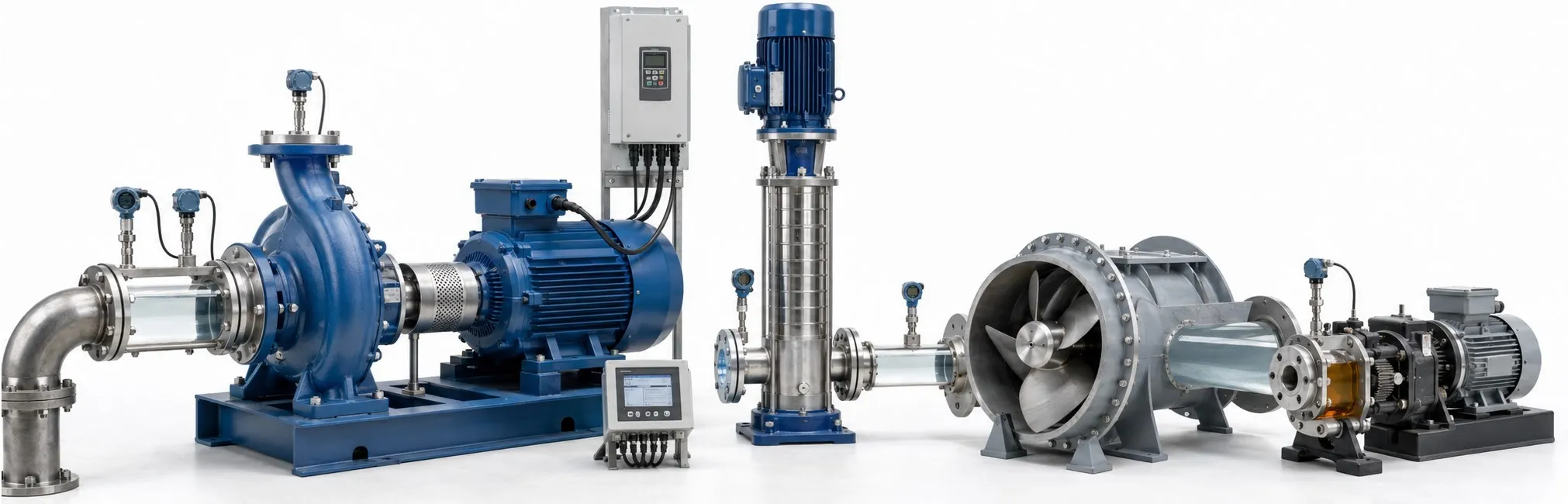
Look for the lowest energy use at the required duty
An efficient pump delivers the required flow and pressure with the least total energy. That may mean a different design for clean water, viscous oil, heating circulation or wastewater. The pumping mechanism matters, but so do sizing, operating point, motor efficiency and control strategy. A low wattage or an efficient motor alone does not settle the comparison.
Which designs suit which duties?
Clean water and low-viscosity liquids: A correctly sized centrifugal pump is often a strong choice for continuous transfer. Aim to work near its best efficiency point, or BEP, while respecting the manufacturer's permitted operating range. In irrigation and water supply, an oversized unit kept under control by throttling may waste energy.
Variable water demand: Pair a suitable hydraulic design with variable-speed control where the system conditions justify it. Pump control, PID regulation and appropriate feedback can avoid unnecessary flow or pressure. Multi-pump sets also need effective staging. Duty rotation balances running hours; efficient load sharing is a separate requirement for saving energy.
Heating and cooling circulation: Correctly adjusted electronic circulators with ECM motors can reduce consumption compared with older fixed-speed designs. ECM means electronically commutated motor. Select the control mode for the circuit rather than leaving every pump at maximum output. When choosing a home pump, keep heating circulation and potable hot-water return requirements distinct.
Oils, pastes and viscous products: Suitable positive displacement designs, including gear, screw, lobe and progressing cavity pumps, can offer an advantage. The difference between water and oil service is critical: a centrifugal water-performance curve cannot simply be reused for a thick liquid. Internal leakage, mechanical losses and suction conditions still affect each design. Hydraulic pumps likewise need to match the actual flow and load.
Wells and high-head supply: A properly selected multistage or submersible pump can provide good efficiency. Neither label guarantees it. Evaluate pumping water level, required flow and motor losses together. A submersible pump drive must preserve adequate motor cooling, minimum speed and the head needed to deliver water.
Wastewater and solids: Consider reliable solids handling alongside hydraulic efficiency. A unit with attractive catalogue figures but frequent blockages can be a poor operational choice. For household or industrial service, the liquid, impeller geometry and operating pattern determine the fit.
Check what the efficiency figure includes
Pump efficiency compares hydraulic output with power at the pump shaft. Electricity consumption also includes motor and drive losses. If measurement is taken at a drive's mains input, the combined efficiency is hydraulic power divided by incoming active electrical power. Define that measurement boundary when calculating pump power or comparing supplier data.
Worked example: Two systems deliver water at 30 m³/h and 25 metres of head. Hydraulic output is approximately 2.04 kW. If combined efficiencies, including motor and controls, are 50% and 70%, their electrical inputs are about 4.09 kW and 2.92 kW. At the same duty for 3,000 hours a year, the difference is approximately 3,500 kWh annually. These are assumed efficiencies for an illustration, not performance claims for particular products.
When speed reduction pays off
For a centrifugal pump with the same impeller, at corresponding operating points and approximately unchanged efficiency, flow follows speed, head follows speed squared and shaft power follows speed cubed. Reducing speed to 80% gives approximate ratios of 80% flow, 64% head and 51.2% shaft power. This is particularly useful in systems with little static head and predominantly frictional resistance.
It does not promise a 48.8% reduction in the electricity bill. Actual duty, motor and drive efficiency, operating hours and total required volume may change. Significant static head can also limit usable speed reduction. If shut-off head is 50 metres at full speed, it becomes approximately 32 metres at 80% speed; the pump cannot then overcome a 40-metre static lift. Check the system curve before choosing a lower-energy operating strategy.
Read efficiency labels in context
IE identifies a motor efficiency class. MEI is a hydraulic efficiency index for specified water-pump categories. EEI uses a defined reference and load profile; a lower figure is better within the same comparable scope and method. An MEI of 0.70 is not a pump efficiency of 70%. Indices from different product groups or test methods are not interchangeable.
Improve the system before replacing equipment
Reducing unnecessary pressure, choosing suitable pipe sizes, repairing leaks and eliminating needless running can lower system consumption. Filters, valves and other accessories should not impose avoidable losses, while still providing the required protection. Impeller wear and internal leakage involve pump components; address them through maintenance while considering service life.
Measure a comparable service. Record flow, total head, active electrical power, operating hours and delivered volume. kWh/m³ equals energy consumed divided by volume pumped, but comparisons need equivalent head and service conditions. A low-head measurement cannot fairly be used to judge a pump doing a high-head job. Investigate fault symptoms and overheating with measurements. Use annual energy and maintenance data for meaningful brand comparisons and lifecycle cost assessments.
Technical references: DOE — Efficient pump selection · DOE — Variable-speed pumping · DOE — Pump-system efficiency testing · DOE — Matching pump and system · KSB — Efficiency definitions · KSB — Viscosity · KSB — IE, MEI and EEI · Grundfos — Efficient circulators