
Could we install large-scale floating solar panels on oceans?
The engineering behind solar power at sea
Yes, floating solar installations can be built at sea, and operating marine pilot projects exist. However, moving a reservoir installation into the open ocean requires more than stronger floats. Wave motion, salt exposure, mooring arrangements and power export to shore affect the design of the entire installation. Technical feasibility, large-scale economics and environmental suitability require separate assessments.
Floating photovoltaics, or FPV, places solar panels on structures supported by water; “floatovoltaics” is another name. It can reduce land requirements, but marine space is also shared with fishing, navigation, conservation and other energy activities. Comparison with land-based solar farms therefore involves more than the amount of available space.
Freshwater, sheltered coastal waters and offshore sites differ
In lakes and reservoirs, water level changes, wind, shore connections and existing water uses matter. Sheltered coastal waters add factors such as salinity and tides. Exposed offshore sites bring persistent wave motion, storm loading, currents and more difficult service access. Being close to shore does not, by itself, establish that a location is sheltered.
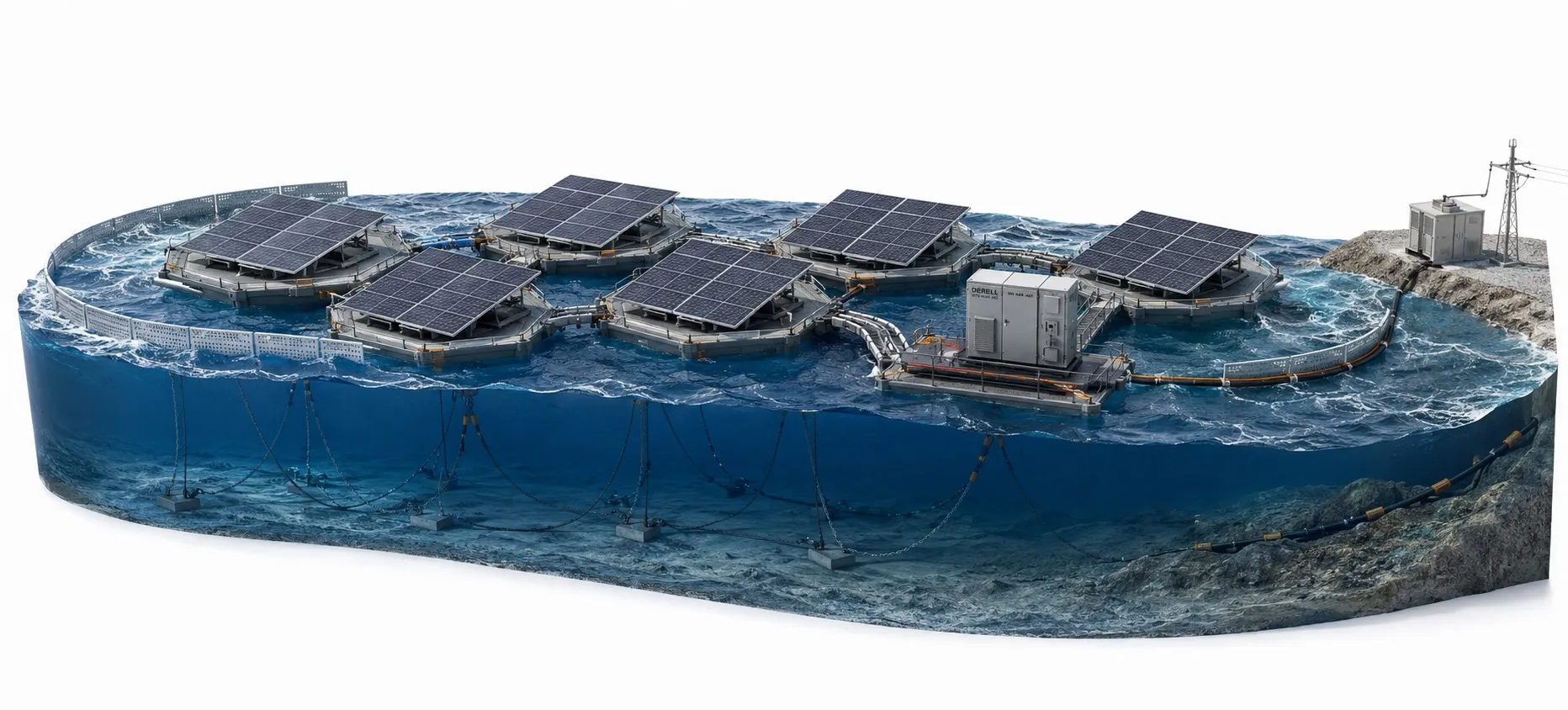
For a concrete example, TNO reports that the North Sea Merganser project installed and tested a 500 kWp pilot comprising six connected platforms in summer 2024. Marine deployment is therefore more than a concept. Testing a pilot does not establish that the same design suits every ocean or that the long-term performance of very large installations has been demonstrated.
Waves, connections and moorings form one design problem
A floating structure needs adequate buoyancy and fatigue-resistant connections. Repeated wave motion can load module frames, platform joints and cables. Design considers combined wind, wave and current loads, seabed conditions and water depth. Mooring lines keep the installation within its permitted movement limits.
Read the scope of standards carefully. DNV-ST-C108 addresses structural design and testing of floats, while DNV-ST-E309 addresses station keeping and mooring design. DNV-RP-0584 primarily concerns sheltered inland and near-shore applications; it is not unconditional design approval for harsher offshore conditions. Match the operating environment to the scope of the document being used.
Salt corrosion and electrical safety
Salt mist, moisture and the use of dissimilar metals require specific assessment of connections, structural parts and electrical equipment. IEC 61701 defines test sequences for evaluating PV module resistance to salt mist corrosion. It does not verify the wave resistance of an entire floating installation or the service life of a subsea cable.
An IP rating alone does not establish resistance to salt corrosion, UV ageing or continual mechanical movement. Cable design considers bending, abrasion, tensile loads and water exposure; connectors require suitable matching and sealing. DC fuses, isolation, surge protection and earthing arrangements are selected through the installation's electrical design.
The electrical system still includes PV strings, MPPT control, inverters and an appropriate grid connection. Locating inverters on shore or offshore affects cable distances and maintenance arrangements. Alongside inverter efficiency, availability and losses during power export determine annual energy delivery.
Editor's note: A “marine-suitable panel” and an offshore-suitable installation require different assessments. Module testing does not replace verification of the platform, moorings, moving cable connections and export connection as a complete system.
Cooling, water conservation and energy estimates
Air temperature and ventilation over water can reduce module temperatures in some designs. The benefit depends on climate, platform geometry and airflow behind the modules. A fixed efficiency gain or longer service life cannot be guaranteed for every floating system. Covering part of a reservoir may reduce evaporation, but presenting the same effect as drinking water conservation on the open ocean would be misleading.
For a simple example, assume 1 MWp, or 1,000 kWp, of installed capacity and an annual AC specific yield of 1,400 kWh/kWp including all relevant losses. The result is 1,400,000 kWh, or 1.4 GWh per year. These figures are hypothetical, not measurements from a pilot or a forecast for a particular marine site. An actual assessment considers irradiance, movement, soiling, electrical losses and service downtime.
SCADA and remote monitoring can track irradiance, module temperature, electrical generation and mechanical condition together. Using solar energy at night requires an appropriate arrangement involving the grid, storage or other generation. A lithium battery is one possible option, but investment, losses and marine safety conditions require separate assessment.
Environmental results depend on scale and location
Shading, underwater light, currents, food webs and organisms colonising the structures require investigation. Wageningen Marine Research reports that NS2 field monitoring from 2021 to 2025 found no measurable changes in currents or water mixing around the small-scale installation, while various organisms settled on its structures. The researchers stress that larger installations may have different effects. These findings do not establish that every marine installation has no environmental effect or improves its ecosystem.
Sharing marine space and connection infrastructure with offshore wind is being investigated, but an existing export cable cannot automatically be assumed to carry additional generation at every hour. Solar-powered seawater desalination is another potential electricity use; generation, treatment capacity and the environmental effects of desalination require separate design assessments.
Permits, maintenance access and project economics
Marine space is not automatically available for unlicensed construction. Territorial waters, exclusive economic zones and areas beyond national jurisdiction require different legal assessments. For example, UK MMO guidance explains that certain persons and structures may require licences even for activities beyond national jurisdiction. This example cannot be transferred directly to Türkiye or other countries; location, responsible authorities and applicable rules must be established at the outset.
Alongside inverter and electrical maintenance, feasibility work includes vessel access, suitable weather windows, connection inspections, spare parts and decommissioning plans. Inverter cost is only one part of a marine project's total cost. A useful comparison considers annual electricity delivered to shore, total lifetime cost and operating risk, rather than module price alone.
Related solar energy applications
Large solar farms
Solar power in deserts
Solar-powered seawater desalination
Using solar energy at night
Supplying cities with solar energy
Supporting technical topics
IEC 61701 salt mist testing
IP protection ratings
DC fuses
Plant monitoring with SCADA
Lithium batteries
Sources
World Bank: floating solar applications, 2018
World Bank, ESMAP and SERIS: handbook for practitioners, 2019
TNO: offshore floating solar projects and monitoring
DNV-RP-0584: scope and application limits
DNV-ST-C108: structural design of floats
DNV-ST-E309: station keeping and mooring design
IEC 61701:2020: salt mist corrosion testing of PV modules
Wageningen Marine Research: NS2 environmental monitoring and scale limitations
UK MMO: marine licensing jurisdiction
UK MMO: licensing guidance for activities beyond national jurisdiction